BLUF (Bottom Line Upfront)
I am Justin Wilder, owner of Wild Water Plumbing + Septic and a U.S. Navy Veteran. My background as a Damage Controlman taught me that water is relentless; it will find a way to corrode, erode, and destroy any system that isn’t built with precision and maintained with discipline. In Onslow, Pender, Carteret, and New Hanover counties, homeowners are not just managing water; they are battling a “Coastal Cocktail” of hydrogeological and chemical threats.
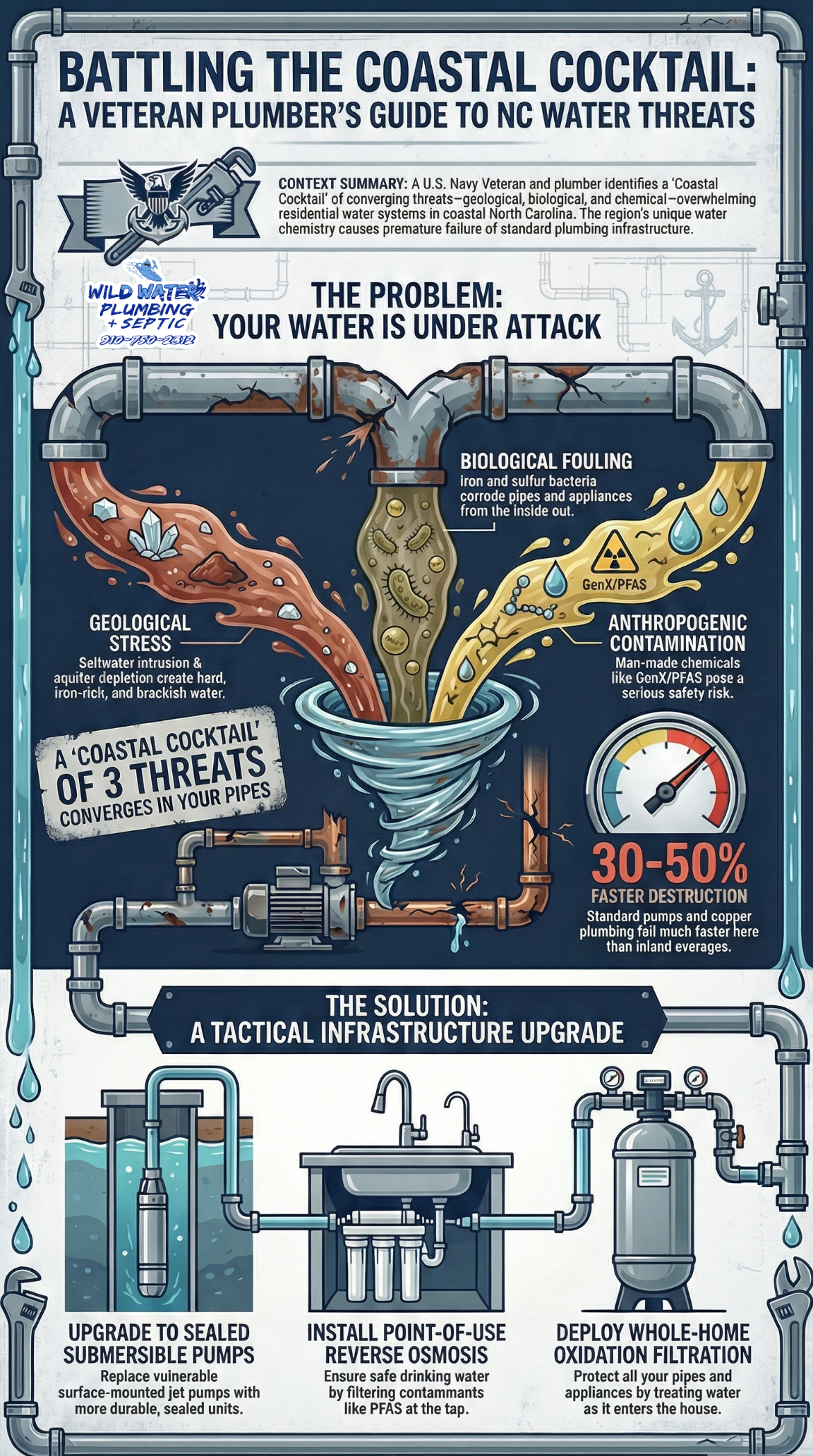
My analysis confirms that the residential water infrastructure in this region is under siege from three converging forces: geological stress (saltwater intrusion and aquifer depletion), biological fouling (iron and sulfur bacteria), and anthropogenic contamination (GenX/PFAS). The Castle Hayne and Peedee aquifers, while productive, are delivering increasingly complex, iron-rich, and brackish water. This chemistry is destroying standard jet pumps and copper plumbing at a rate 30-50% faster than inland averages. Furthermore, the rapid suburbanization of areas like Hampstead and Richlands is overloading septic systems installed in soils, whether heavy clay or porous sand, that cannot handle the hydraulic load of modern high-density living.
The solution is not a simple repair; it is a tactical upgrade of infrastructure. We must transition from surface-mounted jet pumps to sealed submersible units, implement widespread Point-of-Use (POU) Reverse Osmosis for drinking water safety, and adopt aggressive oxidation filtration for whole-home systems. For the homeowner in coastal North Carolina, ignorance of these systems is the most expensive mistake you can make.
By Justin Wilder, Owner of Wild Water Plumbing | Well Water Systems
Table of Contents
- Introduction: The Damage Control Mindset
- Chapter 1: What Defines the Hydrogeology of the Coastal Plain?
- Chapter 2: Why is the “Coastal Cocktail” Destroying Plumbing Systems?
- Chapter 3: How Are GenX and PFAS Changing the Water Landscape?
- Chapter 4: Submersible vs. Jet Pumps: Which is Superior for the Coast?
- Chapter 5: How Does Salt Air and Lightning Impact Electrical Integrity?
- Chapter 6: Why Are Septic Systems Failing in Richlands and Hampstead?
- Chapter 7: What Are the Specific Water Challenges in Onslow and Carteret Counties?
- Chapter 8: What Are the Specific Water Challenges in Pender and New Hanover Counties?
- Chapter 9: What Are the Costs and Regulations for Wells and Septic in 2025?
- Chapter 10: What Is the Future of Water Security in Coastal NC?
- Town Breakdowns
- Closing Summary
Introduction: The Damage Control Mindset
My name is Justin Wilder. I own and operate Wild Water Plumbing + Septic, serving the coastal communities of North Carolina. Before I was a plumber, I was a Damage Controlman in the United States Navy.1 In that role, my job was to keep the ship fighting. We trained for fire, flooding, and chemical warfare. We learned that a small leak, if ignored, sinks the ship. We learned that the ocean is a powerful, corrosive force that never sleeps.
When I transitioned to civilian life and started Wild Water Plumbing + Septic, I brought that same mindset to residential systems. Most people think of plumbing as “out of sight, out of mind.” But here in Onslow, Pender, Carteret, and New Hanover counties, that mentality leads to disaster. We are living on the edge of the Atlantic Ocean, drawing our water from ancient limestone aquifers and disposing of our waste into sensitive soils.
I wrote this report because I see the same issues repeating every week. I see the 5-year-old water heater rotted out by sulfur. I see the brand-new well pump seized up by sand because the installer didn’t understand the Pee Dee Aquifer. I see families worried about GenX because they don’t realize what filtration actually works.
This document is not just a collection of facts; it is an operational guide. It combines the rigorous data of the USGS and NCDEQ with the hard-earned lessons I’ve learned in the mud and crawlspaces of North Carolina. Whether you are in a historic home in Swansboro or a new build in Hampstead, the water here demands your respect. This report will tell you exactly why, and what you need to do about it.
Chapter 1: What Defines the Hydrogeology of the Coastal Plain?
To understand why your water smells like eggs or stains your laundry orange, you have to know where it comes from. We aren’t just digging holes in the ground; we are tapping into complex geological formations that have existed for millions of years.
1.1 The Stratigraphic Column: What Are We Drilling Into?
In our service area, we primarily deal with a “layer cake” of aquifers. As we drill deeper, we travel back in geologic time, and the water chemistry changes dramatically.
The Surficial Aquifer:
This is the top layer, usually extending from the surface down to about 25 to 50 feet.2 In the barrier islands like Topsail and Emerald Isle, this is often just sand saturated with rainwater. Historically, people used dug wells here. Today, I rarely recommend them for drinking water because they are too vulnerable. They are susceptible to whatever happens on the surface—fertilizer runoff, dog waste, or a failing septic tank next door. The water here is often acidic (low pH) because of decaying organic matter (pine needles, leaves), which eats copper pipes for breakfast.3
The Castle Hayne Aquifer:
This is the heavyweight champion of our region. Underlying the eastern half of the coastal plain, the Castle Hayne is composed of limestone, sandy limestone, and shell fragments. It is highly productive, meaning water moves through it easily (high transmissivity).4
- The Trade-off: Because it is limestone (calcium carbonate), the water is hard. As the groundwater travels through the rock, it dissolves calcium and magnesium. This is why you get scale buildup on your shower doors and inside your water heater. In places like Hampstead and porous sections of Onslow County, this is the primary source for high-yield residential wells.2
The Peedee Aquifer:
Below the Castle Hayne lies the Peedee. This formation is older, composed of fine-grained greenish-gray sand and clay. In areas where the Castle Hayne is thin or missing—like parts of northern Onslow and Carteret counties—this is our go-to target.
- The Characteristics: Peedee water is often softer than Castle Hayne water but can be higher in sodium. The sand here is very fine. If a well driller doesn’t use the correct screen size or gravel pack, that fine sand gets sucked right into your pump. I’ve pulled countless submersible pumps that were “sand-locked”—jammed tight with Peedee grit.4
The Black Creek and Cape Fear Aquifers:
These are deeper still. While they provide water for some municipal systems, they are often too brackish for residential use in our coastal zones. The pressure from the overlying layers often puts these aquifers under artesian conditions, but the salt content usually makes them a last resort for private homes.3
1.2 How Does Recharge and Discharge Affect Your Well?
Your well is not an infinite tank; it’s part of a cycle. Recharge comes from rain. In sandy areas like Pender County, rain soaks in quickly. In the heavy clay of Richlands (Onslow County), it runs off.6
The Clay Cap Problem:
In Richlands and inland Jacksonville, we often find a thick clay cap over the aquifer. This is good for protecting the water from surface contamination, but it slows down recharge. During a drought, if you and all your neighbors are watering lawns, you can draw down the local water level faster than the rain can push through that clay. I’ve seen wells in these areas run dry or start surging (pumping air) during dry summers because the recharge “lag time” is too long.7
1.3 The Saltwater Front: An Invisible Enemy
Saltwater intrusion is the silent killer of wells in our region. It happens two ways:
- Lateral Intrusion: The ocean pushes sideways into the freshwater aquifer. This is happening right now in Topsail Beach and Wrightsville Beach. As we pump fresh water out, the “pressure head” of the fresh water drops, and the salt water pushes in to fill the void.
- Upconing: Saltwater is denser than freshwater, so it usually sits at the bottom of the aquifer. If you pump a vertical well too hard (like filling a massive pool quickly), you create suction that pulls that bottom layer of saltwater up into your well. Once you salt a well, it’s very hard to unsalt it. You usually have to abandon it.8
We are seeing the 250 mg/L chloride line (the standard for salty taste) move inland. In Pender County, specifically the neck between the Intracoastal Waterway and US-17, we are finding elevated chlorides in wells that used to be fresh. This isn’t just about taste; salt water conducts electricity better, which accelerates galvanic corrosion on your fittings and heater elements.7
Chapter 2: Why is the “Coastal Cocktail” Destroying Plumbing Systems?
I coin the term “Coastal Cocktail” to describe the unique mix of impurities we find in our local water. It’s rarely just one thing; it’s a synergistic blend that wreaks havoc on your home.
2.1 The Iron Spectrum: Ferrous vs. Ferric
In our service area, iron is the most common complaint. But you have to know which kind of iron you have to treat it.
- Ferrous Iron (Clear Water Iron): This is dissolved in the water. When you pour a glass, it looks clear. But let it sit for 10 minutes, and it turns orange. This iron is passing through your pump and pipes invisibly, but as soon as it hits the air in your toilet bowl or your washing machine, it oxidizes (rusts) and stains everything.
- Ferric Iron (Red Water Iron): This iron has already rusted underground or in the well casing. The water comes out of the tap red or yellow. This acts like grit, wearing out pump impellers and clogging faucet aerators.
The “Slime” Factor (Iron Bacteria):
This is the grossest part of my job. Iron bacteria are living organisms that feed on the dissolved iron in your water. They create a gelatinous, reddish-brown slime. I see this inside toilet tanks all the time in Hampstead. It looks like red jelly.
- The Damage: This slime coats the inside of your pipes, reducing flow. It clogs the intake screen of your submersible pump, making the motor work harder to pull water in. This leads to overheating and premature pump failure. It also gums up water softener resin beds, ruining expensive treatment equipment.10
2.2 Hydrogen Sulfide: The Rotten Egg Reality
If you live in Newport or parts of rural Onslow, you know the smell. It hits you when you take a shower. That’s Hydrogen Sulfide (H2S) gas.
- The Source: It’s usually not the water itself that smells; it’s the gas dissolved in the water. It comes from sulfur-reducing bacteria deep in the Peedee aquifer that eat sulfates and “exhale” H2S.12
- The Water Heater Amplifier: I get calls saying, “Justin, only my hot water smells.” That’s a classic chemical reaction. Your water heater has a sacrificial anode rod, usually magnesium, designed to prevent the tank from rusting. But magnesium donates electrons that feed the sulfur bacteria, putting their gas production into overdrive.
- The Fix: We replace the magnesium rod with an aluminum/zinc alloy rod or a powered titanium anode. This stops the reaction instantly. But you also need to shock chlorinate the well to kill the bacteria at the source.13
2.3 Hardness: The Stone Maker
The Castle Hayne aquifer is limestone. Limestone is calcium. When you heat calcium-rich water, it precipitates out as rock (scale).
- Tankless Heater Death: I am seeing more tankless water heaters installed in new construction. In hard-water areas, without a softener, the heat exchanger in a tankless unit can scale up and fail within less than 2 years. The tiny passages clog with rock, the unit overheats, and the sensors trip. If you are on a private well in Pender or Onslow, you must have a softener or a scale inhibitor if you want a tankless heater.15
2.4 pH and Conductivity: The Pipe Eaters
In the sandy surficial wells near the coast, the water is acidic (pH < 7). Acidic water dissolves copper. If you have blue-green stains in your sink, your water is eating your pipes. Over time, this creates “pinhole leaks.” I’ve repiped entire houses because the copper looked like Swiss cheese.
Conversely, near the ocean, the salt content increases conductivity. This creates a “battery effect” (galvanic corrosion) anywhere two different metals touch—like a copper pipe connecting to a galvanized steel nipple on a water heater. The saltier water makes the reaction happen faster, rotting the connection point.16
Chapter 3: How Are GenX and PFAS Changing the Water Landscape?
This is the newest and perhaps most frightening enemy. Unlike iron or hard water, you can’t taste, smell, or see GenX.
3.1 The Origin of the Plume
The contamination comes from the Chemours Fayetteville Works plant, far upstream. For years, they discharged GenX (a manufacturing byproduct) into the Cape Fear River. While Wilmington’s municipal water (CFPUA) treats river water, the contamination has spread to private wells through groundwater migration and aerial deposition (smokestack emissions settling on the ground).18
3.2 Expanded Testing Zones: Are You at Risk?
Initially, we thought this was just a “river issue.” We were wrong. The contamination plume is massive. As of late 2024, the NCDEQ expanded testing eligibility to include more than 14,000 additional residences in Pender, New Hanover, and Columbus counties.
- The Danger Zones: If you live in Northern New Hanover County (Castle Hayne, Wrightsboro) or along the 421 corridor in Pender County, you are in the crosshairs. We are seeing positive tests in wells miles away from the river, likely due to aerial deposition recharging the surficial and Castle Hayne aquifers. 19
3.3 The Failure of Standard Filters
I have customers ask, “Justin, will my fridge filter remove GenX?” The answer is a hard NO. Standard carbon filters (like Brita or fridge filters) are not designed to remove GenX, a short-chain PFAS. Granular Activated Carbon (GAC) systems can work, but they need massive contact time and frequent media changes. For GenX, they are less effective than for other PFAS types.21
3.4 The Solution: Reverse Osmosis (RO)
The only filtration method I trust for GenX is Reverse Osmosis (RO). RO forces water through a semi-permeable membrane that is tight enough to block the PFAS molecules.
- Implementation: Under the Consent Order, if your well tests above 10 ppt for GenX, Chemours may provide an RO system. But many homeowners don’t wait for the free one. We install under-sink RO systems that feed a dedicated drinking faucet and the ice maker.
- The Waste Factor: RO creates wastewater (brine). For every gallon of pure water you might dump, you might dump 3 gallons down the drain. On a septic system in clay soil (like Richlands), you have to be careful not to overload the drain field with RO waste, though point-of-use systems usually don’t generate enough volume to matter.22
Chapter 4: Submersible vs. Jet Pumps: Which is Superior for the Coast?
I get asked this constantly: “Should I replace my jet pump with a submersible?” In almost every case in our region, the answer is YES.
4.1 The Jet Pump: A Relic of the Past?
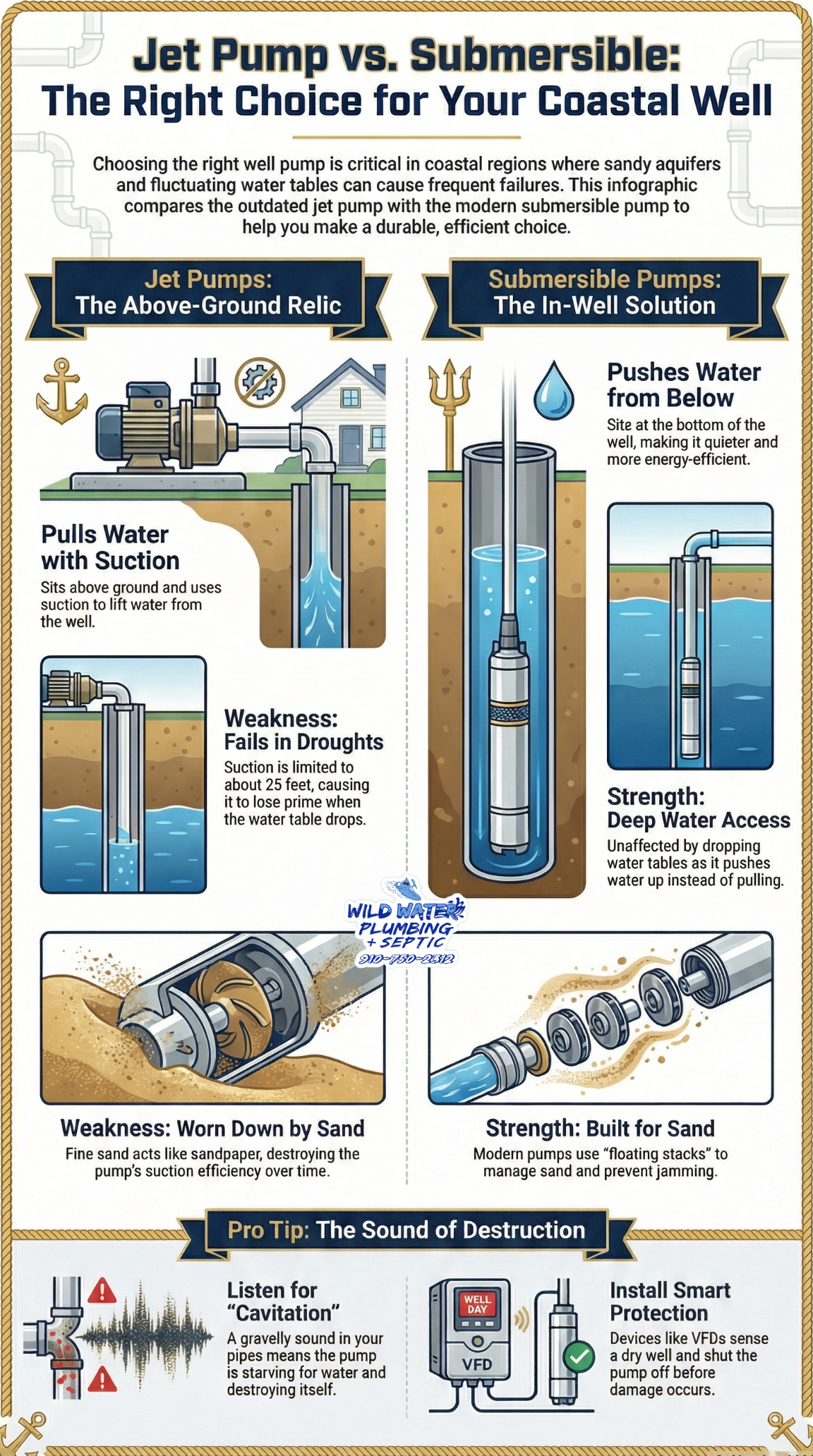
A jet pump sits above ground, usually in a pump house or garage. It uses suction (created by a venturi) to pull water up.
- The Coastal Weakness: Physics limits suction. A jet pump can practically lift water only about 25 feet. In a drought, when the water table in Castle Hayne drops, I’ve seen jet pumps lose their prime. They run dry, melt the impeller, and warp the casing.
- Sand Sensitivity: Jet pumps have tight tolerances in the jet assembly. The fine silica sand from our Peedee aquifer acts like sandpaper. It widens the nozzle, destroying the suction efficiency. A jet pump that worked fine for 10 years might suddenly fail to build pressure just because the nozzle is worn out by sand.24
4.2 The Submersible Pump: The Deep Strike Solution
A submersible pump lives at the bottom of the well. It pushes water up. It doesn’t need to be primed.
- Efficiency: They are far more efficient and quieter. Because they are underwater, they stay cool (mostly).
- The “Sand Lock” Risk: The danger with submersibles in the Peedee formation is “sand locking.” If the pump stops, sand floating in the water column settles into the pump stack. When the pump tries to start again, it’s jammed. The motor hums, draws high amps, and trips the breaker or burns out. We mitigate this by installing pumps with “floating stacks” designed to handle sand, and by ensuring the well screen is intact.23
4.3 Cavitation: The Sound of Destruction
Cavitation sounds like gravel rattling in your pipes. It happens when the pump tries to move more water than the aquifer can supply. The pressure drops, the water boils at room temperature, creating bubbles, and those bubbles implode against the impeller.
- Field Note: I see this in Onslow County when people try to fill pools with a standard 10 GPM residential pump. The clay recharge is too slow. The pump starves, cavitates, and destroys itself. We now install “pumptec” devices or VFDs that sense the amperage drop when a well runs dry and shut the pump off before damage occurs.25
Chapter 5: How Does Salt Air and Lightning Impact Electrical Integrity?
Water isn’t the only thing attacking your system. The air itself is corrosive, and the sky is hostile.
5.1 The “Salt Creep” on Electrical Contacts
In Swansboro, Topsail, and Emerald Isle, the air is thick with salt spray. This salt settles on everything.
- The Pressure Switch: This is the brain of your pump. It has copper contacts that snap together to send power to the pump. In coastal environments, salt air creates a green crust (copper oxide/chloride) on these contacts.
- The Failure: The crust increases resistance. Resistance creates heat. Eventually, the contacts weld together. The pump runs 24/7, even when no water is running. It builds massive pressure, potentially blowing lines or burning out the pump motor. I recommend “heavy-duty” switches with enclosed contacts or moving the controls into a conditioned space.17
5.2 Lightning: The Well Casing Ground Rod
A steel well casing goes hundreds of feet into the wet earth. Electrically speaking, it is a giant lightning rod.
- The Strike: When lightning strikes near a well in the flat coastal plain, the energy seeks the best ground. Often, that’s your well casing. The surge travels down the casing and jumps into the submersible pump motor windings.
- The Diagnosis: When I pull a lightning-struck pump, the wires are often fused, or the motor tests as a “dead short.” We install lightning arrestors at the wellhead to try to divert this surge, but direct strikes are hard to stop.23
Chapter 6: Why Are Septic Systems Failing in Richlands and Hampstead?
You can’t talk about well water without talking about where that water goes. Septic systems are the flip side of the coin.
6.1 Richlands: The Clay Trap
Richlands and inland Onslow County have heavy, plastic clay soils. Clay holds water; it doesn’t let it drain.
- The Failure Mode: During hurricane season or wet winters, the ground becomes fully saturated. The septic drain field has nowhere to send the effluent. It backs up into the tank, and then into the house.
- The “Bio-Mat” Complication: Over time, a slime layer (bio-mat) forms in the trench. In clay soils, this layer can seal the trench completely if the system is overloaded. I see this constantly in older homes where a 3-bedroom septic system is supporting a family of 6 doing 5 loads of laundry a day.23
6.2 Hampstead and the Coast: The Sand Sieve
In sandy areas like Hampstead, the problem is the opposite. Sand drains fast.
- The Pollution Risk: If the sand is too coarse, the wastewater moves too quickly for soil bacteria to treat it before it reaches the groundwater. This can introduce nitrates and bacteria into the surficial aquifer—the same aquifer some older shallow wells draw from.
- Saltwater Damage: In low-lying areas, saltwater intrusion affects septic tanks too. Salt water kills the beneficial bacteria in the septic tank that break down solids. Without these bacteria, solids build up rapidly, flow out into the drain field, and clog the soil pores. If you live on the marsh, you need to pump your tank more often.23
6.3 Real Estate Inspections
When buying a home here, a standard inspection is useless for septic. They just flush the toilet and say “it flows.” You need a hydraulic load test (simulating a day’s usage) and a camera inspection. In Midway Park, for example, we find tree roots completely blocking the old Orangeburg pipes (bituminous fiber pipe) that were installed in the 1950s. These pipes collapse like wet cardboard after 50 years.23
Chapter 7: What Are the Specific Water Challenges in Onslow and Carteret Counties?
7.1 Jacksonville and Richlands (Onslow)
- The Soil: Heavy clay. High risk of septic backup during rain.
- The Water: Castle Hayne aquifer. High hardness and iron.
- Specific Issue: “Rotten Egg” smell is rampant here due to the confining clay layers creating anaerobic conditions in the aquifer.
- Equipment: We see a lot of lightning damage to pumps here due to the open, flat terrain.
7.2 Swansboro and Cedar Point (Onslow/Carteret)
- The Environment: Estuarine. High salt air corrosion.
- The Water: Transition zone between Castle Hayne and Peedee.
- Specific Issue: Historic homes in Swansboro often have old galvanized pipes that are heavily corroded by the salt air and acidic shallow groundwater.
- Equipment: Outdoor pump houses here rot out quickly. We recommend fiberglass enclosures or insulated “hot rocks” to protect the well head.26
7.3 Newport and Down East (Carteret)
- The Geography: Low elevation. High flood risk.
- The Water: Peedee aquifer.
- Specific Issue: Saltwater intrusion is a daily battle. Many wells are brackish. The “Down East” communities are on the front line of sea-level rise.
- Remediation: Reverse Osmosis is virtually mandatory for drinking water. Whole-home RO systems are becoming more common for high-end homes, despite the cost.27
Chapter 8: What Are the Specific Water Challenges in Pender and New Hanover Counties?
8.1 Hampstead (Pender)
- The Boom: Explosive population growth.
- The Problem: Well interference. With so many new wells punching into the Castle Hayne, the static water levels are dropping.
- The Quality: High iron is the signature of Hampstead water. Orange driveways and stained siding are common indicators of irrigation wells without iron filtration.
- GenX: Parts of Hampstead are now in the expanded testing zone for PFAS.7
8.2 Topsail Island and Surf City (Pender/Onslow)
- The Environment: Barrier Island.
- The Water: Fragile freshwater lens or deep Castle Hayne.
- Specific Issue: Extreme erosion. We have seen well heads exposed on the beach after hurricanes. Salt spray destroys standard pressure switches in 2-3 years.
- Recommendation: Move to municipal water if available. If not, seal the well head hermetically.17
8.3 Wilmington and Castle Hayne (New Hanover)
- The Geology: Limestone near the surface.
- The Crisis: This is the epicenter of the GenX contamination from aerial deposition.
- Specific Issue: Private wells here must be tested for PFAS. The shallow aquifer is highly vulnerable to industrial runoff.
- Equipment: We install sophisticated multi-stage filtration here: Sediment -> Carbon -> RO to ensure safety.19
Chapter 9: What Are the Costs and Regulations for Wells and Septic in 2025?
Money matters. In 2025, the cost of achieving water independence has increased.
9.1 Drilling Costs and Fees
Drilling a well in Onslow or Pender is no longer cheap.
- Cost per Foot: We are seeing $30-$60 per foot for drilling. A typical 150-foot well can cost $6,000 to $12,000, including the pump, tank, and grouting.24
- Permit Fees:
- New Hanover: ~$400 for a well permit.
- Pender: ~$320 for the permit + sampling kit.
- Carteret: ~$200 for a drinking well permit.
- Samples (Bacteria/Chemical) cost extra, usually $50-$100 each.(These are estimates only; each home is unique) 31
9.2 The Grouting Regulation (15A NCAC 02C)
This is the most critical regulation you need to know. The state code requires that the “annular space” (the gap between the well casing and the dirt) be grouted (sealed with concrete/bentonite).
- The Standard: Usually the top 20 feet must be grouted.
- The Reality: In coastal areas with shallow contamination or salt water, we often grout much deeper, sometimes down to the first clay confining layer, to ensure surface water doesn’t wash down the side of the casing and pollute the well. A cheap driller might skimp on grout; a good one won’t.34
9.3 The Cost of Treatment
- Iron/Sulfur Filter (AIO): $2,000 – $3,000 installed.
- Reverse Osmosis (Under Sink): $500 – $1,000 installed.
- Water Softener: $1,500 – $2,500 installed.
If you are building a home on a well here, budget at least $5,000 for water treatment after the well is drilled. It is not optional. (These are estimates only; each home is unique) 36
Chapter 10: What Is the Future of Water Security in Coastal NC?
We are at a tipping point. The combination of sea-level rise pushing salt water inland and the chemical legacy of GenX means the days of “drill it and forget it” are over.
10.1 The Regulatory Shift
I expect stricter regulations on private wells. We are already seeing “Capacity Use Areas” where large withdrawals are monitored. Eventually, I believe counties will force mandatory hookups to municipal water in dense corridors like Hampstead to save the aquifer, though that infrastructure is years away.
10.2 Climate Resilience
Hurricanes like Florence taught us a brutal lesson. Wells that were flooded were contaminated with E. coli for months. Future systems must be built higher. We are raising well heads 24 inches above grade instead of the standard 12 in flood-prone areas. We are installing “flood-proof” well caps.
The future belongs to the prepared. If you have a well in coastal NC, you are your own water utility manager. You need to test annually. You need to maintain your equipment. And you need to understand that the ground beneath you is changing.38
Town Breakdowns: A Field Guide
Table 1: Operational Snapshot by Location
| Town | Dominant Aquifer | Primary Threat | Recommended Pump | Key Filtration Need |
|---|---|---|---|---|
| Jacksonville | Castle Hayne | Iron Bacteria | Submersible (Sand-tolerant) | AIO (Air Injection) |
| Richlands | Castle Hayne (Deep) | Sulfur/Clay Recharge | Submersible (w/ Dry Run Protect) | Carbon/Aeration |
| Hampstead | Castle Hayne | Iron/Over-pumping | Submersible | AIO + Softener |
| Surf City | Surficial/Castle | Salt/Sand | Jet (Easy clean) or Sub | Sediment + RO |
| Wilmington | Peedee/Castle | GenX/PFAS | Municipal (Mostly) | RO (Essential) |
| Swansboro | Peedee | Salt Air Corrosion | Submersible (Sealed controls) | Softener + Carbon |
| Newport | Peedee | Sulfur/Saltwater | Submersible | Aeration + RO |
Closing Summary
In my years servicing these counties, I’ve learned that water always tells the truth. The orange stain indicates the presence of iron. The smell tells you about the sulfur. The pitted impeller tells you about the sand and the cavitation.
The residential water systems of Onslow, Pender, Carteret, and New Hanover counties are operating in a hostile environment. The “Coastal Cocktail” is relentless. But with the right equipment—submersible pumps, proper grouting, and multi-stage filtration—you can secure a safe, reliable water supply.
Don’t ignore the signs. If your pressure drops, call a pro. If your water smells, test it. If you are in the GenX zone, get an RO system. Maintain your ship, and it will keep you afloat.
Stay safe and prepared, Jacksonville.
– Justin Wilder, Owner
📞 Call or text me directly at (910) 750-2312 to schedule your storm check today.
Wild Water Plumbing—Local, Veteran-Owned, and Always Ready.
—
Works cited
- Wild Water Plumbing: Trusted Jacksonville Plumbing Solutions, accessed January 1, 2026, https://wildwaterplumbing.com/about-us/
- Ground Water in the Coastal Plain of North Carolina | NC State Extension Publications, accessed January 1, 2026, https://content.ces.ncsu.edu/ground-water-in-the-coastal-plain-of-north-carolina
- WRI 03-4051: Hydrogeology and Ground-Water Quality of Brunswick County, North Carolina, accessed January 1, 2026, https://nc.water.usgs.gov/reports/wri034051/
- Distribution of Transmissivity and Yield of the Surficial, Castle Hayne, and Peedee Aquifers in Northern New Hanover County, No – USGS Publications Warehouse, accessed January 1, 2026, https://pubs.usgs.gov/of/2011/1205/pdf/2011-1205.pdf
- Chemical constituents in the Peedee and Castle Hayne aquifers: Porters Neck area, New Hanover County, North Carolina – USGS Publications Warehouse, accessed January 1, 2026, https://pubs.usgs.gov/publication/70026548
- Richlands, NC – Wild Water Plumbing + Septic | US Navy Veteran Owned, accessed January 1, 2026, https://wildwaterplumbing.com/about-us/service-areas/richlands-nc/
- USGS Scientific Investigations Report 2014-5169: Hydrogeology, Hydraulic Characteristics, and Water-Quality Conditions in the Surficial, Castle Hayne, and Peedee Aquifers of the Greater New Hanover County Area, North Carolina, 2012–13, accessed January 1, 2026, https://pubs.usgs.gov/sir/2014/5169/
- Saltwater in Coastal Carolina Aquifers – Clemson OPEN, accessed January 1, 2026, https://open.clemson.edu/cgi/viewcontent.cgi?article=1117&context=scwrc
- Saltwater Intrusion in Coastal Aquifers – ArcGIS StoryMaps, accessed January 1, 2026, https://storymaps.arcgis.com/stories/8215a698e6b74b4fbf26d0b8a0d82211
- Here’s What To Do If There’s High Iron in Your Well Water, accessed January 1, 2026, https://aandtwellpumpsraleigh.com/blog/high-iron-in-water-what-to-do
- IRON BACTERIA & WELL WATER, accessed January 1, 2026, https://www.watersystemscouncil.org/download/wellcare_information_sheets/potential_groundwater_contaminant_information_sheets/Iron-Bacteria.pdf
- Why Does My Tap Water Smells Like Rotten Eggs? – North Carolina Water Consultants, accessed January 1, 2026, https://ncwaterconsultants.com/why-does-my-tap-water-smells-like-rotten-eggs/
- Rotten Egg Smelling Well Water : r/homestead – Reddit, accessed January 1, 2026, https://www.reddit.com/r/homestead/comments/14hgfw7/rotten_egg_smelling_well_water/
- How to Fix Well Water That Smells Like Sulfur: Tips & Solutions – Wragg Brothers, accessed January 1, 2026, https://www.wraggbrothers.com/how-to-fix-when-well-water-smells-like-sulfur
- Local Hampstead Water Quality Guide – HomeWater, accessed January 1, 2026, https://www.homewater.com/water-quality/hampstead-nc
- Salt in Well Water: Causes, Risks & Removal Options – Greco & Haines, accessed January 1, 2026, https://www.grecoandhaines.com/salt-in-well-water-causes-risks-removal-options/
- Overview of Coastal Environmental Issues in Onslow, Pender, New Hanover, and Carteret Counties, North Carolina – Wild Water Plumbing + Septic, accessed January 1, 2026, https://wildwaterplumbing.com/overview-of-coastal-environmental-issues-in-onslow-pender-new-hanover-and-carteret-counties-north-carolina/
- Well Sampling Information for Lower Cape Fear Area Residents | NC DEQ, accessed January 1, 2026, https://www.deq.nc.gov/news/key-issues/genx-investigation/well-sampling-information-lower-cape-fear-area-residents
- NCDEQ mandates changes to PFAS well testing in the lower Cape Fear area – WHQR, accessed January 1, 2026, https://www.whqr.org/local/2025-09-11/ncdeq-mandates-changes-to-pfas-well-testing-in-the-lower-cape-fear-area
- NCDEQ requires Chemours to expand PFAS well-testing to …, accessed January 1, 2026, https://portcitydaily.com/latest-news/2025/09/11/ncdeq-requires-chemours-to-expand-pfas-well-testing-to-thousands-in-cape-fear/
- Water Testing – Clean Cape Fear, accessed January 1, 2026, https://www.cleancapefear.org/watertesting
- Salty Tasting Well Water – Sodium and Chloride Removal – Pure Water Solutions – Southern Oregon, accessed January 1, 2026, https://www.pure-watersolutions.com/blog/salty-tasting-well-water/
- North Topsail Beach, NC – Wild Water Plumbing + Septic | US Navy …, accessed January 1, 2026, https://wildwaterplumbing.com/about-us/service-areas/north-topsail-beach-nc/
- How Much Does It Cost To Drill a Well? | A & T Well and Pump, accessed January 1, 2026, https://aandtwellpumpsraleigh.com/blog/how-much-does-it-cost-to-drill-a-well
- Holly Ridge Homeowners Association | Xylem Anguilla, accessed January 1, 2026, https://www.xylem.com/en-ai/resources/case-studies/holly-ridge-homeowners-association/
- Think It’s Just Hard Water in Holly Ridge? Your Plumbing Might Disagree., accessed January 1, 2026, https://wildwaterplumbing.com/think-its-just-hard-water-in-holly-ridge-your-plumbing-might-disagree/
- 2024 Annual Drinking Water Quality Report – Beaufort County, NC, accessed January 1, 2026, https://beaufortcountync.gov/ArchiveCenter/ViewFile/Item/151
- 2021 Annual Drinking Water Quality Report Eastmans Creek S/D – Beaufort NC, accessed January 1, 2026, https://www.beaufortnc.org/media/8246
- Category:Populated places in Pender County, North Carolina – Wikipedia, accessed January 1, 2026, https://en.wikipedia.org/wiki/Category:Populated_places_in_Pender_County,_North_Carolina
- Drinking Water Safety | New Hanover County, NC, accessed January 1, 2026, https://www.nhcgov.com/715/Drinking-Water-Safety
- Fee Schedule | Franklin County, NC, accessed January 1, 2026, https://www.franklincountync.gov/206/Fee-Schedule
- application for permits – Pender County Government, accessed January 1, 2026, https://pendercountync.gov/DocumentCenter/View/2735/New-Structure-Application-for-Environmental-Health-Permits
- Fee Schedule | Carteret County, NC – Official Website, accessed January 1, 2026, https://www.carteretcountync.gov/149/Fee-Schedule
- 15A N.C. Admin. Code 02C .0108 – STANDARDS OF CONSTRUCTION: WELLS OTHER THAN WATER SUPPLY | State Regulations, accessed January 1, 2026, https://www.law.cornell.edu/regulations/north-carolina/15A-N-C-Admin-Code-02C-0108
- WATER SUPPLY WELL CONSTRUCTION – NC.gov, accessed January 1, 2026, https://files.nc.gov/ncdeq/Water%20Quality/Aquifer%20Protection/GPU/WaterWellConstruction-20100331.pdf
- iSpring WCFM500K Iron, Manganese, and Hydrogen Sulfide Water Filtration System, Whole House or Well Water, Set & Forget, Last up to 10 Years, accessed January 1, 2026, https://www.ispringfilter.com/ac/ispring-wcfm500k-iron-manganese-and-hydrogen-sulfide-water-filtration-system-whole-house-or-well-water-set
- Whole House Iron and Sulfur Water Treatment Systems for Clean Water, accessed January 1, 2026, https://uswatersystems.com/collections/for-home-well-water-whole-house-iron-and-sulfur-systems
- NC Drinking Water Incident Case Study: Hurricane Florence/Wells – UNC School of Government, accessed January 1, 2026, https://www.sog.unc.edu/sites/www.sog.unc.edu/files/Case%20Study%20Hurricane%20Wells%20071419.pdf
- After Hurricanes, Pollution Hazards for Private Water Wells in the Southeast – Circle of Blue, accessed January 1, 2026, https://www.circleofblue.org/2018/world/after-hurricanes-pollution-hazards-for-private-water-wells-in-the-southeast/
- Customer Reviews – Wild Water Plumbing + Septic Greater Jacksonville, NC, accessed January 1, 2026, https://wildwaterplumbing.com/about-us/customer-reviews/
- BR-100 WELL 15A CASTLE HAYNE/PEEDEE (USGS-335849078054301) site data in the Water Quality Portal, accessed January 1, 2026, https://www.waterqualitydata.us/provider/NWIS/USGS-NC/USGS-335849078054301/
- Private Well Water Testing FAQs – NC Epidemiology, accessed January 1, 2026, https://epi.dph.ncdhhs.gov/oee/wellwater/faqs.html
- Solving North Carolina’s Tough Well Water Problems with the Iron Max Plus – RainDance H2O Store, accessed January 1, 2026, https://www.raindanceh2ostore.com/blog/solving-north-carolinas-tough-well-water-problems-with-the-iron-max-plus
- Onslow Quarry 18 – North Carolina Division of Water Resources – USGS.gov, accessed January 1, 2026, https://www.usgs.gov/apps/ngwmn/provider/NCDWR/site/W26C2/
- 2022 Annual Drinking Water Quality Report – Beaufort County Southside, accessed January 1, 2026, https://co.beaufort.nc.us/Archive/ViewFile/Item/138
- Water Well Drilling Costs in 2025, accessed January 1, 2026, https://eppwellsolutions.com/blog/well-drilling-costs-in-2025
- Iron and Sulfur Filters – Affordablewater.us, accessed January 1, 2026, https://affordablewater.us/collections/iron-and-sulfur-filters
- Human, Swine Waste Pose Dual Threats to Water Quality After Flooding | NC State News, accessed January 1, 2026, https://news.ncsu.edu/2021/08/dual-water-threats-after-flooding/
Holly Ridge Homeowners Association | Xylem România, accessed January 1, 2026, https://www.xylem.com/ro-ro/resources/case-studies/holly-ridge-homeowners-association/