BLUF (Bottom Line Upfront)
The drainage and plumbing infrastructure in Onslow, Pender, Carteret, and New Hanover counties is facing a systemic crisis driven by a perfect storm of geological, environmental, and aging structural factors. Unlike inland regions where plumbing failure is often a localized blockage, coastal failures are frequently driven by hydraulic overload — a condition where the receiving environment is too saturated or pressurized to accept waste. High water tables, aggressive saltwater corrosion, unstable sandy soils, and the intrusion of maritime forest root systems are causing widespread failures in both private septic systems and municipal infrastructure.
By Justin Wilder, Owner of Wild Water Plumbing | Well Water Systems
Introduction: The Invisible Crisis of Coastal Plumbing
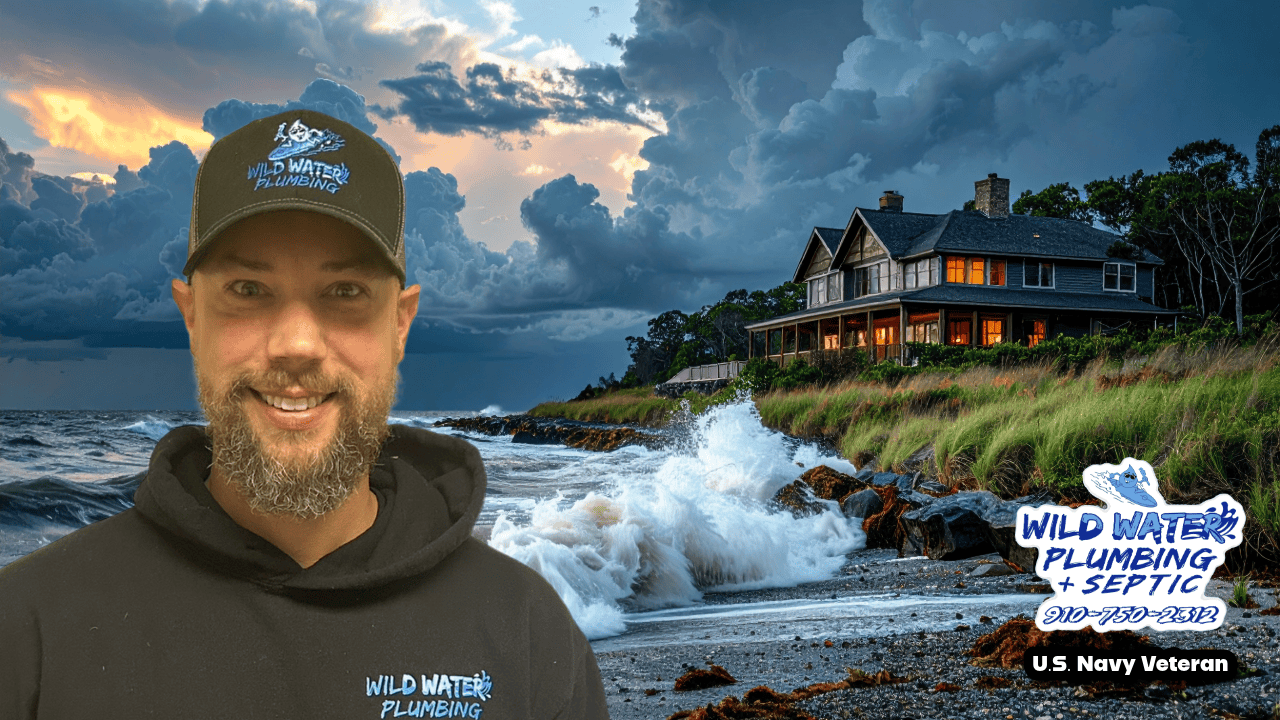
My name is Justin Wilder. I am a U.S. Navy Veteran and the owner of Wild Water Plumbing + Septic. I have spent years in the trenches of Eastern North Carolina, battling a foe that is relentless, invisible, and overwhelmingly powerful: the water itself. When I speak to homeowners in Onslow, Pender, Carteret, and New Hanover counties, I often have to explain that their plumbing problems are rarely just about what they put down the drain. The problem, more often than not, is what is waiting for that water when it tries to leave the house.
Chapter 1: Why Coastal Geology Rejects Water
The water table in much of this region sits merely 12 to 24 inches below the surface in many areas. When two fluids cannot occupy the same space, effluent trying to discharge into a drain field surrounded by saturated soil faces backpressure from groundwater equal to or greater than the gravity pushing it down. This is why homeowners report that their plumbing works fine during dry spells but becomes sluggish or backs up completely during high tides or heavy rains — it is not a clog in the pipe, it is the entire earth refusing to accept more liquid.
Chapter 2: Hydraulic Overload and Mass Septic Failures
The drainage and plumbing infrastructure in coastal counties faces a condition called hydraulic overload: the receiving soil is too saturated to accept waste. In areas like Hampstead and Sneads Ferry, the groundwater is rising into the drain trenches. When the drain field is saturated, oxygen-dependent aerobic bacteria die off, pathogen breakthrough into groundwater occurs without treatment, and the tank cannot empty. In coastal communities on barrier islands, tanks can even become buoyant during major storm flooding and pop right out of the ground if they have been recently pumped.
Chapter 3: Sandy Soils, Structural Bellies, and Cast Iron
Sand lacks structure. When sand beneath pipes gets wet and shifts, pipes lose their bedding support and sag, creating bellies where waste collects instead of draining. Homeowners snake these lines, poking a hole through the blockage, but because the belly remains, the clog returns. In historic neighborhoods like Wilmington and older military housing in Midway Park, cast iron pipes experience channel rot from the inside out and, in Midway Park specifically, Orangeburg pipe — made from wood pulp tar paper — is collapsing flat like a crushed soda can across an entire mid-century housing stock.
Chapter 4: Root Intrusion in Maritime Forest Communities
Live oaks have massive, sprawling root systems adapted to find water in sandy soils. They are hydrotropic — they grow toward moisture. A sewer pipe carrying warm wastewater creates a condensation sweat on its outer wall in cool soil. The roots sense this differential. In older clay or cast iron pipes, roots penetrate microscopic cracks or loose mortar joints. Once inside the nutrient-rich sewer environment, they explode in growth. If you hear your toilet gurgle when the washing machine drains, it is often because a root mass in the main line is blocking airflow, forcing air back up through the toilet trap.
Strategic Solutions for Future-Proofing Coastal Drains
French drains using geotextile fabric, washed gravel, and perforated pipe address the surface water issues in flat communities like Midway Park. For failing septic systems in Hampstead and Down East, mound systems built above natural grade create the necessary unsaturated soil separation. For the root-infested and rotting pipes of Wilmington and Beaufort, trenchless CIPP (Cured-in-Place Pipe) lining creates a seamless plastic pipe inside the old rotting cast iron without digging up mature tree roots. The bottom line: the days of install it and ignore it are over.
The hydraulic overload and systemic failure patterns described in this report produce specific warning signs that homeowners can identify. Read the complete guide covering every warning sign across all four coastal counties: 8 Signs Your Septic System Is Failing — Onslow, Pender, New Hanover, and Carteret Counties.
Stay safe and prepared, Jacksonville.
– Justin Wilder, Owner
📞 Call or text me directly at (910) 750-2312
Wild Water Plumbing—Local, Veteran-Owned, and Always Ready.