
BLUF (Bottom Line Upfront)
If you’ve noticed water pooling at the base of your water heater and you’re trying to figure out whether it’s something you can ignore or a sign of a bigger issue, then this article is written for you. A leak from the bottom of your water heater can come from a faulty drain valve, corrosion or sediment buildup, or even a tank rupture, and catching the source early can help you decide whether you need a repair or a replacement before it causes water damage in your home.
If you are asking questions like these…
Is the water under my heater real water or just condensation?
Could a leaking drain valve be causing the water I’m seeing?
Is the bottom leak a sign my tank is failing or needs replacement?
What does sediment buildup have to do with leaks at the base?
Should I call a plumber now or wait to see if it gets worse?
…this article is written for you:
Water Heater Repair, Replacement & Installation Plumbers
What It Means and How Soon It Can Fail
My name is Justin Wilder, owner of Wild Water Plumbing + Septic, serving the entire Coastal North Carolina region. I work in Onslow, Carteret, Pender, and New Hanover Counties every single day, and one of the most urgent calls I get from homeowners in Jacksonville, Sneads Ferry, Hampstead, Wilmington, and many other communities is this one.
“My water heater is leaking from the bottom. What does this mean?”
When a tank water heater starts leaking from the bottom, the clock is ticking. A bottom leak is one of the most evident signs that your water heater is seconds, minutes, or hours away from total failure. Coastal homes face a harsher environment than nearly anywhere else in North Carolina, and our tanks rarely fail slowly.
Salt air, humidity, sediment-filled wells, and older crawl spaces combine to accelerate the destruction at water heaters.
In this article, I will break down precisely what a bottom leak means, how long your water heater has left, what steps you need to take right now, and the differences I see from town to town across our coastline.
Understanding Why Coastal North Carolina Water Heaters Fail Faster
Suppose you live anywhere in Jacksonville, Richlands, Swansboro, Hubert, Hampstead, Surf City, Burgaw, Wilmington, or Carolina Beach.
In that case, your water heater is dealing with more stress than the average homeowner realizes.
Why Coastal Tanks Fail Quickly
- high humidity that constantly wets metal surfaces
- salt-rich air that speeds corrosion
- shallow wells filled with sediment and iron
- storm water intrusion from hurricanes and nor’easters
- older crawlspaces that trap moisture
- outdoor installations exposed to blowing salt spray
By the time a homeowner notices a leak at the bottom, these factors have already been eating away at the tank’s interior for months or even years.
Condensation or a Real Leak: Knowing the Difference Matters
Sometimes homeowners call me from Jacksonville or Wilmington and say, “Justin, my tank looks wet at the bottom, but I cannot tell if it is leaking or just sweating.”
It is a good question because our humidity levels cause tanks to sweat heavily, especially in garages, closets, and crawlspaces.
When It Is Just Condensation
Homes in places like Sneads Ferry, North Topsail Beach, Surf City, and Carolina Beach deal with intense humidity.
Warm water inside a cold tank causes condensation to form on the jacket.
Sometimes this water runs down the sides, creating a small puddle.
How to Tell the Difference
You can perform a simple check.
- If the water is cold and clear, it may be condensation
- If the water feels warm, it is usually a real leak
- If the puddle grows even when the heater is not running, it is almost always a leak
- If rust forms around the bottom seam, the tank is failing internally
In crawl spaces in Burgaw or Maple Hill, condensation is extremely common, but so are real leaks, so testing is essential.
Drain Valve Leaks A Common Early Warning Sign
One of the most common causes of water near the bottom of the heater is a leaking drain valve.
I see this a lot in Onslow and Pender County homes, where sediment from wells accumulates in the tank.
What Causes Drain Valve Leaks
- sediment enters the valve during flushing
- older plastic valves crack in humid crawlspaces
- iron deposits prevent the valve from fully sealing
- salt exposure weakens the valve threads
I replace a lot of these in Richlands, Maysville, Hubert, Burgaw, and Rocky Point.
What a Drain Valve Leak Looks Like
- small drip from the spigot
- a slow expanding wet circle
- moisture appearing after someone showers or runs the dishwasher
A drain valve leak often gives homeowners a day or two before it worsens.
However, it remains serious because it can flood the flooring and sheetrock if left unaddressed.
Internal Tank Rupture The Most Dangerous Type of Bottom Leak
When I get a call from a homeowner in Wilmington saying, “The bottom of the water heater is wet and it seems like it is getting worse,” I know exactly what is happening.
The tank’s interior has ruptured, and that water heater is at the end of its life.
Why Tanks Burst Faster in Coastal NC
- Well water heavy in iron and manganese corrodes the tank lining
- Salt air in Morehead City, Atlantic Beach, and Wrightsville Beach attacks exterior metal
- Sediment buildup in tanks in rural areas like Maple Hill and Hubert causes overheating
- Moist crawlspaces in Surf City and Hampstead trap humidity around the tank
- Outdoor heaters in Wilmington and Carolina Beach get blasted with salt spray
Signs Internal Rupture Has Already Started
- continuous moisture even during non use
- popping or rumbling inside the tank
- rusty or brown hot water
- wet insulation around the bottom seam
- hot water running out faster than normal
Once the internal tank ruptures, it cannot be repaired. It is only a matter of hours to days before total failure.
Signs Your Tank Is Seconds Away from a Major Burst
I always tell homeowners that a bottom leak is one of the final warnings.
Here are the red flags I treat as emergencies when responding to calls in places like Jacksonville, Swansboro, Sneads Ferry, Hampstead, and Wilmington.
Immediate Danger Indicators
- A rapidly growing puddle
- The tank hissing or crackling
- Bulging at the bottom seam
- Water spraying or running rather than dripping
- Pilot light repeatedly extinguishes on gas units
- A strong metallic smell near the heater
If the tank is visibly bulging or if you hear water refilling nonstop, turn off the power or gas right away.
A tank burst can release forty to eighty gallons of water instantly.
Emergency Steps Homeowners Should Take Right Now
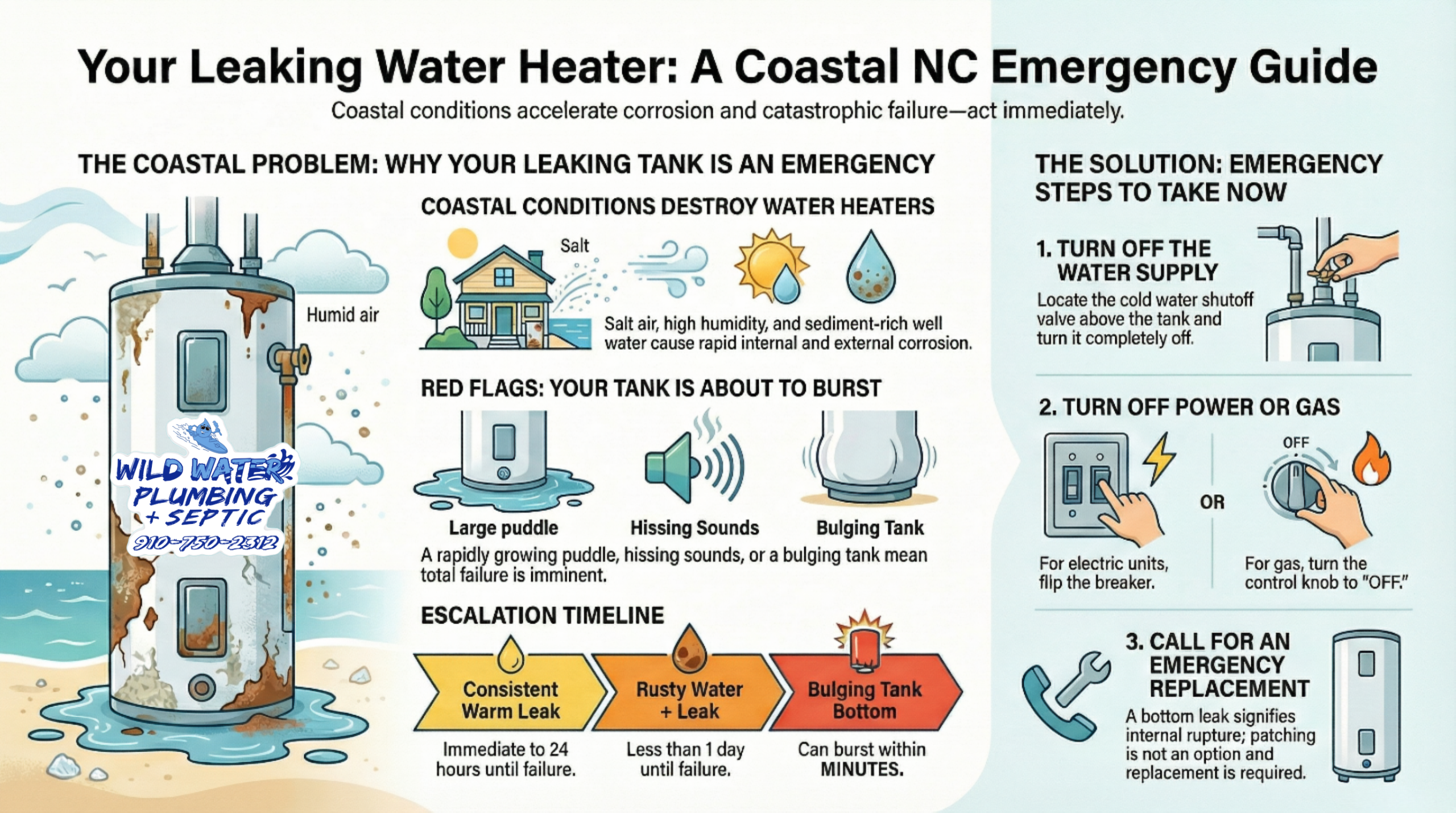
If your water heater is leaking from the bottom in any of our four counties, follow these steps immediately.
Step One: Turn Off the Water Supply
Find the cold water shutoff valve above the tank. In older Jacksonville and Richlands homes, you may see a stiff gate valve.
Newer homes in Wilmington, Hampstead, and Morehead City often have quarter-turn valves.
Turn this valve off completely.
Step Two: Turn Off Power or Gas
For electric water heaters
- go to your breaker panel
- turn off the double breaker marked water heater
For gas water heaters
- turn the gas control knob to off
- use the nearby shutoff valve if necessary
Gas units in Wilmington, Surf City, and Morehead City often sit in garages where gas lines are readily accessible.
Step Three: Call for Replacement
Once a tank starts leaking from the bottom, replacement is the only safe option. No coating or patching will stop an internal rupture.
How Well Water Corrosion Accelerates Water Heater Failure
Well water chemistry varies widely from one town to the next, and it has a huge impact on how long tanks survive.
Onslow County Water Problems
Towns affected: Jacksonville, Richlands, Maysville, Hubert, Swansboro, North Topsail Beach
Issues
- iron heavy wells
- hydrogen sulfide smell
- sediment from shallow pumps
- sand intrusion during storms
Result
Anode rods disappear quickly, and tanks rust from the inside out.
Carteret County Water Problems
Towns affected: Emerald Isle & Cape Carteret
Issues
- mineral-rich aquifers
- salt air exposure
- storm flooding and surge
Result
Corrosion attacks tanks from both the inside and the outside.
Pender County Water Problems
Towns affected: Hampstead, Surf City, Burgaw, Rocky Point, Maple Hill, Topsail
Issues
- iron-rich well water inland
- heavy humidity in crawlspaces
- salt spray along the coast
Result
Tanks rust at a faster rate, especially in outdoor and crawlspace installations.
New Hanover County Water Problems
Towns affected: Wilmington, Carolina Beach, Wrightsville Beach, Castle Hayne
Issues
- constant salt air exposure
- outdoor units exposed to storms
- high humidity mechanical rooms
Result
Exterior corrosion and electrical failure are common, especially in beach towns.
How Soon a Bottom Leak Turns Into Total Failure
This section is critical because homeowners often do not realize how fast things can escalate.
Small Drip from Drain Valve
Failure window
Several hours to one or two days
Consistent Warm Leak from the Bottom
Failure window
Immediate to twenty four hours
Rusty Hot Water Plus a Leak
Failure window
Usually less than one day
Bulging or Deformed Tank Bottom
Failure window
Some tanks burst within minutes
Leak Appearing Only During Heating Cycles
Failure window
Tank pressure is rising, and rupture can occurat any moment
If you live in a condo in Wilmington or a crawlspace home in Hampstead, ignoring a leak at the bottom can lead to thousands of dollars in damage.
Replacement Options in Onslow, Carteret, Pender, and New Hanover County
Every home and every county has different factors that affect your replacement choice.
Tank Style Replacement
- Best for
well water homes in Richlands, Hubert, Burgaw, and Maple Hill - homes near the coast with corrosion risk
- homeowners who want simple and reliable equipment
Advantages
- most affordable option
- handles sediment better
- good for single or small family homes
Tankless Replacement
Best for
- condos and townhomes in Wilmington
- large families in Hampstead, Surf City, and Swansboro
- homes with limited space
- homes with filtration already in place
Advantages
- endless hot water
- better efficiency
- compact size
Coastal Protection Options
- corrosion-resistant pans
- elevated platforms
- whole house sediment filters
- upgraded anode rods
- annual inspections to catch early corrosion
My Final Word to Homeowners in Coastal NC
A water heater leaking from the bottom is never a small problem. In our four counties, tanks fail faster and with more force due to humidity, salt air, sediment, and corrosion.
A small leak today can become a full burst tonight.
I have seen homes from Wilmington to Jacksonville flooded in minutes because the homeowner waited just a little too long.
If you see moisture near the base of your water heater, even if it seems minor, call me.
I will diagnose the issue, protect your home, and help you choose a safe replacement that fits your water conditions and budget.
I am here to help every homeowner across Onslow, Carteret, Pender, and New Hanover Counties stay safe, stay dry, and stay prepared.