

Bottom Line Up Front
If you own a home in Richlands, North Carolina and you’re starting to worry that thick clay soil, soggy spots, or slow drainage might be quietly overwhelming your septic drain field, then this article is written for you. Richlands’ heavy clay soil makes drain fields oversaturate and fail more often than most homeowners realize, and a proper inspection can uncover hidden problems before they turn into costly failures.
If you are asking questions like these…
Are slow drains and standing water in my yard a sign of a septic problem?
Why does my drain field stay soggy even weeks after rain?
Could Richlands’ clay soil be killing my septic system?
What should an inspection reveal about my drain field issues?
How do I know if I need professional help before things get worse?
…this article is written for you:
By Justin Wilder, Owner of Wild Water Plumbing | Septic Systems
Richlands Septic Inspections
Exposing Drain Field Oversaturation in Clay Heavy Soils
Richlands, North Carolina, is known for its farmland roots, wide-open properties, and fast-growing residential communities stretching along Catherine Lake Road, Bannermans Mill Road, Kinston Highway, Fowler Manning Road, and Haw Branch Road.
Many homes in Richlands sit on land that was once agricultural fields, pastureland, or timber property. That means the soil beneath these homes is packed with decades of clay compaction, iron-rich sublayers, and moisture-holding sediment. Together, these soil conditions create one of the most common septic problems in Richlands: drain fields that oversaturate and fail long before the homeowner realizes something is wrong.
If you live in or near Richlands, your septic system is far more vulnerable to oversaturation, backup, and soil drainage issues than homes closer to the coast. Dense clay soil simply does not release wastewater efficiently, especially after storms or extended periods of rain. Because of this, professional septic inspections in Richlands play a critical role in identifying problems early, before the drain field collapses or the tank overflows.
Here is what every Richlands homeowner needs to understand about their septic system and why soil conditions make inspections essential.
Why Richlands Struggles with Septic Drainage
It Starts with Clay Heavy Soil
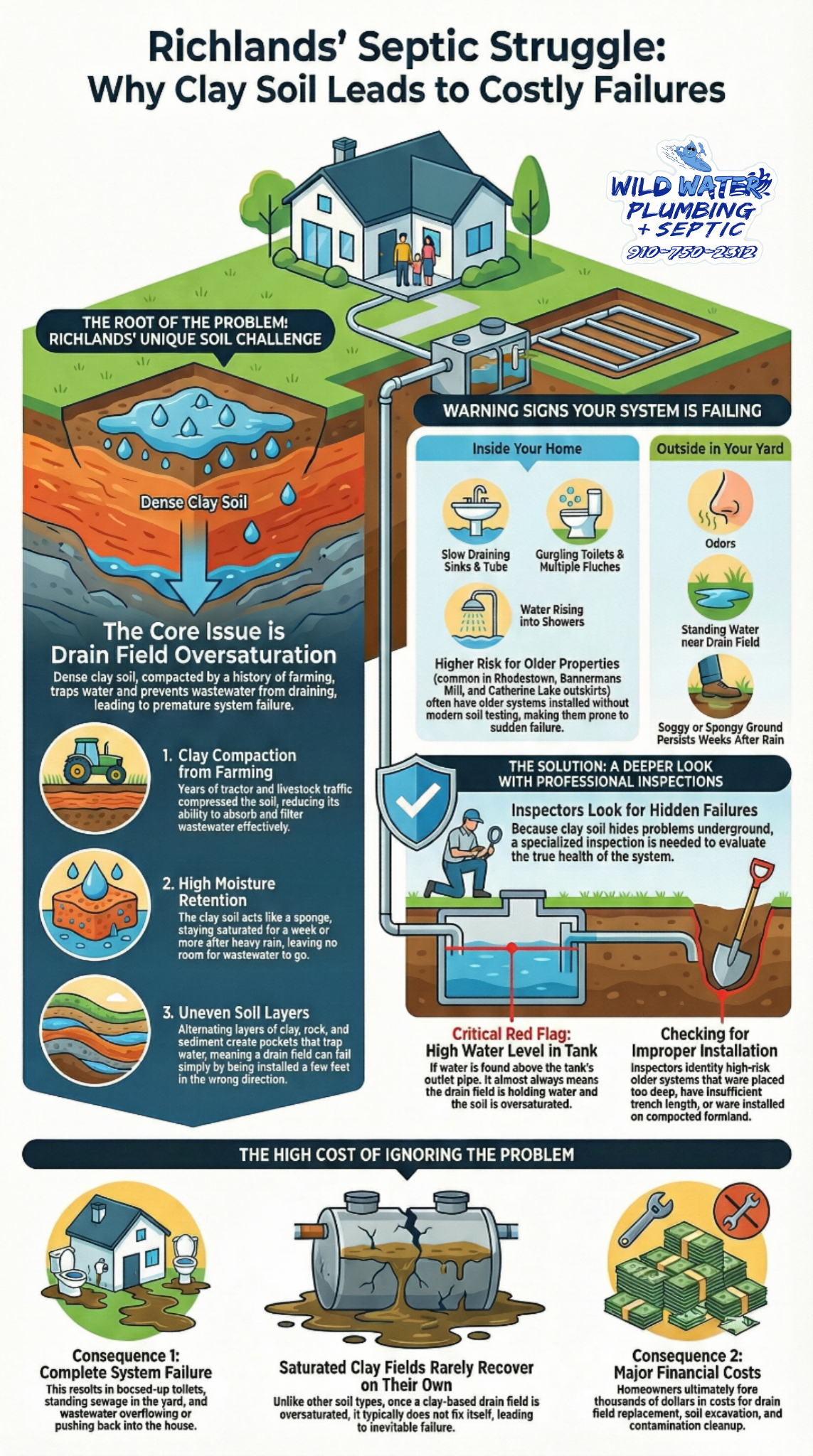
While much of coastal Onslow County deals with sandy soil and flooding, Richlands faces the opposite challenge: thick clay soil that does not drain well, even in dry weather. When a septic drain field is installed in clay-based soil, wastewater spreads slowly, saturates quickly, and remains trapped longer.
Richlands homeowners face three major soil-related issues:
- Clay Compaction from Decades of Farming
Large portions of Richlands were historically used as farmland. Years of tractor traffic, livestock, and plowing compacted the soil deeply. Even when a new subdivision is built, the lower layers remain tightly compressed, reducing how well wastewater can travel downward and outward. - High Moisture Retention
Clay holds moisture like a sponge. After a heavy rain, the soil can stay wet for a week or more. This means the drain field has nowhere to send wastewater, eventually causing the septic tank to overflow or force sewage back toward the house. - Uneven Soil Layers
Richlands soil often contains alternating layers of clay, rock, and sediment. Some areas drain slightly, while others trap water completely. A drain field installed just a few feet in the wrong direction can fail years earlier than expected.
These soil conditions are exactly why drain field oversaturation is one of the most common septic problems found during inspections in Richlands.
What Septic Inspectors Check in Richlands
A Deeper Look for Hidden Failures
A septic inspection in Richlands is not just a routine check. Because clay soil hides septic failures underground, inspectors must evaluate every part of the system more thoroughly.
Here is what a full inspection includes:
Locating the Tank and Drain Field
Older Richlands properties often have septic tanks placed far from the home, sometimes hundreds of feet away. In rural areas around Haw Branch Road or Baseline Road, tanks may be buried deeper than expected due to natural grade or prior agricultural use. Inspectors identify:
- Septic tank location
- Distribution box
- Drain field trenches
- Any repairs or add-on fields
- Pump systems if used
Evaluating the Tank’s Interior Condition
Inspectors uncover the lids and check:
- Sludge levels
- Scum thickness
- Structural condition
- Root intrusion
- Cracking or corrosion
- Inlet and outlet function
Note: Clay soil does not cause tank corrosion like coastal salt does, but oversaturation can push water back into the tank, damaging baffles and raising water levels.
Measuring Water Levels
One of the most telling inspection results in Richlands is a water level above the outlet pipe. This almost always means:
- The drain field is holding water
- Groundwater is intruding
- The soil is oversaturated
- Trenches are clogged
Clay soil is notorious for trapping water around the drain field.
Inspecting the Drain Field for Oversaturation
Inspectors check for:
- Soggy or spongy ground
- Water pooling in the yard
- Slow drainage from the home
- Uneven plant growth
- Wet spots after weeks without rain
In Richlands, if the yard feels soft even in dry weather, the drain field is probably struggling.
Checking for Improper Installation
Richlands has many older septic systems installed before modern standards. Inspectors often find:
- Drain fields placed too deep
- Insufficient trench length
- Systems installed without soil testing
- Undersized tanks
- Outdated distribution boxes
Older rural installations frequently relied on “good enough” soil conditions, not engineered design.
Warning Signs Richlands Homeowners Should Never Ignore
If you live in Richlands, pay close attention to these symptoms:
- Slow draining sinks and tubs
- Gurgling toilets
- Frequent backups after rainfall
- Standing water near the drain field
- Odors in the yard
- Toilets requiring multiple flushes
- Water rising into showers during heavy use
Any of these early signs may mean your drain field is already oversaturated.
Why Older Richlands Properties Are at Higher Risk
The farmland history of Richlands means many septic systems were installed under different soil assumptions. Homes built before newer regulations may have:
- Shallow drain fields
- Inadequate trench spacing
- Smaller tanks
- Systems installed on compacted farmland
- No modern soil percolation testing
This is especially common in areas like:
- Rhodestown
- Bannermans Mill
- Catherine Lake outskirts
- Back Swamp Road
- Richlands rural subdivisions
These homes may function well for years, then suddenly fail once soil saturation reaches a critical point.
How Weather Impacts Septic Performance in Richlands
Clay soil reacts dramatically to weather.
- After Rain: The ground swells and holds water, slowing drainage.
- During Long Dry Spells: Soil hardens and cracks, forcing wastewater to travel unevenly.
- During Winter: Cold, saturated clay drains even slower.
This constant cycle accelerates drain field deterioration.
The Cost of Ignoring Septic Problems in Richlands
Oversaturated clay-based drain fields rarely recover on their own. When ignored, homeowners eventually face:
- Backed up toilets
- Standing sewage in the yard
- Drain field replacement
- Contaminated soil
- Thousands of dollars in excavation costs
A septic inspection helps catch these issues long before they escalate into major repairs.
Protect Your Richlands Home Before Oversaturation Causes Permanent Damage
Clay-heavy soil will constantly challenge septic systems in Richlands, but early detection through professional inspections can save homeowners thousands of dollars and prevent messy failures.
If you live on former farmland, near dense clay ground, or notice slow drainage after rain, your septic system is already trying to warn you.
A septic inspection gives you clarity, protects your property, and ensures your system survives Richlands’ challenging soil conditions.
Stay safe and prepared, Jacksonville.
– Justin Wilder, Owner
📞 Call or text me directly at (910) 750-2312 to schedule your storm check today.
Wild Water Plumbing—Local, Veteran-Owned, and Always Ready.
—