BLUF (Bottom Line Upfront)
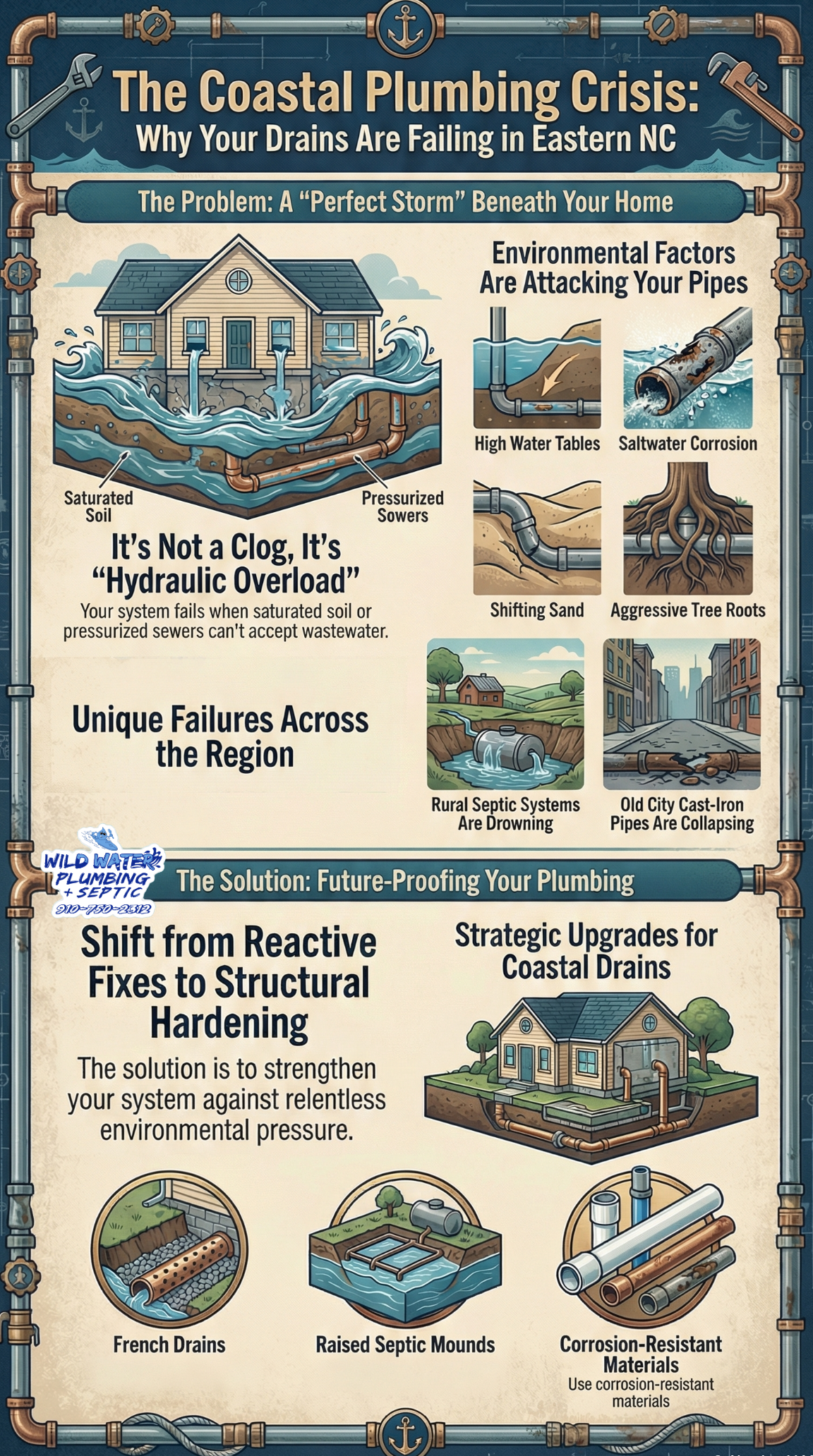
The drainage and plumbing infrastructure in Onslow, Pender, Carteret, and New Hanover counties is currently facing a systemic crisis driven by a “perfect storm” of geological, environmental, and aging structural factors. Unlike inland regions where plumbing failure is often a localized blockage, coastal failures are frequently driven by “hydraulic overload”—a condition where the receiving environment (soil or municipal sewer) is too saturated or pressurized to accept waste. High water tables, aggressive saltwater corrosion, unstable sandy soils, and the intrusion of maritime forest root systems are causing widespread failures in both private septic systems and municipal infrastructure. Specifically, rural areas like Down East Carteret and Hampstead are seeing septic failures due to rising groundwater, while historic urban centers like Wilmington and older military housing in Midway Park are battling the collapse of legacy cast iron and Orangeburg piping. Immediate mitigation requires a shift from reactive maintenance to structural hardening, including the use of French drains, raised septic mounds, and corrosion-resistant materials.
By Justin Wilder, Owner of Wild Water Plumbing | Well Water Systems
Table of Contents
- Introduction: The Invisible Crisis of Coastal Plumbing
- Chapter 1: Why Does the Coastal Geology Reject Water? The Science of Soil and Saturation
- Chapter 2: How Is “Hydraulic Overload” Causing Mass Septic Failures in Rural Areas?
- Chapter 3: Why Do Sandy Soils Destabilize Sewer Infrastructure and Cause Structural Bellies?
- Chapter 4: What Is the “Cast Iron Epidemic” in Historic and Military Neighborhoods?
- Chapter 5: How Does the “Live Oak” Problem Drive Root Intrusion in Coastal Lines?
- Chapter 6: What Impact Do Saltwater Intrusion and Water Quality Have on System Longevity?
- Chapter 7: Why Do “Flat Land” Communities Like Midway Park Face Unique Drainage Paralysis?
- Chapter 8: Detailed Analysis of Drainage Issues in Onslow County
- Chapter 9: Detailed Analysis of Drainage Issues in Carteret County
- Chapter 10: Detailed Analysis of Drainage Issues in Pender County
- Chapter 11: Detailed Analysis of Drainage Issues in New Hanover County
- Chapter 12: What Are the Strategic Solutions for Future-Proofing Coastal Drains?
- Closing Summary
- References
Introduction: The Invisible Crisis of Coastal Plumbing
My name is Justin Wilder. I am a U.S. Navy Veteran and the owner of Wild Water Plumbing + Septic. I have spent years in the trenches—quite literally—of Eastern North Carolina, battling a foe that is relentless, invisible, and overwhelmingly powerful: the water itself. When I speak to homeowners in Onslow, Pender, Carteret, and New Hanover counties, I often have to explain that their plumbing problems are rarely just about what they put down the drain. The problem, more often than not, is what is waiting for that water when it tries to leave the house.
In this region, we are living on the edge of the Atlantic Ocean, atop a complex layer cake of shifting sands, dense clays, and ancient aquifers. The drainage issues here are not standard “clogs” in the traditional sense. You cannot simply plow through a high water table. You cannot snake a pipe that has been crushed by the shifting weight of a sand dune. The challenges we face are structural and environmental. They are driven by the very geology that makes this coast so beautiful.
From the flat, marshy expanses of Midway Park to the shifting barrier islands of North Topsail and Emerald Isle, the ground is in a constant state of flux. In the rural reaches of Pender County, septic systems installed thirty years ago are now drowning in groundwater that has risen due to sea-level changes and increased rainfall. In the historic streets of Wilmington and the older neighborhoods of Jacksonville, cast iron pipes laid by previous generations are rotting from the outside in, eaten away by salt air and acidic soil.
This report is an exhaustive analysis of these issues. I have compiled data on soil composition, water table fluctuations, infrastructure materials, and local municipal challenges to provide a comprehensive view of the drainage and plumbing landscape in our region. We will look at why septic systems in Hampstead are failing at alarmingly high rates, why “sunny day flooding” in Down East Carteret is destroying plumbing functionality, and why the sandy soil of our barrier islands is effectively sandpaper to our sewer lines.
This is not just a list of problems; it is a diagnostic deep dive into the health of our region’s infrastructure. As we move through these chapters, understand that every gurgling toilet and slow drain is telling a story about the ground beneath our feet—a story of hydraulic pressure, geological instability, and the relentless march of nature against the built environment.
Chapter 1: Why Does the Coastal Geology Reject Water? The Science of Soil and Saturation
1.1 How Does the High Water Table Create “Hydraulic Lock”?
To understand why drains fail in our coastal counties, you first have to understand the concept of “hydraulic head” and the water table. In inland areas, like the Piedmont or the Mountains, the water table—the level below which the ground is saturated with water—is typically tens or hundreds of feet deep. When you flush a toilet or run a washing machine, gravity pulls that water down into a vast, empty sponge of soil.
Here in the coastal plain, specifically in Onslow and Carteret counties, that sponge is already full. In many areas, the seasonal high water table sits merely 12 to 24 inches below the surface.1 In barrier island communities or low-lying areas like Down East, it fluctuates with the tide.
This creates a phenomenon I call “hydraulic lock.” Physics dictates that two fluids cannot occupy the same space at the same time. When you try to discharge wastewater into a drain field or a municipal sewer pipe surrounded by saturated soil, groundwater exerts backpressure. If the pressure of the groundwater is equal to or greater than the gravity pushing your wastewater down, the flow stops.
This is why homeowners often report that their plumbing works fine during dry spells but becomes sluggish or backs up completely during high tides or heavy rains.2 It is not a clog in the pipe; it is the entire earth refusing to accept more liquid. The “hydraulic head”—the elevation difference that drives flow—has been neutralized by the rising groundwater.3
1.2 What Is the “Sand vs. Clay” Paradox in Our Region?
Our region is geologically schizophrenic. We are defined by two opposing soil types, both of which present unique nightmares for drainage: the coarse, shifting sands of the coast and the dense, impermeable clays of the inland plain.
The Instability of Sandy Soil:
In towns like North Topsail Beach, Emerald Isle, and Surf City, the soil is predominantly Norfolk sand or similar sandy loams.4 Sand is highly permeable, which sounds good for drainage, but it has a fatal flaw: it lacks structure.
- Liquefaction: When sand gets wet, it can behave like a liquid. During heavy storms or hurricanes, the sand bedding supporting underground pipes can wash away or shift. This causes pipes to sag, creating “bellies” where waste collects.5
- Infiltration: Sand is fine-grained. If there is even a hairline crack in a pipe, the vacuum pressure of the flowing water sucks the sand into the pipe. This sand accumulates, creating heavy, abrasive sludge that is nearly impossible to flush out.5
The Barrier of Clay:
Move inland to Burgaw, parts of Jacksonville, or the rural tracks of Pender County, and you hit clay—specifically expansive clays like the Craven or Lenoir series.4 Clay particles are microscopic plates that pack tightly together.
- Impermeability: Clay holds water but does not let it move. A septic drain field in clay acts like a ceramic bowl. Once you fill it with wastewater, the water sits there. It cannot percolate down because the clay is too dense.6
- Expansion/Contraction: Clay swells when wet and shrinks when dry. This constant movement heaves underground pipes, snapping rigid PVC or cracking cast iron lines, leading to structural failures that are invisible from the surface.7
1.3 How Does the Aquifer System Influence Surface Drainage?
We sit atop a complex aquifer system—the Castle Hayne, the Peedee, and the Surficial aquifers.8 The Castle Hayne is a limestone aquifer, which creates “hard” water conditions rich in calcium carbonate.8
While these aquifers provide our drinking water, their proximity to the surface in the eastern coastal plain complicates drainage. In areas where the confining units (clay layers) are breached or missing, there is a direct hydraulic connection between the surface water and the groundwater. This means that when we have massive rain events, the aquifers can actually “reject” recharge if they are full, forcing water to stay on the surface and flooding septic drain fields from below.9 This interaction between deep geology and surface drainage is a critical, often overlooked factor in the chronic wet yards seen in places like Rocky Point and Castle Hayne.
Chapter 2: How Is “Hydraulic Overload” Causing Mass Septic Failures in Rural Areas?
2.1 The Mechanics of Septic Suffocation
In rural Onslow, Pender, and Carteret counties, the septic system is the standard for waste disposal. A functioning septic system is a living ecosystem. It relies on a “biomat” of bacteria in the soil to filter effluent before it reaches the groundwater. State regulations generally require 12 to 18 inches of unsaturated soil beneath the drain lines to allow this treatment to happen.10
The crisis we are seeing now is “Septic Hydraulic Overload.” Because of rising sea levels and more intense precipitation events, that 18-inch buffer zone is vanishing. In areas like Hampstead and Sneads Ferry, the groundwater is rising into the drain trenches.2
When the drain field is saturated:
- Oxygen Depletion: The aerobic bacteria that break down waste die off because they drown.
- Pathogen Breakthrough: Wastewater flows through the saturated soil too quickly or mixes directly with groundwater without treatment, leading to contamination.10
- Backups: The tank cannot empty. You flush the toilet, and the water level in the tank rises, but it has nowhere to go. This forces sewage back up the line into the house or out onto the surface of the yard.2
2.2 The Phenomenon of the “Floating Tank”
One of the most catastrophic failures I see in coastal septic systems, particularly in North Topsail Beach and sound-side Carteret County, is the “floating tank.”
Septic tanks are essentially large, hollow concrete or plastic vessels. When the ground around them becomes fully saturated with floodwater or storm surge, they become buoyant—like a boat. If a homeowner has recently pumped their tank (making it light), the upward hydrostatic pressure of the groundwater can pop the tank right out of the ground.11
This is a violent failure. As the tank lifts, it shears off the inlet pipe coming from the house and the outlet pipe going to the drain field. I have seen tanks rise several inches or even feet, destroying the entire plumbing infrastructure of the property in a single event.11
2.3 Saltwater: The Biological Assassin
For homes on the barrier islands or near the Intracoastal Waterway, saltwater intrusion is a silent assassin. Septic systems rely on freshwater biology. Saltwater is toxic to the beneficial bacteria in the tank.11
During a storm surge or even a “King Tide” event where brackish water infiltrates the tank, the salt kills the bacteria. Without these microbes, solids do not break down. They accumulate rapidly, turning the tank into a holding cell rather than a treatment plant. The solids then flow out into the drain field, clogging the soil pores with a “biomat” of sludge that seals the ground permanently. Once a drain field is “salted,” it often cannot be recovered and must be replaced.11
Chapter 3: Why Do Sandy Soils Destabilize Sewer Infrastructure and Cause Structural Bellies?
3.1 The Physics of Pipe “Bellies”
In New Hanover and Onslow counties, particularly in the sandy zones, I frequently diagnose “bellies” in sewer lines. A belly is a sag or low spot in the pipe.
Sewer lines work on gravity. They need a consistent slope—typically a quarter-inch drop per foot of run. In sandy soil, this support is precarious. Groundwater movement, tidal fluctuations, or even nearby vibrations can cause the sand bedding beneath the pipe to shift or wash away (erosion).5
When the support vanishes, the pipe sinks under its own weight and the weight of the earth above it. This creates a dip. Water pools in this dip, acting like a sediment trap. Toilet paper, waste, and grease hit this stagnant pool and stop, settling to the bottom. Over time, this debris hardens.
Homeowners will snake the line, poking a hole through the mess, but because the belly—the structural flaw—remains, the clog inevitably returns. In sandy coastal soils, this is a pervasive structural defect that snaking cannot fix.5
3.2 Sand Infiltration: The Sandpaper Sludge
The sand here is fine, almost like sugar. In older infrastructure—the clay pipes of downtown Wilmington or the concrete mains of Morehead City—joints and seals degrade over time. In clay soil, a small crack might seal itself with mud. In sandy soil, it becomes a vacuum.5
Water flowing through the pipe creates negative pressure (the Venturi effect) at the crack, sucking the surrounding sand into the line.
- Abrasion: The sand acts like sandpaper, scouring the bottom of the pipe and thinning the walls further.
- Obstruction: The sand is heavy. It settles on the bottom of the pipe and does not wash away. It builds up layer by layer, eventually filling the pipe with a dense, concrete-like sludge that standard jetting struggles to move.
- Sinkholes: As the sand enters the pipe, it leaves a void in the ground outside. Eventually, the grass or driveway above the pipe collapses into this void, creating a sinkhole.5
Chapter 4: What Is the “Cast Iron Epidemic” in Historic and Military Neighborhoods?
4.1 The Chemistry of “Channel Rot”
In the historic districts of Wilmington, the older sections of Jacksonville, and pre-1980s homes in Morehead City, cast iron was the material of choice. Cast iron is strong, but in a coastal environment, it has a fatal weakness: oxidation.12
Our soil is often acidic and, near the coast, saline. This creates an electrolytic reaction with the iron. The bottom of the pipe, which is constantly wet with wastewater, suffers from “channel rot.” The iron molecules are leached away, leaving behind a brittle graphite structure.
Eventually, the bottom of the pipe simply dissolves. The pipe becomes a tunnel with no floor. The wastewater runs into the dirt, eroding the soil and causing backups as the rough, jagged edges of the rusted iron snag toilet paper and solids.12
4.2 The Orangeburg Disaster in Midway Park
Midway Park in Onslow County, built largely for Camp Lejeune housing in the 1940s, is ground zero for a specific material failure: Orangeburg pipe.12
Orangeburg pipe is essentially wood pulp pitch-impregnated fiber—tar paper rolled into a tube. It was cheap and available during the metal shortages of WWII. It was never meant to last 80 years.
In the wet, humid soils of Midway Park, these pipes are absorbing moisture and deforming. They turn from round tubes into ovals, and eventually, they flatten completely like a stepped-on soda can. They are also highly susceptible to root intrusion. There is no repairing Orangeburg; when I find it in Midway Park, the only honest solution is to dig it up and replace it with PVC.12
Chapter 5: How Does the “Live Oak” Problem Drive Root Intrusion in Coastal Lines?
5.1 The Hydrotropic Aggression of Maritime Forests
The coastal landscape is defined by the majestic Live Oak (Quercus virginiana) and the tenacious Sweet Gum. While beautiful, these trees are the mortal enemies of underground plumbing.
Live Oaks have massive, sprawling root systems that are adapted to find water in sandy, well-drained soils. They are “hydrotropic,” meaning they grow toward moisture.5
A sewer pipe carrying warm wastewater creates a “sweat” of condensation on its outer wall in the cool soil. The roots sense this temperature and moisture differential. They seek out the pipe.
5.2 Mechanics of Intrusion and Destruction
In older clay or cast iron pipes (common in Wilmington and Beaufort), the joints are the weak points. Roots grow hair-thin tendrils that penetrate microscopic cracks or loose mortar joints.
Once inside the nutrient-rich environment of the sewer (which is full of water and natural fertilizer), the roots explode in growth. A root the size of a thread can swell to the thickness of a human arm inside the pipe.
- The Net Effect: The root mass forms a fibrous net that catches everything—grease, paper, wipes.
- Pipe Splitting: As the root expands, it exerts immense radial pressure, physically shattering clay pipes and splitting cast iron seams.
- Detection: If you hear your toilet gurgle when the washing machine drains, it’s often because a root mass in the main line is blocking the airflow, forcing air back up through the toilet trap.5
Chapter 6: What Impact Do Saltwater Intrusion and Water Quality Have on System Longevity?
6.1 The Corrosive Power of the Salt Air
For homes on the barrier islands (Topsail, Wrightsville, Emerald Isle), the air itself is corrosive. Salt spray (aerosolized sodium chloride) settles on everything, including plumbing vents on the roof and exposed cleanouts.11
This salt washes down into the system. Inside the pipes, the chloride ions attack metals—copper supply lines, cast iron drains, and brass fittings. This leads to “pitting corrosion,” where tiny pinholes form in the metal. I often see cast iron stacks in beach houses that look solid but crumble to dust when touched because the salt has destroyed the iron matrix.5
6.2 Hard Water Scale from the Castle Hayne Aquifer
The water we drink and use in Onslow and Pender counties often comes from the Castle Hayne aquifer, which is limestone-based.8 This means the water is “hard”—rich in calcium and magnesium.
- Scaling: As this water flows through pipes, minerals precipitate out, forming a rock-hard scale on the interior walls of the pipe.13
- Flow Restriction: Over decades, a 4-inch drain pipe can be reduced to a 3-inch or 2-inch diameter due to scale buildup. This rough, narrowed channel is much more prone to clogging from hair and grease.
- Local Variation: Interestingly, areas served by reverse osmosis plants (like some barrier island districts) have “soft” water, which eliminates scale but can be aggressive toward copper piping if not properly buffered, leading to blue-green staining.14
Chapter 7: Why Do “Flat Land” Communities Like Midway Park Face Unique Drainage Paralysis?
7.1 The Physics of Zero-Grade Drainage
Gravity is a plumber’s best friend. In Midway Park, Piney Green, and parts of low-lying Pender County, gravity is absent. The terrain is “pancake flat”.1
Water requires a slope to move. In these areas, when it rains, the water does not run off; it pools. This creates a “bathtub effect.” The yard fills with water, and because the water table is also high, there is nowhere for it to go.
7.2 The “Mock” Sewer Failure
This standing water creates a hydrostatic pressure head against the home’s foundation and plumbing.
- I&I (Inflow and Infiltration): Stormwater forces its way into the sewer lines through manholes, cleanouts, and cracks. This overwhelms the municipal system.
- The Symptom: Residents in Midway Park often call me saying their sewer is backed up. When I arrive, the sewer isn’t clogged; it’s full. The city main is pressurized with rainwater, preventing the home’s lateral from emptying. It’s a “mock” plumbing failure caused by the drainage environment.1
- Health Risk: This standing water in the yard is not just a nuisance; it is a breeding ground for mosquitoes and can wick into crawlspaces, causing mold and structural rot.1
Chapter 8: Detailed Analysis of Drainage Issues in Onslow County
8.1 Jacksonville: The Clay-Sand Hybrid
Jacksonville sits at a geological crossroads. Some neighborhoods are sandy, but others, especially older tracks like Northwoods, sit on pockets of dense clay.
- The Issue: Surface ponding. The clay subsoil acts as a barrier, trapping rainwater on the surface.
- Infrastructure: We see a high incidence of root intrusion from established trees attacking aging terra cotta and cast iron lines in the city center.1
8.2 Midway Park: The Infrastructure Time Bomb
As discussed, Midway Park is a critical hotspot.
- The Issue: Widespread failure of Orangeburg pipe and zero-grade drainage.
- The Consequence: Homeowners face chronic, un-clearable backups because the pipes have physically collapsed. The flat terrain means that even when pipes are replaced, maintaining proper slope is a constant engineering challenge.1
8.3 Sneads Ferry: Growing Pains and Water Tables
Sneads Ferry is exploding with development, but it sits at the mouth of the New River with an extremely high water table.
- The Issue: Septic saturation. New developments are pushing into marginal lands where the seasonal high water table is dangerously close to the surface.
- The Consequence: During wet seasons, we see “sluggish” flushing and wet spots in yards as septic systems struggle to discharge against the groundwater pressure.1
8.4 North Topsail Beach: The Front Line
This barrier island community faces the most aggressive conditions.
- The Issue: Erosion and Salt. Storm surges frequently wash over dunes, filling septic systems with sand and salt.
- The Consequence: “Floating tanks” are a real risk here. The corrosion rate of metal components is 3-4 times faster than on the mainland. If you live here, stainless steel and plastic are your only friends.11
8.5 Holly Ridge: Capacity Constraints
Holly Ridge has faced significant challenges with municipal sewer capacity.
- The Issue: The wastewater treatment plant has struggled to keep up with rapid growth and Inflow & Infiltration (I&I) during storms.
- The Consequence: This has led to moratoriums or restrictions on new connections in the past, and existing residents may experience slower service or backups during peak rain events due to the system being hydraulically overloaded.16
Chapter 9: Detailed Analysis of Drainage Issues in Carteret County
9.1 Morehead City: Urban Drainage vs. The Tide
Morehead City is an old port town. Its drainage infrastructure fights a daily battle with Bogue Sound.
- The Issue: Tidal locking. The storm drains rely on gravity to empty into the sound. During “King Tides,” the sound level is higher than the drain outlets.
- The Consequence: Seawater flows back up the storm drains, flooding streets and yards even on sunny days. This creates the “mock” sewer backup scenarios where home drains cannot empty because the municipal system is full of tide water.1
9.2 Beaufort: Historic Charm, Historic Pipes
Beaufort is one of the oldest towns in North Carolina.
- The Issue: Ancient infrastructure. We find hand-laid brick sewers and very old cast iron.
- The Consequence: These lines are often brittle and filled with roots. The historic Live Oaks that line the streets are beautiful, but they are wreaking havoc on the subterranean grid.13
9.3 Newport: The River Basin Bowl
Newport sits inland but is heavily influenced by the Newport River.
- The Issue: Riverine flooding. Heavy rains in the watershed drain toward Newport, raising the local water table rapidly.
- The Consequence: Septic drain fields that function well in dry months can fail for weeks at a time during the rainy season as the river level keeps the groundwater high.1
9.4 Down East (Harkers Island, Atlantic): The Ghost Forest Crisis
The communities “Down East” are on the front lines of sea-level rise.
- The Issue: The “Ghost Forest” effect. Saltwater is infiltrating the groundwater table, killing trees and poisoning the soil.
- The Consequence: Traditional septic systems are failing en masse. The soil is too wet and too salty to treat waste. We are seeing a public health crisis where sewage surfaces in yards because the “sponge” of the earth is full of ocean water. Residents report ditches that never drain, staying full of brackish water year-round.3
9.5 Emerald Isle: Sand Shifts
Similar to Topsail, Emerald Isle deals with sandy instability.
- The Issue: shifting dunes.
- The Consequence: Sewer laterals that were installed with proper slope can develop “bellies” or sags as the sand moves beneath them, leading to chronic stoppages.1
Chapter 10: Detailed Analysis of Drainage Issues in Pender County
10.1 Hampstead: The Septic Density Problem
Hampstead has grown from a sleepy village to a bustling bedroom community, but much of it lacks municipal sewer.
- The Issue: Septic density. We have thousands of septic systems packed into an area with high water tables and pockets of “hardpan” soil.
- The Consequence: During heavy rains, the ground becomes a swamp. With so many systems discharging into the same aquifer, the ground saturates quickly. I get calls from homeowners whose toilets simply won’t flush for three days after a hurricane because the entire neighborhood’s ground is water-locked.18
10.2 Burgaw: The Clay Trap
Burgaw sits on heavier soils compared to the coast.
- The Issue: Low percolation rates. The clay soil holds water tight.
- The Consequence: Septic systems here often require “mound” systems or advanced pretreatment because the native soil simply won’t accept the effluent fast enough. “Perc” tests frequently fail, limiting development or requiring expensive engineering.6
10.3 Surf City: The Dual Threat
Spanning the mainland and the island, Surf City sees both sides.
- The Issue: Tidal flooding on the sound side, salt corrosion on the ocean side.
- The Consequence: Properties near the swing bridge often see ditch water levels rise with the tide, preventing yard drainage. The sandy soil allows for rapid infiltration of salt water into any cracked sewer pipes.11
10.4 Rocky Point: The Limestone Influence
Rocky Point sits atop the Castle Hayne aquifer’s limestone deposits.
- The Issue: Hard water and sinkholes.
- The Consequence: We see significant scale buildup in pipes here. Also, the interaction of acidic rainwater with the limestone bedrock can create sinkholes, which occasionally swallow sections of drainage pipe or septic fields.19
Chapter 11: Detailed Analysis of Drainage Issues in New Hanover County
11.1 Wilmington: The Urban Root War
Wilmington is the urban core of the region.
- The Issue: Aging infrastructure meets urban forestry. The city has miles of 70+ year old clay and cast iron mains.
- The Consequence: Root intrusion is the #1 cause of failure here. The city’s massive oaks are relentless. We also see frequent collapses of the city’s main lines due to age, causing sinkholes in streets and backups into homes.5
11.2 Wrightsville Beach: Density and Salt
- The Issue: Extreme density and corrosive environment.
- The Consequence: With houses packed tightly together, the municipal sewer load is high. The salt air corrodes cleanout caps and vents, allowing sand and rain to enter the system. We see a high rate of “pitting corrosion” in copper pipes here.11
11.3 Castle Hayne: The Hard Water Capital
Named for the aquifer, Castle Hayne has some of the hardest water in the region.
- The Issue: Calcium carbonate scale.
- The Consequence: Water heaters fail faster here due to sediment buildup. Drain lines narrow over time as scale deposits accumulate, requiring descaling or replacement earlier than in other areas.8
Chapter 12: What Are the Strategic Solutions for Future-Proofing Coastal Drains?
12.1 The French Drain Revolution
For the “flat land” and surface water issues in Midway Park and Onslow County, the French Drain is the gold standard—if done right.
- The Fix: We dig a trench, line it with geotextile fabric (to stop that fine sand from clogging it), fill it with washed gravel, and install a perforated pipe.
- The Secret: The holes in the pipe must face DOWN. This allows the rising groundwater to enter the pipe from below and flow away.
- Discharge: In flat areas, we often have to install a sump pump basin to mechanically lift this water and eject it to a street drain or ditch, because gravity isn’t enough.1
12.2 Septic Solutions: Mounds and Risers
For the failing septic systems in Hampstead and Down East:
- Mound Systems: We bring in truckloads of sand to build a drain field above the natural grade. This creates the necessary 18 inches of unsaturated soil separation for treatment.18
- Risers and Lids: Installing watertight risers prevents surface floodwater from pouring into the tank during storms.
- ATUs: Aerobic Treatment Units can be installed to treat wastewater to a higher standard before it hits the soil, which is helpful in areas with poor soil biology.20
12.3 Trenchless Pipe Rehabilitation
For the root-infested and rotting pipes of Wilmington and Beaufort:
- CIPP (Cured-in-Place Pipe): Instead of digging up the yard and killing the Live Oak trees, we shoot a resin-saturated liner into the old pipe and cure it with hot water or UV light. This creates a new, seamless plastic pipe inside the old rotting cast iron one. It is root-proof and corrosion-proof.2
12.4 Material Upgrades
We must stop using materials that fail in this environment.
- PVC Only: Schedule 40 or 80 PVC should be the only standard for drains. No more thin-wall styrene.
- Stainless Steel: For strapping and mounts in coastal areas (North Topsail), galvanized steel rusts in months. Stainless steel is mandatory.
- Check Valves: Every coastal home low on the elevation chart needs a backwater valve (check valve) on their sewer lateral. This prevents the city main or the rising tide from pushing sewage back into the house.1
Closing Summary
The drainage challenges in Onslow, Pender, Carteret, and New Hanover counties are not going away. In fact, with sea levels rising and development increasing, they are intensifying. The days of “install it and ignore it” are over.
If you live in these counties, you are essentially managing a small water treatment facility in a hostile environment. The high water tables in Sneads Ferry, the rotting cast iron in Wilmington, the floating tanks in Topsail, and the ghost forests of Down East all point to a single truth: we are in a battle against hydraulic saturation.
The solution lies in acknowledging the geology. We cannot change the soil or lower the ocean, but we can adapt our infrastructure. By moving away from legacy materials like Orangeburg and cast iron, utilizing engineered drainage like French drains and mound systems, and proactively managing our vegetation, we can keep the water flowing. It requires vigilance, investment, and a respect for the power of the water that surrounds us.
Stay safe and prepared, Jacksonville.
– Justin Wilder, Owner
📞 Call or text me directly at (910) 750-2312 to schedule your storm check today.
Wild Water Plumbing—Local, Veteran-Owned, and Always Ready.
—
References
- 21 Pender County Towns & Communities. (n.d.). Pender County NC.
- 22 Geography of Onslow County. (n.d.). NCpedia.
- 23 List of municipalities in North Carolina. (n.d.). Wikipedia.
- 24 Cities in North Carolina. (n.d.). UNC School of Government.
- 25 Onslow County, North Carolina. (n.d.). Wikipedia.
- 2 The Most Common Septic Emergencies We See in Coastal NC. (n.d.). Coastal Septic Solutions.
- 26 Top 5 Common Septic System Problems in North Carolina. (n.d.). Kent Services NC.
- 5 Common Residential Plumbing Issues in Wilmington NC. (n.d.). Wild Water Plumbing.
- 11 Top Septic System Challenges Unique to North Topsail Beach. (n.d.). Wild Water Plumbing.
- 27 Septic Systems. (n.d.). Onslow County NC.
- 28 Pender County Position on Interbasin Transfer. (n.d.). Pender County NC.
- 29 Navigating Septic Tank Installation in Eastern NC. (n.d.). Coastal Septic Solutions.
- 18 Need help with septic permit with high ground water. (n.d.). Reddit.
- 10 Rising Sea Levels Threaten Coastal Septic Systems. (n.d.). PBS North Carolina.
- 13 Doctoral research addresses natural hazards Down East. (2024). UNC Chapel Hill.
- 3 Guest commentary: When the water doesn’t go away. (2025). Coastal Review.
- 1 If You Don’t Have a French Drain You Must Read This. (n.d.). Wild Water Plumbing.
- 17 Changes from Hurricane Florence Down East still visible. (2023). Coastal Review.
- 12 Sewer Line and Drain Problems in New Hanover County Homes. (n.d.). Wild Water Plumbing.
- 4 Soil Survey of Pender County, North Carolina. (1914). USDA.
- 6 Clay vs Sandy Soil: Key Differences. (n.d.). Pro Landscapes MD.
- 7 Soil Issues & Foundations in North Carolina. (n.d.). Regional Waterproofing.
- 2 The Most Common Septic Emergencies. (n.d.). Coastal Septic Solutions.
- 20 What To Do If Your Land Fails A Perc Test. (n.d.). Soils Inc.
- 30 FAQ – Onslow Water and Sewer Authority. (n.d.). ONWASA.
- 14 FAQ – Bogue Banks Water Corporation. (n.d.). Bogue Banks Water.
- 16 Wastewater Facilities Annual Report. (2018). ONWASA.
- 8 Ground Water in the Coastal Plain of North Carolina. (n.d.). NC State Extension.
- 15 Older Base Housing and Sewer Problems in Midway Park. (n.d.). Wild Water Plumbing.
Works cited
- French Drains for Yards in Onslow, Pender, Carteret, New Hanover, accessed January 1, 2026, https://wildwaterplumbing.com/if-you-dont-have-a-french-drain-you-must-read-this/
- 5 of the Most Common Septic Emergencies We See in Coastal NC, accessed January 1, 2026, https://www.coastalsepticsolutions.com/blog/the-most-common-septic-emergencies-we-see-in-coastal-nc
- Guest commentary: When the water doesn’t go away | Coastal Review, accessed January 1, 2026, https://coastalreview.org/2025/11/guest-commentary-when-the-water-doesnt-go-away/
- Soil survey of Pender County, North Carolina – ECU Digital Collections, accessed January 1, 2026, https://digital.lib.ecu.edu/17064
- Wilmington Plumbing Issues: Expert Help from Wild Water, accessed January 1, 2026, https://wildwaterplumbing.com/common-residential-plumbing-issues-in-wilmington-nc/
- Clay vs. Sandy Soil: Key Differences for Maryland Landscapes, accessed January 1, 2026, https://prolandscapesmd.com/clay-vs-sandy-soil-key-differences-for-maryland-landscapes/
- Common Soil Issues Affecting Foundations In North Carolina, accessed January 1, 2026, https://regionalwaterproofing.com/blog/soil-issues-foundations-north-carolina/
- Ground Water in the Coastal Plain of North Carolina | NC State Extension Publications, accessed January 1, 2026, https://content.ces.ncsu.edu/ground-water-in-the-coastal-plain-of-north-carolina
- Saltwater Moves Into Drinking Water Aquifers – Coastal Review, accessed January 1, 2026, https://coastalreview.org/2014/11/saltwater-moves-drinking-water-aquifers/
- Rising Sea Levels Threaten Coastal Septic Systems | PBS North Carolina, accessed January 1, 2026, https://www.pbsnc.org/blogs/science/rising-sea-levels-threaten-coastal-septic-systems/
- Top Septic System Challenges in North Topsail Beach Homes, accessed January 1, 2026, https://wildwaterplumbing.com/top-septic-system-challenges-unique-to-north-topsail-beach-properties/
- Sewer Line and Drain Problems in New Hanover County Homes, accessed January 1, 2026, https://wildwaterplumbing.com/sewer-line-and-drain-problems-in-new-hanover-county-homes/
- Doctoral research addresses natural hazards Down East | UNC-Chapel Hill, accessed January 1, 2026, https://www.unc.edu/discover/doctoral-research-addresses-natural-hazards-down-east/
- FAQ | Bogue Banks Water Corporation, accessed January 1, 2026, https://boguebankswater.com/faq
- Older Base Housing and Sewer Problems in Midway Park, NC – Why Frequent Backups Need a Permanent Fix – Wild Water Plumbing + Septic, accessed January 1, 2026, https://wildwaterplumbing.com/older-base-housing-and-sewer-problems-in-midway-park-nc-why-frequent-backups-need-a-permanent-fix/
- ONWASA Wastewater Facilities Annual Report for 2018, accessed January 1, 2026, https://www.onwasa.com/DocumentCenter/View/3743/Wastewater-Facilities-Annual-Report-2018
- Changes from Hurricane Florence Down East still visible | Coastal Review, accessed January 1, 2026, https://coastalreview.org/2023/10/changes-from-hurricane-florence-down-east-still-visible/
- Need help with septic permit with high ground water : r/septictanks – Reddit, accessed January 1, 2026, https://www.reddit.com/r/septictanks/comments/1i0vsmz/need_help_with_septic_permit_with_high_ground/
- Official Series Description – PENDER Series – USDA, accessed January 1, 2026, https://soilseries.sc.egov.usda.gov/OSD_Docs/P/PENDER.html
- What To Do If Your Land Fails A Perc Test? (Your Options) – Soils Inc., accessed January 1, 2026, https://soils-inc.com/what-to-do-if-your-land-fails-a-perc-test/
- Towns & Communities | Pender County, NC, accessed January 1, 2026, https://www.pendercountync.gov/469/Towns-Communities
- Onslow County – NCpedia, accessed January 1, 2026, https://www.ncpedia.org/geography/onslow
- List of municipalities in North Carolina – Wikipedia, accessed January 1, 2026, https://en.wikipedia.org/wiki/List_of_municipalities_in_North_Carolina
- Cities in North Carolina – UNC School of Government, accessed January 1, 2026, https://www.sog.unc.edu/resources/microsites/knapp-library/cities-north-carolina
- Onslow County, North Carolina – Wikipedia, accessed January 1, 2026, https://en.wikipedia.org/wiki/Onslow_County,_North_Carolina
- 5 Common Septic System Problems in North Carolina – Kent Services, accessed January 1, 2026, https://kentservicesnc.com/top-5-common-septic-system-problems-in-north-carolina-and-how-to-avoid-them/
- Septic Systems | Onslow County, NC, accessed January 1, 2026, https://www.onslowcountync.gov/675/Septic-Systems
- Pender County Commissioners Approve Resolution Opposing Interbasin Transfer to Protect Water Supply, accessed January 1, 2026, https://www.pendercountync.gov/m/NewsFlash/Home/Detail/214
- Navigating Septic Tank Installation in Eastern NC: A County-by-County Guide, accessed January 1, 2026, https://www.coastalsepticsolutions.com/blog/navigating-septic-tank-installation-in-eastern-nc-a-county-by-county-guide
- Frequently Asked Questions – Onslow Water and Sewer Authority, accessed January 1, 2026, https://www.onwasa.com/FAQ/Topic?topic=16&mobile=ON