

THE SHORT VERSION, READ THIS FIRST
A water heater in coastal North Carolina works harder than its manufacturer planned for. Mineral-heavy water from the Castle Hayne Aquifer or treated Cape Fear municipal supply deposits scale on heating elements within months. Salt air corrodes the exterior of tanks in coastal communities. The result: an appliance rated for 10 to 12 years often fails at 7 or 8 years across Onslow, Pender, New Hanover, and Carteret Counties. This guide covers every water-heater question coastal homeowners face: sizing, repair vs. replace, tank vs. tankless, by-town considerations, and what it actually costs to fix or replace one.
📄 TABLE OF CONTENTS
- Water Heater Types: Tank, Tankless, Hybrid
- How Coastal NC Water Chemistry Affects Water Heaters
- Sizing Your Water Heater Correctly
- 8 Warning Signs Your Water Heater Is Failing
- Repair vs Replace: How to Decide
- Tankless Considerations for Coastal NC
- Water Heaters by County
- Maintenance That Extends Service Life
- What Replacement Actually Costs
- Summary
- Frequently Asked Questions
- References
Chapter 1: Water Heater Types: Tank, Tankless, Hybrid
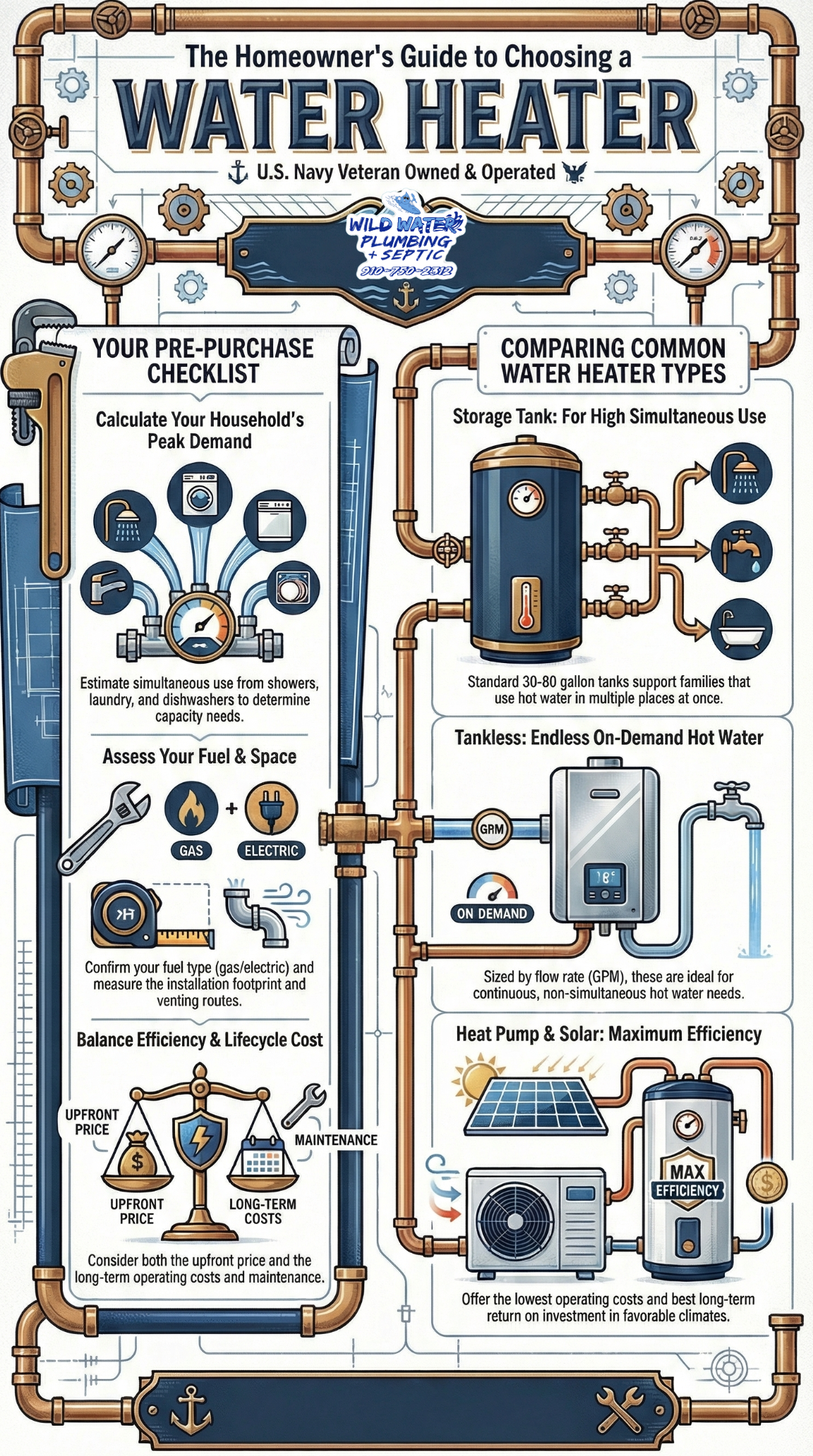
Three main residential water heater types serve coastal North Carolina homes. Each has specific strengths and weaknesses in this region’s water chemistry and climate.
Standard Tank Water Heaters
The most common type, a tank water heater stores 30 to 80 gallons of heated water continuously. Heating elements maintain temperature whether or not anyone uses the water. Tank units cost the least to purchase and install. They produce a finite hot water supply that depletes during high-demand periods and requires recovery time. In coastal North Carolina, tank water heaters face accelerated wear from mineral scale buildup inside the tank and salt air corrosion on exterior fittings.
Tankless Water Heaters
A tankless unit heats water on demand as it passes through the unit, providing unlimited hot water supply without storing heated water. Modern tankless units use either gas combustion or high-amperage electric resistance heating. Tankless costs more upfront, requires larger gas lines or electrical service in some installations, lasts roughly twice as long as tank units, and offers meaningfully better energy efficiency for households with moderate hot water demand patterns.
Heat Pump Hybrid Water Heaters
A hybrid unit combines a tank with a heat pump that extracts ambient air heat to warm the water. Hybrids use 60 to 70 percent less electricity than standard electric tank units. They work best in conditioned interior spaces and produce slight cool air and humidity reduction as a byproduct of operation. Hybrid units cost more than standard tanks, less than tankless, and are well-suited to homes with electric service and adequate installation space.
Gas, Electric, or Propane?
Coastal North Carolina homes split roughly evenly between gas and electric water heaters depending on whether natural gas service reaches the property. Piedmont Natural Gas serves most of Jacksonville, parts of Wilmington, and selected corridors. Outside those service areas, propane and electric are the standard options. Gas water heaters recover faster than electric and cost less to operate where natural gas is available. Electric units are simpler to install and require no venting. Propane operates like natural gas but with higher fuel cost.
Chapter 2: How Coastal NC Water Chemistry Affects Water Heaters
The water entering your water heater across coastal North Carolina is meaningfully different from the test water manufacturers use to rate their products. The differences matter.
Hardness and Scale Formation
Calcium and magnesium minerals in coastal water precipitate as scale when the water is heated. Scale builds on heating elements, tank walls, and tankless heat exchangers. Scale is an excellent thermal insulator, which means the heating element has to reach higher and higher temperatures to push heat through the growing scale layer. Element failure from thermal stress and tank wall stress from elevated heating temperatures are the predictable outcomes.
The Castle Hayne Aquifer that serves most coastal NC private wells produces very hard water. The Cape Fear Public Utility Authority municipal water is moderately hard. Both produce measurable scale formation inside untreated water heaters within months of installation.
Iron and Manganese
Private wells across the region carry dissolved iron and sometimes manganese. These minerals deposit inside the water heater tank along with calcium and magnesium scale, creating a mixed mineral layer that is more difficult to flush than calcium scale alone. Iron deposits also stain plumbing fixtures throughout the home as the heated water carries oxidized iron particles to every tap.
Salt Air Exterior Corrosion
Properties within a few miles of the coast face accelerated corrosion on every exterior metal component: tank shells, pressure relief valves, gas inlet fittings, electrical conduit, flue vents on gas units, and water connections at the inlet and outlet. Salt air also degrades anode rods faster than inland conditions. The result is that tank water heaters in coastal communities like Sneads Ferry, Wrightsville Beach, Carolina Beach, Surf City, and the Down East peninsulas of Carteret County typically fail several years before similar units in inland locations.
The Practical Impact
A water heater rated for 12 years of service often delivers 7 or 8 years in coastal North Carolina without specific maintenance. The same unit with annual flushing, anode rod replacement, and a whole-home water softener can reach or exceed its rated lifespan. The difference is preventive service.
Chapter 3: Sizing Your Water Heater Correctly
A water heater that is undersized for the household runs constantly, recovers slowly, and produces frustrating hot water shortages during peak demand. An oversized unit wastes energy maintaining temperature on water nobody uses. Right-sizing matters.
Tank Sizing by Household Size
- 1 to 2 people: 30 to 40 gallon tank
- 2 to 3 people: 40 gallon tank
- 3 to 4 people: 50 gallon tank
- 4 to 5 people: 50 to 65 gallon tank
- 5 or more people: 75 gallons or larger, or a tankless system
The First-Hour Rating Matters
Tank size alone does not determine hot water capacity. The first-hour rating, which measures gallons of hot water delivered in the first hour of peak demand, accounts for both stored hot water and the recovery rate of the unit. A 50-gallon tank with a high first-hour rating can outperform a 65-gallon tank with poor recovery. Gas units typically have higher first-hour ratings than electric units of the same capacity because gas burners heat water faster than electric elements.
Tankless Sizing
Tankless units are sized by flow rate in gallons per minute (GPM). A typical coastal North Carolina home needs:
- Single bathroom, modest use: 5 to 7 GPM unit
- 2 bathrooms, simultaneous use possible: 7 to 9 GPM unit
- 3+ bathrooms or high-volume household: 9 to 11 GPM unit or larger
Cold incoming water temperature affects tankless capacity. Coastal NC ground water reaches winter lows around 55 to 60 degrees, which is warmer than colder climates but still affects unit sizing.
Chapter 4: 8 Warning Signs Your Water Heater Is Failing
Water heaters give warning before they fail. Recognizing the signs early converts an emergency replacement into a scheduled service.
Chapter 5: Repair vs Replace: How to Decide
Three factors drive the repair-versus-replace decision: the age of the unit, the nature of the failure, and the cost of repair versus replacement.
When Repair Makes Sense
A water heater under 8 years old with a single repairable failure, such as a thermocouple, heating element, pressure relief valve, or pilot assembly, is usually worth repairing. The unit has years of useful life remaining and the repair cost is a small fraction of replacement cost.
When Replacement Is the Honest Answer
A water heater over 10 years old with tank body corrosion, multiple component failures, or scale buildup severe enough to affect performance is a replacement candidate. Repairing one component on a system at the end of its life simply postpones the next repair, and the cumulative cost typically exceeds replacement within 18 to 24 months.
The Trigger Points
- Tank body leak: always replacement
- Unit over 12 years with any significant failure: replacement
- Multiple failures within 12 months: replacement
- Rusty hot water: typically replacement
- Single component failure on unit under 8 years: repair
- Anode rod depletion only: replace the anode rod and continue using the tank
Chapter 6: Tankless Considerations for Coastal NC
Tankless water heaters perform well across coastal North Carolina when properly specified and serviced. The advantages and the considerations both matter.
Why Tankless Works Well Here
Coastal humidity and salt air affect tank water heaters more aggressively than tankless units. A tankless mounted in a conditioned interior space avoids most of the corrosion exposure that limits tank unit life. The unit’s compact size frees up utility space. Energy efficiency is meaningfully better, particularly for households with moderate use patterns where tank standby losses represent a significant portion of total water heating energy.
What to Consider Before Converting
Gas line capacity. A gas tankless typically requires a larger gas line than a tank unit. Existing 1/2 inch gas lines may need upgrading to 3/4 inch.
Electrical capacity. An electric tankless requires significant amperage, often 100 to 150 amps of dedicated 240V service. Many homes need a panel upgrade or dedicated service expansion to accommodate.
Hard water scaling. Tankless heat exchangers scale faster than tank units in hard water. Annual or biennial descaling service is necessary in coastal North Carolina without a water softener upstream.
Venting requirements. Gas tankless units require specific venting different from gas tank units. Reroute or replacement of existing vent is often needed.
Upfront cost. Installation runs roughly twice the cost of a tank replacement. The savings come over the longer service life and reduced energy consumption.
When Tankless Is Worth the Investment
For households with high hot water demand, multiple simultaneous fixture use, limited installation space, or planned long-term ownership beyond 10 years, tankless conversion typically delivers better total cost than serial tank replacements. For households with modest demand and shorter ownership timelines, replacing tank with tank is often more economical.
Chapter 7: Water Heaters by County
Each county in our service area has specific water heater considerations.
Onslow County
Jacksonville, Hubert, Sneads Ferry, Richlands, Maple Hill, Maysville, Holly Ridge, and the surrounding communities split between Piedmont Natural Gas service in town centers and propane or electric service in outlying areas. Onslow’s military housing stock produces high-occupancy water demand that often outsizes existing tank capacity. Read our dedicated guides for Sneads Ferry water heater service and Holly Ridge water heater replacement.
Pender County
Hampstead, Burgaw, Surf City, Topsail Beach, Atkinson, and the rural interior communities are predominantly well water and propane or electric served. Pender County’s Castle Hayne Aquifer water chemistry produces particularly aggressive scaling on water heaters without softeners.
New Hanover County
Wilmington, Castle Hayne, Murrayville, Wrightsboro, and the beach communities of Wrightsville Beach, Carolina Beach, and Kure Beach are served by Cape Fear Public Utility Authority municipal water in most locations. Salt air exposure on barrier island properties is the dominant factor shortening tank water heater life. Read our coverage of Wrightsville Beach water heater service.
Carteret County
Newport, Cape Carteret, Morehead City, Beaufort, Emerald Isle, and the Down East peninsulas face the most aggressive salt air corrosion in our service area. Tank water heaters in Down East properties typically reach 7 to 9 years before requiring replacement. See our dedicated Swansboro water heater guide for the closest comparable conditions.
Chapter 8: Maintenance That Extends Service Life
Four maintenance steps extend coastal water heater life significantly when performed consistently.
Annual Tank Flushing
Draining the tank and flushing accumulated sediment removes the scale buildup that insulates heating elements and reduces efficiency. Annual flushing takes 30 to 60 minutes, costs little when combined with other service, and adds 3 to 5 years to realistic tank life in coastal water.
Anode Rod Inspection and Replacement
The anode rod sacrifices itself to protect the tank lining from corrosion. In coastal water chemistry, anodes typically deplete in 3 to 5 years. Inspection at year 3 and replacement when more than 50 percent depleted maintains tank protection and extends life dramatically.
Pressure Relief Valve Testing
The pressure relief valve is the most important safety component on the tank. Annual testing by lifting the valve lever and observing discharge confirms the valve operates correctly. Stuck valves should be replaced immediately.
Temperature Setting Verification
A thermostat set above 140 degrees accelerates scaling, increases scalding risk, and shortens equipment life. The recommended setting is 120 degrees, which balances energy efficiency, scalding safety, and bacterial control.
Chapter 9: What Replacement Actually Costs
Pricing reflects typical residential installation in coastal North Carolina as of 2026. Final pricing depends on the specific unit, installation conditions, and any code-required updates.
Water Heater Trouble in Coastal NC?
Wild Water Plumbing + Septic services every water heater type across Onslow, Pender, New Hanover, and Carteret Counties. Honest diagnostics, transparent pricing, same-week scheduling for most service.
Summary
Eight points every coastal NC homeowner should take away:
- Coastal NC water heaters fail earlier than the manufacturer rating because of water chemistry and salt air exposure.
- Tank, tankless, and hybrid each have specific advantages for different households and installation conditions.
- Right-sizing matters more than the average homeowner realizes. A larger tank is not always a better solution.
- Eight common warning signs precede water heater failure in a predictable sequence. Acting on early signs prevents emergency replacement.
- Repair makes sense on younger units with single failures. Replacement is the better answer on aging units with multiple issues or tank body damage.
- Tankless conversion works well in coastal NC when properly specified, but requires considering gas line capacity, electrical service, scaling, and venting.
- Each county has specific considerations from water chemistry to salt air exposure to gas service availability.
- Annual maintenance extends life dramatically. Flushing, anode rod service, pressure relief testing, and temperature verification add years to every unit.
Frequently Asked Questions
How long does a water heater last in coastal North Carolina?
Standard tank water heaters in coastal North Carolina typically last 8 to 12 years, which is shorter than the 10 to 15 year national average. Mineral content in the water, salt air corrosion on exposed components, and lack of routine maintenance all shorten realistic lifespan. Tankless water heaters can last 18 to 20 years with proper descaling service. Tanks with annual flushing and anode rod inspection reach the upper end of their range.
What size water heater do I need?
Standard household water heater sizing in coastal North Carolina runs 40 gallons for a household of 2 to 3 people, 50 gallons for 3 to 4 people, 75 gallons or larger for 5 or more people. First-hour rating, recovery rate, and peak demand patterns matter more than tank size alone. Tankless units are sized by flow rate in gallons per minute rather than storage volume.
Should I replace my water heater with a tankless?
Tankless water heaters provide unlimited hot water, last roughly twice as long as tank units, and offer significantly better energy efficiency. They require larger upfront investment, may need gas line or electrical upgrades during installation, and require periodic descaling in hard water areas. For coastal North Carolina homes with high hot water demand or limited installation space, tankless conversion is often the better long-term value.
What are the signs my water heater is going bad?
The eight most common warning signs are running out of hot water faster than before, popping or rumbling sounds during heating cycles, discolored or rusty water at first draw, water collecting around the base of the tank, the pilot light or burner failing to ignite consistently, the tank’s age exceeding 10 years, higher energy bills without other explanation, and unusual smells from the hot water tap.
How much does it cost to replace a water heater in coastal NC?
Standard tank water heater replacement in coastal North Carolina typically runs $1,500 to $2,800 installed for a 40 to 50 gallon residential unit. Tankless water heater installation runs $3,500 to $6,500 installed depending on gas or electric model, flow rate, and any required line upgrades. Costs depend on accessibility, code-required updates, and whether a complete system change is involved.
Why does my water heater pop and rumble?
Popping and rumbling noises come from water trapped beneath a layer of sediment at the bottom of the tank. As the heating element fires, the trapped water superheats and bubbles through the scale, producing the noise. The sediment also insulates the heating element from the water, reducing efficiency and accelerating element failure. Annual tank flushing removes sediment before it causes these issues.
Should I flush my water heater?
Yes. Annual flushing removes sediment and mineral buildup that accumulates inside the tank, particularly in coastal North Carolina’s hard water environment. Flushing takes 30 to 60 minutes, costs little or nothing in service when included with other plumbing work, and extends water heater life by 3 to 5 years in most cases. Tanks that have never been flushed in 5 or more years should be evaluated to confirm flushing is safe before proceeding.
What is an anode rod and does it need replacement?
The anode rod is a sacrificial metal rod inside the water heater tank that corrodes preferentially to protect the steel tank lining from rusting. Anode rods in coastal North Carolina typically deplete in 3 to 5 years due to the mineral content of the water. A depleted anode rod leaves the tank itself unprotected, leading to internal corrosion and eventual tank failure. Inspection and replacement during routine maintenance significantly extends water heater life.
Why is my water heater leaking from the bottom?
A water heater leaking from the bottom usually indicates either a failed pressure relief valve discharge, a failed drain valve, condensation from a cold supply line on a high-humidity day, or in serious cases tank wall failure from internal corrosion. The first three are repairable. Tank wall failure requires replacement of the entire unit. Wild Water diagnoses the specific cause before recommending repair or replacement.
Do tankless water heaters work well in coastal NC?
Yes, tankless water heaters perform well across coastal North Carolina when properly sized and serviced. Hard water accelerates scaling on the heat exchanger, so annual or biennial descaling is necessary. The mineral resistance of modern stainless heat exchangers handles coastal water chemistry better than older copper designs. Tankless units placed in conditioned interior space also avoid the salt air corrosion that shortens tank water heater life in this region.
References
U.S. Department of Energy. (2023). Water heating basics: Selection, efficiency, and installation considerations. Energy Saver. https://www.energy.gov/energysaver/water-heating
Water Quality Research Foundation. (2019). The impact of water hardness on residential water heater efficiency and service life. WQRF Technical Study. https://www.wqrf.org
Rheem Manufacturing. (2021). Water heater maintenance guide: Flushing, anode rod service, and sediment management. Rheem Technical Publications. https://www.rheem.com/resources
American Council for an Energy-Efficient Economy. (2022). Heat pump water heaters: Performance and economics in residential applications. ACEEE Report A2201. https://www.aceee.org
North Carolina Department of Insurance. (2022). North Carolina plumbing code: Water heater installation requirements. NCDOI Engineering and Codes Division. https://www.ncdoi.gov/OSFM
NACE International. (2020). Corrosion of water heater tanks in coastal and marine environments. NACE International Publication. https://www.nace.org
U.S. Geological Survey. (2021). Hydrogeology and water quality of the Castle Hayne Aquifer System. USGS Water-Resources Investigations Report. https://www.usgs.gov/centers/sa-water