
THE SHORT VERSION, READ THIS FIRST
If your well water has changed color, your shower pressure has dropped, your pump runs more often than it used to, or your fixtures and laundry are showing iron stains, your well system is telling you something. Across Onslow, Pender, New Hanover, and Carteret Counties, the combination of the Castle Hayne Aquifer, high coastal water tables, and aging equipment produces a predictable set of well water problems that almost every homeowner here faces at some point. This guide covers every problem, every warning sign, every solution, and every county. The earlier you act, the cheaper the fix.
Well Water Defense Guide: Coastal North Carolina
📄 TABLE OF CONTENTS, CLICK TO JUMP TO ANY CHAPTER
- Why Coastal North Carolina Well Water Is Different
- Understanding Your Well Water System
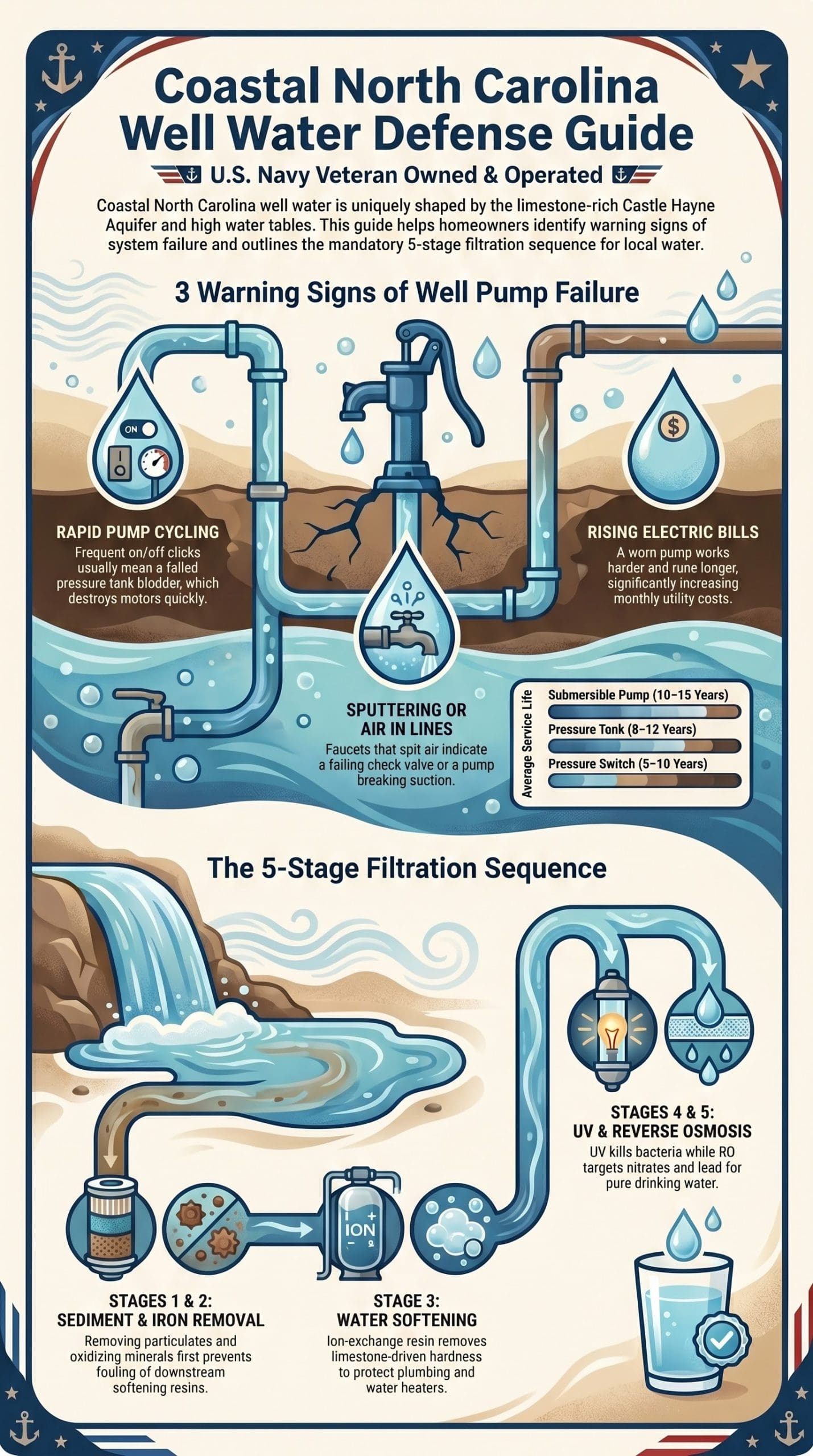
- The 8 Warning Signs of Well Pump Failure
- Common Well Water Quality Problems
- Well Water by County: What Homeowners Are Actually Dealing With
- Water Treatment Solutions: The Right Filtration Sequence
- Repair vs Replace: How to Make the Right Call
- How Wild Water Diagnoses and Fixes Well Water Problems
- Deep Dives: Topics and Towns Across Coastal NC
- Summary: What Every Coastal NC Homeowner Should Take Away
- Frequently Asked Questions
- References
Chapter 1: Why Coastal North Carolina Well Water Is Different
Well water problems exist everywhere wells exist. What makes coastal North Carolina different is the specific combination of geology, climate, and infrastructure age that produces the same handful of issues over and over again across thousands of properties. Understanding why these problems are common here is the first step toward recognizing them in your own home and choosing the right solution rather than treating symptoms.
The Castle Hayne Aquifer Is the Story
Most private wells across Onslow, Pender, New Hanover, and Carteret Counties draw from the Castle Hayne Aquifer or the surficial aquifer system above it. The Castle Hayne is a thick limestone and shell limestone formation that produces highly mineralized water. Calcium, magnesium, iron, manganese, and hydrogen sulfide are all present at concentrations that affect both the equipment delivering the water and the water itself. This is not contamination. It is the natural chemistry of water that has been in contact with limestone for thousands of years.
The High Water Table
Across much of the coastal plain, the water table sits within a few feet of the surface for significant portions of the year. After tropical systems, nor’easters, or any extended wet period, that table rises further. A high water table means well casings and surrounding soil are exposed to constant moisture, accelerating casing corrosion on older wells and creating opportunities for surface water contamination if a casing has any compromise at all.
The Age of the Equipment
Significant residential well drilling across this region occurred from the 1960s through the 1990s. Pumps, pressure tanks, switches, and casings installed during that period are now 30 to 60 years old. Submersible well pumps have a typical service life of 10 to 15 years. Pressure tanks last 8 to 12 years. Pressure switches usually need replacement every 5 to 10 years. A well system that has been operating with original equipment for 25 years has every component well past its design life.
The Salt Air Factor Inland Homes Never Face
Properties within a few miles of the coast, including most of Onslow, eastern Pender, eastern New Hanover, and all of Carteret County, experience accelerated corrosion on every exposed metal component of the well system. Pressure tank fittings, pressure switches, pump wiring connections, and well head plumbing all deteriorate faster than equivalent components inland. A pressure switch that lasts 10 years in Raleigh may need replacement in 5 to 7 years on a Carolina Beach property.
The Growth Pressure on a Shared Resource
Hampstead, Castle Hayne, Murrayville, and Porters Neck have grown dramatically over the past two decades. Every new home that drills a well draws from the same aquifer system as the established homes around it. The cumulative effect on static water levels is documented in North Carolina Division of Water Resources monitoring data. Homeowners whose pumps once delivered steady pressure may experience declining performance not because anything in their system failed but because regional drawdown reduced the available resource. This effect is most pronounced in the rapidly growing corridors and during peak summer demand.
Chapter 2: Understanding Your Well Water System
Most homeowners think of their well as the pump. A complete well system has six interconnected components, and a failure at any one of them can produce symptoms that look identical to a failure at any of the others. Diagnosing the actual cause requires checking each component in sequence.
The Well Casing and Screen
The casing is the pipe lining the borehole from ground surface down to the aquifer. The screen at the bottom of the casing allows aquifer water to enter the well while keeping out soil and gravel. Casings on older coastal wells may be galvanized steel, which corrodes from both sides over decades. Modern casings are PVC or stainless. A failing casing can allow surface water infiltration that introduces bacteria the aquifer water does not naturally carry.
The Submersible Pump and Motor
Most coastal North Carolina homes use submersible pumps installed at the bottom of the well, often 50 to 200 feet below grade. The pump pushes water up the drop pipe to the pressure tank in the home. Submersible pumps last 10 to 15 years under normal conditions and less in mineral-heavy water that accelerates impeller wear and motor stress.
The Pressure Tank
The pressure tank stores pressurized water between pump cycles. A flexible bladder separates a charge of compressed air from the water. When you open a faucet, the air pressure pushes water out of the tank into the house. When tank pressure drops below the cut-in setting, the pressure switch starts the pump. When pressure reaches the cut-out setting, the switch stops the pump. A failed bladder is the single most common cause of well system problems.
The Pressure Switch
The pressure switch is a simple electromechanical component that monitors system pressure and controls when the pump runs. Switch contacts corrode in humid coastal environments. A switch with corroded contacts may fail to start the pump at the correct pressure, may allow the pump to run past its cutoff, or may not operate at all.
The Check Valve
The check valve prevents water from draining back into the well when the pump stops. A failed check valve allows the system to depressurize immediately after the pump shuts off, forcing the pump to repressurize from zero on every start. This dramatically increases pump cycling, motor stress, and energy consumption.
The Service Line to the Home
The buried line from the well head to the home is often overlooked. A small underground leak in this line bleeds pressure before water reaches any fixture inside the house. These leaks produce no visible symptom inside the home and can persist for years before discovery.
Why This Matters for Diagnosis
A pump that runs constantly could be a worn pump, a failed pressure tank, a stuck-open check valve, a leaking service line, or even a leaking toilet inside the home. Replacing the pump when the actual problem is a $200 tank bladder solves nothing and costs thousands. Systematic diagnosis at every component is the only reliable way to identify the real cause.
Chapter 3: The 8 Warning Signs of Well Pump Failure
Well pumps rarely fail without warning. They produce a sequence of symptoms that begin subtly and escalate. Homeowners who catch these signs early face a manageable repair. Homeowners who wait until water stops completely face an emergency replacement that often happens at the worst possible moment.
Chapter 4: Common Well Water Quality Problems
Even when a well pump is performing perfectly, the water it delivers may carry the mineral and biological content of the aquifer it draws from. Coastal North Carolina well water consistently shows a handful of quality issues that affect plumbing, appliances, laundry, and in some cases drinking water safety.
Iron and Manganese
The Castle Hayne Aquifer naturally contains dissolved iron and manganese at concentrations that frequently exceed the EPA secondary drinking water standards of 0.3 mg/L for iron and 0.05 mg/L for manganese. These minerals are not health hazards at typical residential concentrations, but they produce reddish-orange staining on every porcelain and stainless surface in the home, build up as scale inside water heaters and supply lines, and discolor laundry over time. Iron in well water is the single most common reason coastal homeowners install whole-home filtration.
Calcium and Magnesium Hardness
The same limestone formation that produces iron also dissolves calcium and magnesium continuously into the water. Coastal North Carolina well water commonly tests in the hard to very hard range. Hard water deposits scale inside water heater tanks, shortens water heater service life by years, clogs fixtures and aerator screens, leaves film on glassware and shower doors, and reduces the effectiveness of soap and detergent.
Sediment and Turbidity
Sandy or cloudy water can come from a pump intake screen that has failed, a casing that has cracked and is allowing soil infiltration, or the natural turbidity of water from certain aquifer zones. Sediment damages pump components, abrades supply lines, and accumulates inside water heaters where it insulates heating elements and reduces efficiency.
Hydrogen Sulfide
The rotten-egg smell at the tap is hydrogen sulfide gas dissolved in the water. It comes from sulfur-reducing bacteria or from the natural chemistry of confined aquifers under reducing conditions. Hydrogen sulfide is not typically a health hazard at residential concentrations but corrodes copper and brass fittings, blackens silverware, and makes the water unpleasant for every household use until treated.
Bacteria and Coliform Contamination
Coliform bacteria in well water indicate that surface water or other contamination has reached the aquifer or the well casing. Sources include flooding events that overtop the wellhead, casing cracks, septic system effluent from nearby properties, and agricultural runoff. Coliform-positive water requires immediate professional disinfection and source investigation. Annual testing is recommended for all private wells.
Nitrates
Nitrates in coastal well water typically come from agricultural fertilizer use and from cumulative septic effluent loading in areas with high septic density. Nitrate above 10 mg/L is a health hazard, especially to infants. Hampstead, Castle Hayne, and other rapidly growing communities with high septic density warrant nitrate testing as part of any well water assessment.
Tannins
Tannins are organic compounds from decaying vegetation that produce a yellow to brown tint in water. Wells drilled in shallow surficial aquifers near wetland areas commonly produce tannin-stained water. Tannins are not a health hazard but require specific treatment beyond standard sediment or iron filtration.
Testing Is the Only Way to Know
Every well water assessment starts with a professional water quality test that quantifies the specific concentrations of iron, manganese, hardness, hydrogen sulfide, coliform bacteria, nitrates, and pH. Generic filtration solutions sized without test data either fail to address the actual contaminants present or are oversized for what the water actually carries. Wild Water performs water testing as the foundation of every filtration system design.
Chapter 5: Well Water by County: What Homeowners Are Actually Dealing With
The same Castle Hayne Aquifer system serves four counties but with meaningful local variation in well depth, casing materials, water quality, and the specific demand pressures that affect each community.
Onslow County Wells
Onslow County contains a wide range of well environments. Jacksonville’s older neighborhoods rely on municipal water, but the rural and suburban communities of Hubert, Sneads Ferry, Maple Hill, Stella, Verona, Richlands, Maysville, and Holly Ridge are heavily well-dependent. The county’s proximity to Marine Corps Base Camp Lejeune produced a stock of high-occupancy homes that put years of above-design-load demand on their wells. Iron and manganese are widespread. Hydrogen sulfide odors are common in the western communities. The water table is highest in low-lying areas near the New River and the White Oak River, increasing the risk of surface water contamination after flood events.
Pender County Wells
Pender County splits into two well water environments. The coastal corridor of Hampstead, Surf City, Scotts Hill, and Topsail Beach draws from the same aquifer system as New Hanover County, with comparable iron, hardness, and growth-driven demand pressure. The rural interior of Burgaw, Rocky Point, Atkinson, Currie, Willard, Watha, Penderlea, and Long Creek sits over the Black River watershed where wells are often shallower, more sensitive to surface conditions, and prone to tannin staining alongside the standard mineral profile.
New Hanover County Wells
Most of New Hanover County is served by Cape Fear Public Utility Authority municipal water, but the rural and semi-rural communities of Castle Hayne, Murrayville, Wrightsboro, and Porters Neck retain significant private well populations. These wells draw from the Castle Hayne Aquifer at its source formation, producing some of the most mineral-rich water in the region. Hardness commonly tests in the very hard range. Iron staining is universal in untreated systems. Hydrogen sulfide odors are reported across the county’s private well population.
Carteret County Wells
Carteret County’s well water environment is shaped by the maritime geography of the Down East communities and the proximity of tidal water to almost every property. Wells in Newport, Cape Carteret, and the inland portions of the county draw from similar formations to inland Pender County. Wells on the Down East peninsulas and barrier islands face the additional challenge of tidal influence on shallow aquifers, with seasonal saltwater intrusion documented in some areas. Hardness, iron, and hydrogen sulfide remain the dominant water quality concerns.
Chapter 6: Water Treatment Solutions: The Right Filtration Sequence
The right filtration system for coastal North Carolina well water is rarely a single piece of equipment. It is a sequence of treatment stages, each addressing a specific contaminant, installed in the correct order so each stage protects the next.
The Sequence Matters as Much as the Components
Iron in untreated water reaching a water softener will foul the resin bed and destroy the softener’s capacity within months. A reverse osmosis system installed upstream of a sediment filter will clog its membranes prematurely. A UV system installed before iron removal will not disinfect effectively because the iron particles physically shield bacteria from UV exposure. The sequence is not a preference. It is a technical requirement.
Stage 1: Sediment Pre-Filter
A sediment pre-filter at the point of entry removes particulates that would otherwise clog and damage downstream equipment. Sediment filters are sized by micron rating and flow rate. A typical coastal North Carolina installation uses a 5 to 20 micron filter on the main line into the home.
Stage 2: Iron and Manganese Filter
Iron filters using oxidizing media convert dissolved iron and manganese into solid particles that the filter captures. Common media include manganese greensand, BIRM, and Filox. Iron filters require periodic backwashing and media replacement every several years depending on iron concentration and water usage.
Stage 3: Water Softener
A whole-home water softener uses ion-exchange resin to remove calcium and magnesium hardness. Softeners require salt addition to a brine tank and periodic regeneration cycles. Properly sized softeners extend water heater life by years, eliminate scale buildup throughout the plumbing system, and dramatically reduce soap and detergent consumption.
Stage 4: UV Disinfection
For wells with documented coliform bacteria or wells in environments where surface water contamination is a concern, UV disinfection at the point of entry provides ongoing protection. UV systems require annual bulb replacement and assume the water reaching them is already clear, which is why they follow iron and sediment filtration in the sequence.
Stage 5: Reverse Osmosis at the Kitchen Tap
A point-of-use reverse osmosis system at the kitchen sink addresses contaminants that whole-home filtration does not target, including nitrates, lead, arsenic, and trace organic compounds. Reverse osmosis provides drinking water quality at the tap most used for cooking and consumption while keeping the broader filtration system focused on whole-home protection.
Chapter 7: Repair vs Replace: How to Make the Right Call
Every well system reaches a point where the decision is no longer about repair but about replacement. Getting this decision wrong in either direction is expensive. Replacing a pump that needed a $200 pressure tank wastes thousands. Repairing a 25-year-old system with multiple worn components produces a series of additional repairs over the following years that cost more than a timely replacement would have.
The Three Replacement Triggers
1. Pump age over 12 years with declining performance: A submersible pump approaching the end of its design life with measurable output decline is a replacement candidate, especially when the well is difficult to access or the homeowner depends on uninterrupted service.
2. Multiple failures within 18 months: A system that has experienced two or three significant repairs in quick succession is signaling that distributed wear has reached the point where further repairs are likely to chase from one component to the next.
3. Equipment that cannot be matched to current household needs: A pump and tank sized for a household of two now serving a household of five is undersized regardless of mechanical condition. Replacement with properly sized equipment is the only path to reliable service.
Repairs That Make Sense
A failed pressure tank bladder, a corroded pressure switch, a stuck check valve, or a single damaged supply line connection are component-level repairs that restore system function at a fraction of full replacement cost. These repairs make sense when the pump itself is operating well and the well casing is sound.
When Full System Replacement Is the Honest Answer
A pump that has failed in a well with a casing nearing the end of its life, a system with multiple worn components, or a household whose water demand has outgrown the original system sizing are all situations where replacement produces a better outcome than serial repair. Wild Water provides honest assessments and clear pricing on both options when both are realistic.
Chapter 8: How Wild Water Diagnoses and Fixes Well Water Problems
The most common frustration homeowners express when they call Wild Water is that they have already had someone evaluate the system and been told something that did not solve the problem. Accurate diagnosis is the foundation of every successful well water repair, and accurate diagnosis requires both systematic testing and an understanding of the specific failure patterns that coastal North Carolina well systems produce.
The Wild Water Diagnostic Sequence
Every well system evaluation begins with a series of pressure measurements at the wellhead, the pressure tank inlet, and household fixtures. Pump cycle timing assesses tank bladder function. Visual inspection of the pressure switch, check valve, and service line connections identifies any visible failure points. Water quality testing through a certified laboratory quantifies what the water actually carries. Only after this full evaluation do we recommend any specific repair or replacement. This sequence prevents the diagnostic error of replacing an expensive component based on an assumption rather than evidence.
Wild Water Services for Well Water Systems
Wild Water provides the full range of well water services across all four coastal counties:
- Complete well water system diagnostics
- Well pump repair and replacement
- Pressure tank service and replacement
- Pressure switch and check valve service
- Service line repair and replacement
- Water filtration system design and installation
- Water quality testing through certified laboratories
- Whole-home softener installation and service
- UV disinfection system installation
- Reverse osmosis system installation
- Emergency well system service throughout Onslow, Pender, New Hanover, and Carteret Counties
Well Water Problem in Your Coastal NC Home?
Wild Water Plumbing + Septic serves Onslow, Pender, New Hanover, and Carteret Counties with honest well system diagnostics, water quality testing, and complete repair, replacement, and filtration solutions. The earlier you call, the more options you have.
Deep Dives: Topics and Towns Across Coastal NC
The guide above covers the full picture. The articles below go deeper on the specific topics and towns where well water service in our region runs into the most questions. Each one is written from the same place: years of service calls, real pricing, and honest diagnostics across Onslow, Pender, and New Hanover Counties.
🔧 BY TOPIC
- Pressure Tank Replacement in Coastal NC: Signs, Cost, and What to Expect
- Iron in Well Water: Coastal NC Stains, Fixes, and Cost
- Rotten Egg Smell in Well Water: Coastal NC Causes and Cures
- Well Pump Replacement Cost in Coastal NC: What I Charge and What’s Fair
- Hard Water in Coastal NC: Do You Really Need a Softener?
📍 ONSLOW COUNTY
- Jacksonville NC Well Water: Why Older Homes Need Special Attention
- Saltwater Intrusion in Sneads Ferry Wells: The Coastal Risk Most Homeowners Miss
- Richlands NC Well Water Guide: What Inland Coastal Wells Really Need
- Swansboro Well Water and Historic Homes: What Older Systems Need to Watch
- Holly Ridge Well Water Problems During Storm Season
📍 PENDER COUNTY
- Hampstead Well Water and Growth: What Coastal Plain Wells Are Up Against
- Surf City Vacation Rentals and Well Water Stress: A Plumber’s Perspective
- Topsail Beach Wells: Salt Air, Narrow Lots, and Coastal Plumbing Reality
- Burgaw Well Water: Why Clay Soils and Pender Aquifers Cause Specific Problems
- Rocky Point Well Water and Aging Plumbing Systems
📍 NEW HANOVER COUNTY
- Wilmington NC Well Water: Why the Rural Fringe Still Drinks From Wells
- Castle Hayne Well Water: At the Source of the Aquifer That Names You
- Porters Neck Wells and the Pressure of Rapid Development
- Carolina Beach Wells: Salt, Flood Zones, and Living Below the Water Table
- Wrightsville Beach Wells: Living on the Edge of the Atlantic
Summary: What Every Coastal NC Homeowner Should Take Away
The eight points every homeowner in Onslow, Pender, New Hanover, and Carteret Counties should carry forward from this guide:
- Coastal North Carolina well water carries a predictable mineral and biological profile driven by the Castle Hayne Aquifer geology and the region’s high water table. The problems are common because the geology is shared.
- Well systems are six interconnected components, not just a pump. Diagnosing the actual problem requires checking each component in sequence rather than assuming the pump is at fault.
- The eight warning signs of pump failure appear in a predictable sequence. Recognizing them early converts emergency replacements into scheduled repairs.
- Iron, hardness, and hydrogen sulfide are the three most common water quality problems across the region. Each requires a specific treatment approach and the correct sequencing of equipment.
- Every county has local variation in well depth, water chemistry, and demand pressures. The right diagnosis accounts for what is specifically happening in your area.
- Water testing through a certified laboratory is the starting point for any filtration system design. Generic solutions sized without test data fail to address the actual contaminants present.
- The decision between repair and replacement requires honest full-system assessment. Replacing the wrong component or repairing a system at the end of its life both waste the homeowner’s money.
- The right time to call is when the first warning sign appears, not when the water stops. Every symptom in this guide precedes the failure event. Acting on early signs avoids the disruption, emergency cost, and property damage that complete failure produces.
Frequently Asked Questions
What are the most common well water problems in coastal North Carolina?
The most common well water problems in coastal North Carolina include iron and manganese staining, hard water scale buildup, sediment in the water, hydrogen sulfide odors that smell like rotten eggs, low water pressure, and well pump failures. These problems are driven by the mineral content of the Castle Hayne Aquifer, the region’s high water table, and aging well equipment.
How do I know if my well pump is failing?
Common warning signs of a failing well pump include gradually dropping water pressure, sputtering or air in the lines, the pump running constantly, rapid pump cycling, sand or sediment in the water, strange noises from the pump, rising electric bills, and ultimately no water at all. Early signs are much cheaper to address than full pump failure.
Why does my well water have brown or rust-colored stains?
Brown or rust-colored stains in well water are caused by dissolved iron and sometimes manganese from the Castle Hayne Aquifer. These minerals are not health hazards at typical levels, but they stain porcelain, laundry, and fixtures and build up as scale inside water heaters and pipes. An iron filter installed at the point of entry removes the iron before it reaches your fixtures.
How often should I test my well water?
Private well water should be tested at least once a year for coliform bacteria, nitrates, and pH. A full mineral profile including iron, manganese, and hardness should be performed at least every three years, after any major flooding event, and any time the water taste, color, or smell changes noticeably.
How long does a well pump last in coastal North Carolina?
A submersible well pump in coastal North Carolina typically lasts 10 to 15 years. Coastal conditions, including mineral-heavy water and salt air corrosion on exposed components, can shorten that lifespan. Pumps installed before 2010 in homes with no maintenance history should be evaluated even if they currently appear to function.
What is a pressure tank and why does it matter?
A pressure tank stores pressurized water between pump cycles using a flexible bladder that separates compressed air from the water. When the bladder fails, the pump short-cycles rapidly, which destroys pump motors and produces wildly fluctuating household water pressure. Pressure tank failure is one of the most common well system problems and is usually less expensive to fix than a pump replacement.
Do I need a water softener if I have well water in Coastal NC?
Most coastal North Carolina well water tests in the hard to very hard range due to dissolved calcium and magnesium from the limestone-based Castle Hayne Aquifer. A whole-home water softener extends water heater life by years, eliminates scale buildup in plumbing, and improves the performance of every water-using appliance. Whether you need one depends on your specific water hardness, which should be tested before any equipment is selected.
What causes rotten egg smell in well water?
A rotten egg smell in well water is caused by hydrogen sulfide gas, either from sulfur-reducing bacteria or from the natural reducing conditions of confined aquifers. The smell is not typically a health hazard at residential levels but corrodes copper and brass fittings and makes the water unpleasant for every household use. Treatment usually involves an aeration system followed by carbon filtration or oxidation with manganese greensand.
Why does my well pump cycle on and off so quickly?
Rapid well pump cycling, also called short cycling, is almost always caused by a failed pressure tank bladder. When the air charge in the tank is lost, the pump must restart for every small water demand instead of pulling stored water from the tank. Short cycling generates heat and wear in the pump motor and can destroy a pump in weeks if not corrected.
Can I get sick from well water in Coastal NC?
Most coastal North Carolina well water is safe to drink, but private wells are not regulated like municipal water and require ongoing testing. Coliform bacteria contamination, elevated nitrates from agricultural or septic sources, and in rare cases naturally occurring arsenic can all create health risks. Annual testing is the only way to confirm your well water is safe. Wild Water provides water testing as part of every well water system evaluation.
References
U.S. Geological Survey. (2021). Hydrogeology of the Castle Hayne Aquifer System, Coastal Plain of North Carolina. USGS Water-Resources Investigations Report. https://www.usgs.gov/centers/sa-water
North Carolina Division of Water Resources. (2022). Private well program: Coastal plain aquifer conditions and contaminant monitoring. NCDEQ. https://www.deq.nc.gov/about/divisions/water-resources/water-resources-data/well-program
U.S. Environmental Protection Agency. (2022). Private drinking water wells: Maintenance and water quality testing guidance. EPA Office of Water. https://www.epa.gov/privatewells
National Ground Water Association. (2021). Wellowner.org: Understanding your well water system and pump components. NGWA. https://wellowner.org
Water Quality Association. (2020). Iron, manganese, and hardness treatment for residential well water systems. WQA Technical Fact Sheet Series. https://www.wqa.org
Penn State Extension. (2020). Diagnosing water pressure and pump problems in private well systems. Penn State College of Agricultural Sciences. https://extension.psu.edu/private-water-systems
North Carolina Cooperative Extension. (2021). Well water quality testing and contaminant management for Coastal Plain properties. NC State Extension Publications. https://content.ces.ncsu.edu
Water Research Foundation. (2019). Hydrogen sulfide treatment in residential well water systems. WRF Technical Study. https://www.waterrf.org
Federal Emergency Management Agency. (2021). Private well disinfection after flooding events. FEMA Technical Bulletin. https://www.fema.gov