

By Justin Wilder, Owner of Wild Water Plumbing + Septic
Table of Contents
- BLUF (Bottom Line Up Front)
- Top 5 FAQs
- Introduction
- What Are the Main Types of Water Heaters?
- Conventional Storage Tank Water Heaters
- Tankless (On-Demand) Water Heaters
- Heat Pump (Hybrid) Water Heaters
- Solar Water Heater Systems
- Condensing Water Heaters
- Factors to Consider When Choosing
- Fuel Type and Energy Efficiency
- Sizing, Capacity, and Installation Space
- Installation and Maintenance
- Cost Considerations and Financing
- Additional FAQs
- Lifespan and Family Sizing
- Conclusion
BLUF
Choosing the right water heater in coastal Southeastern North Carolina is not just about efficiency or price. Homes across Pender, Carteret, Onslow, and New Hanover Counties face unique challenges, including hard well water, high mineral content, sandy and clay soils, elevated humidity, and salt air exposure, which can shorten equipment life if the system is not sized and installed correctly.
This guide explains how conventional tank, tankless, heat pump, solar thermal, and condensing water heaters perform in coastal and inland Eastern NC homes, so you can avoid premature failure, reduce energy costs, and protect your plumbing system long term. Built from real field experience by Wild Water Plumbing + Septic, it focuses on proper sizing, fuel selection, installation planning, and maintenance strategies that actually work in Pender, Carteret, Onslow, and New Hanover County homes.
Top 5 FAQs
1. What type of water heater is best for most homes?
For many households, a conventional storage-tank water heater is the simplest and lowest-upfront option. Homes focused on efficiency or long term savings often benefit from tankless, heat pump, or condensing systems when properly sized and installed.
2. How do I choose the right size water heater for my household?
Sizing depends on peak hot water demand. Storage tanks are sized in gallons and first-hour rating, while tankless systems are sized by gallons per minute and temperature rise. Families with multiple simultaneous uses usually need larger tanks or higher GPM capacity.
3. Are tankless water heaters more energy efficient than tank water heaters?
Tankless water heaters can be more efficient because they eliminate standby heat loss, but only when properly sized for demand. Homes with high simultaneous usage may require multiple units or upgrades, which affects cost and efficiency.
4. When does a heat pump water heater make the most sense?
Heat pump water heaters work best in homes with a garage or mechanical room space and moderate ambient temperatures. They offer very low operating costs but require airflow, clearance, and slightly longer recovery times compared to gas systems.
5. What factors most affect the total cost of owning a water heater?
Total cost of ownership includes purchase price, installation complexity, energy use, maintenance, lifespan, and available rebates. A cheaper upfront unit may cost more over 10 to 15 years than a higher efficiency system with lower operating expenses.
Introduction
Picking the right water heater in Eastern North Carolina is about more than just having hot water. In Pender, Carteret, Onslow, and New Hanover Counties, factors like hard well water, coastal humidity, salt air, and fluctuating household demand can drive up energy costs and shorten the life of the wrong system. A properly selected water heater can lower monthly utility bills, deliver consistent hot water, and protect your plumbing from premature wear.
This guide explains the main residential water heating options and how they perform in real-world coastal and inland conditions. We break down when a conventional storage tank, tankless on demand, heat pump hybrid, solar thermal, or condensing water heater actually makes sense for local homes. You will learn practical sizing rules, realistic efficiency trade-offs, installation and maintenance considerations, and up-to-date cost and rebate expectations as of mid-2025.
Rather than generic advice, this guide walks through the full decision process step by step. We cover how fuel types, recovery rates, flow requirements, and long-term total cost of ownership affect performance in Southeastern North Carolina homes. Each section includes clear technical explanations, real use cases, and actionable guidance so homeowners can confidently match their household needs to the right water heater without guesswork.
What Are the Main Types of Water Heaters for Homes?
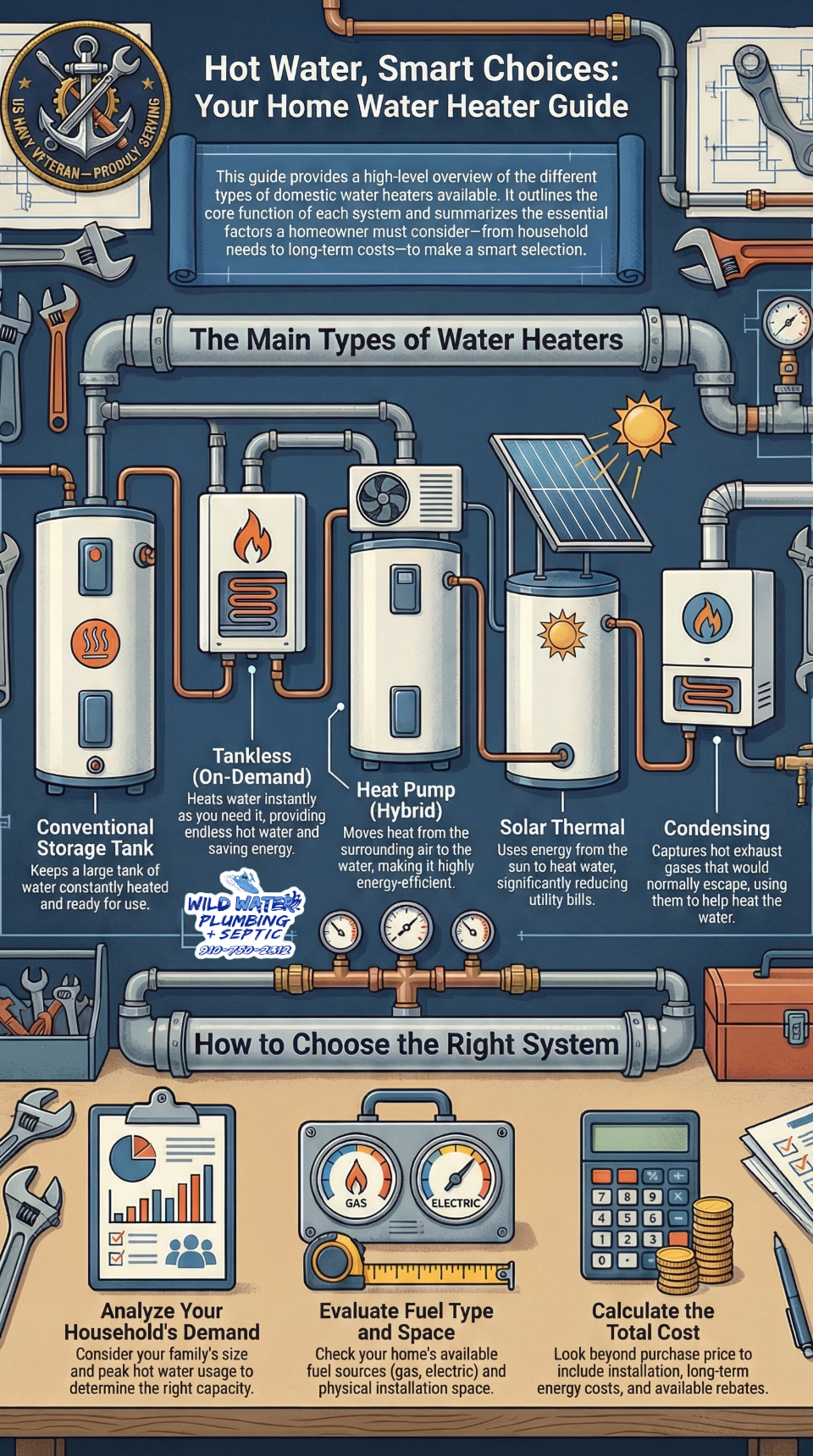
A residential water heater supplies hot water by converting energy into heat, but not all systems behave the same in Eastern North Carolina homes. In Pender, Carteret, Onslow, and New Hanover Counties, factors like mineral-heavy well water, coastal humidity, salt air exposure, and varying household demand play a significant role in how different water heater types perform over time.
The main residential water heater categories include conventional storage-tank, tankless on-demand, heat-pump hybrid, solar thermal, and condensing systems. Each type stores and heats water differently, relies on specific fuel sources, and carries its own efficiency range, lifespan expectations, and installation requirements. These differences directly affect upfront cost, monthly operating expenses, maintenance needs, and long-term reliability in both inland and coastal homes.
The comparison below highlights how each water heater option stacks up in terms of efficiency, lifespan, and best use cases for apartments, single-family homes, and larger households in Southeastern North Carolina. Reviewing these differences first makes it easier to understand the trade-offs before diving into the detailed pros and cons of each system.
| Type | Primary Mechanism | Typical Fuel(s) | Efficiency Range (EF / COP) | Typical Lifespan | Best For |
|---|---|---|---|---|---|
| Conventional storage tank | Stores heated water in an insulated tank | Electric, natural gas, propane | 0.6–0.9 EF | 8–12 years | Lower upfront cost, simple replacement |
| Tankless (on-demand) | Heats water as it flows through the heat exchanger | Gas, electric | 0.8–0.99 EF (varies) | 20–30 years | Continuous hot water, limited space |
| Heat pump (hybrid) | Moves heat from air to water via a compressor | Electricity | COP 2.0–3.0 (200–300% efficiency) | 10–15 years | Energy-conscious homes with space/ambient air |
| Solar thermal | The sun heats the fluid in the collectors, which is transferred to the tank | Solar thermal (supplemented by gas/electric) | Varies by sun exposure; high solar fraction | 15–25 years | Sunny climates, long-term ROI seekers |
| Condensing | Recovers latent heat from exhaust via a second exchanger | Natural gas, propane | 0.9–0.98 EF | 12–20 years | High-efficiency gas homes with venting capacity |
This quick comparison highlights the key trade-offs. Below, we start with the most common household option — conventional storage tanks — and walk through features, pros and cons, and when to choose each technology.
How Do Conventional Storage Tank Water Heaters Work and What Are Their Benefits?
Conventional storage-tank water heaters maintain a set volume of hot water by heating and insulating it in a steel tank. In Pender, Carteret, Onslow, and New Hanover Counties, these systems are standard because they work well with both municipal water and private wells, and they are often the simplest replacement option in older homes. Key components include the storage tank, gas burner or electric heating elements, thermostat, and pressure relief valve that protects the system from overpressure.
Heat is produced through gas combustion or electric resistance, and the unit’s recovery rate determines how quickly it can reheat water after heavy use. For larger households or homes with back-to-back showers, both tank size and recovery capacity are critical. Storage tanks remain popular locally because they have a lower upfront cost and are usually a straightforward replacement in closets, garages, or utility rooms without significant venting or electrical changes.
Regular maintenance is essential in coastal North Carolina. Mineral-heavy well water and sediment can collect at the bottom of the tank, reducing efficiency and accelerating corrosion. Flushing the tank and inspecting the sacrificial anode rod helps protect the steel tank lining and can extend the unit’s lifespan by several years. For homeowners looking to reduce maintenance or avoid storing water entirely, these realities often lead them to consider tankless on-demand systems, which approach sizing and installation very differently.
The pros and cons below make it easier to judge when a storage tank still makes sense.
- Pros: Stored volume gives reliable, immediate hot water. Lower initial purchase and replacement cost. Simpler venting and fewer electrical upgrades in many cases.
- Cons: Standby heat loss raises operating costs. Requires more floor space and carries tank‑failure risk. Typically has a shorter lifespan than tankless or solar systems.
With those points in mind, let’s compare storage tanks to tankless technology so you can weigh the pros and cons of storage versus on‑demand strategies.
What Are the Key Features and Benefits of Tankless Water Heaters?

Tankless (on‑demand) water heaters heat water only when you need it, using a high‑efficiency heat exchanger. That eliminates standby losses and can raise efficiency for homes without large simultaneous hot‑water draws. Sizing focuses on required flow rate in gallons per minute (GPM) and the temperature rise needed — for example, a 2–2.5 GPM shower plus a 1.0–1.5 GPM dishwasher affects the unit size. Because multiple fixtures running at once can push peak demand, some homes need multiple tankless units or a larger commercial‑grade model. Tankless units often last longer and use less energy over their lifetime in the right application, but higher upfront cost and potential upgrades (gas line, venting, or electrical) can add installation complexity. That’s why a careful load analysis is recommended before switching from a conventional tank.
If installation constraints make tankless difficult, hybrid heat pump options (covered next) can still deliver substantial efficiency gains where ambient air is available.
How Does a Heat Pump Water Heater Improve Energy Efficiency?
Heat pump water heaters (HPWHs) move heat from the surrounding air into water using a refrigeration cycle. They can produce two to three times as much heat per unit of electricity as electric resistance heating — a coefficient of performance (COP) that typically translates into sizable electricity savings. An HPWH relies on an evaporator, compressor, and condenser or an integrated tank heat exchanger, so it performs best when placed where it can draw steady warm air an unheated garage or a mechanical room, for example. HPWHs can also dehumidify the installation space, but they require airflow clearance and may produce more noise than passive tanks. Because performance depends on ambient temperature, very cold or cramped installations can reduce savings unless ventilation or space changes are made. Understanding how ambient conditions affect COP helps you choose the proper placement and model.
- Efficiency Profile: Typical COPs run 2.0–3.0 in moderate ambient conditions, lowering electricity bills compared with resistance tanks.
- Placement Needs: Around 1,000–1,500 cubic feet of surrounding air and good airflow usually produce the best results, making garages and basements common sites.
- Operational Trade-offs: HPWHs are efficient but can cool and dehumidify the room and may be noisier than a simple storage tank.
What Is the Role of Ambient Air in Heat Pump Water Heater Operation?
The ambient air is the heat source an HPWH taps into, so temperature and humidity strongly affect performance: warmer, drier air improves COP and recovery, while cold or very humid environments lower efficiency and increase compressor run time. Installers typically recommend spaces that stay above roughly 40°F seasonally and that allow intake and discharge air without recirculating cold exhaust back to the unit. Keep in mind the HPWH’s effect on the space it can provide useful dehumidification in summer but might increase winter heating needs if it cools a conditioned area. Noise and airflow routing are practical concerns; a short commissioning check to verify airflow and operating COP at the installation site is a smart step to confirm expected savings.
Which Homes Are Best Suited for Heat Pump Water Heaters?
Homes that see the most significant benefit from heat pump water heaters in Pender, Carteret, Onslow, and New Hanover Counties typically have a garage or dedicated mechanical space where temperatures stay moderate most of the year. Eastern North Carolina’s mild winters and long warm seasons create favorable conditions for HPWH performance, especially in garages that are protected from extreme cold but still allow proper airflow. Homes on electric service plans that reward efficient appliances often see the fastest return on investment.
Energy-conscious households with moderate-to-high hot water use tend to benefit most when upgrading from older electric-resistance tanks. These systems significantly reduce electricity consumption while still meeting daily demand, making them attractive for families looking to lower utility bills and reduce environmental impact as the regional power grid continues to modernize.
HPWHs may be less ideal for homes with very limited space, poor airflow, or unusually high peak demand that exceeds a single unit’s recovery rate. In those cases, hybrid configurations, supplemental heating, or alternative technologies may provide better performance. A common good fit locally is a mid sized family home with garage space and steady electric usage patterns that support heat pump efficiency. When HPWHs are impractical, solar water heating systems are often the next-best renewable option to consider in coastal and southeastern North Carolina.
What Should You Know About Solar Water Heater Systems?

Solar water heater systems use rooftop collectors to capture heat from the sun and transfer it to a storage tank through a circulating fluid. In Pender, Carteret, Onslow, and New Hanover Counties, intense sun exposure, long summers, and mild winters make solar thermal one of the most effective on-site renewable options for water heating when roof orientation and shading are favorable.
Unlike photovoltaic panels, which generate electricity first, solar thermal systems collect heat directly, often resulting in higher overall efficiency for producing hot water during sunny periods. Most systems installed in coastal North Carolina include a backup water heater to maintain hot water during cloudy stretches or periods of high demand, along with freeze protection for occasional cold snaps.
Installation costs are driven by several factors, including collector type such as flat plate or evacuated tube systems, pump and controller quality, how the solar system integrates with existing tanks or boilers, and roof access or structural reinforcement needs. Ongoing maintenance is also essential in this region. Regular checks of collectors, glycol loops in indirect systems, pumps, and controls help protect performance from corrosion, debris, and wear caused by humidity and salt air. Understanding how solar collectors work alongside storage tanks and backup heating allows homeowners to accurately compare solar thermal systems with photovoltaic plus electric water heating options and choose the approach that best fits local conditions and long-term goals.
How Do Solar Panels Integrate with Water Heating?
Solar integration for water heating typically follows two paths: solar thermal collectors that heat a transfer fluid for a dedicated storage tank, or photovoltaic (PV) modules that generate electricity to run an electric heater or heat pump. Thermal systems (direct or indirect) circulate glycol or potable water through collectors to charge a storage tank and rely on a backup heating element or boiler during low‑sun periods; indirect systems use a heat exchanger to isolate the collector fluid and protect potable plumbing from freezing or corrosion. PV solutions can be grid‑tied or paired with batteries and provide electricity to run a water heater when solar power is available — simpler mechanically, but often requiring larger PV arrays to match thermal collector output for water heating. Controllers and smart thermostats manage when solar energy is prioritized versus when backups run, affecting solar fraction and payback. Weighing these options reveals trade‑offs in complexity, maintenance, and renewable fraction so you can pick the right approach for your climate and budget.
What Are the Installation Costs and Climate Considerations for Solar Water Heaters?
Solar water heater installation costs depend on collector type, roof mounting complexity, pump and controller quality, how the system integrates with existing tanks or boilers, and any required roof reinforcement or plumbing changes. Upfront costs are usually higher than conventional tanks, but fuel savings over time can be substantial in sunny regions. ROI ties closely to solar insolation, roof orientation, local energy prices, and available incentives. Homes in high‑sun areas with expensive fuel sources typically see the fastest payback. Climate matters: cold regions often use indirect glycol systems for freeze protection, while tilt and shading affect collector performance and annual solar fraction. Local rebates and incentives usually tip the feasibility, so factor in lifecycle maintenance for pumps and controllers when estimating total costs. Taking these costs and climate factors into account will help you choose between solar thermal, PV‑plus‑electric, or hybrid solutions.
What Is a Condensing Water Heater and How Does It Work?
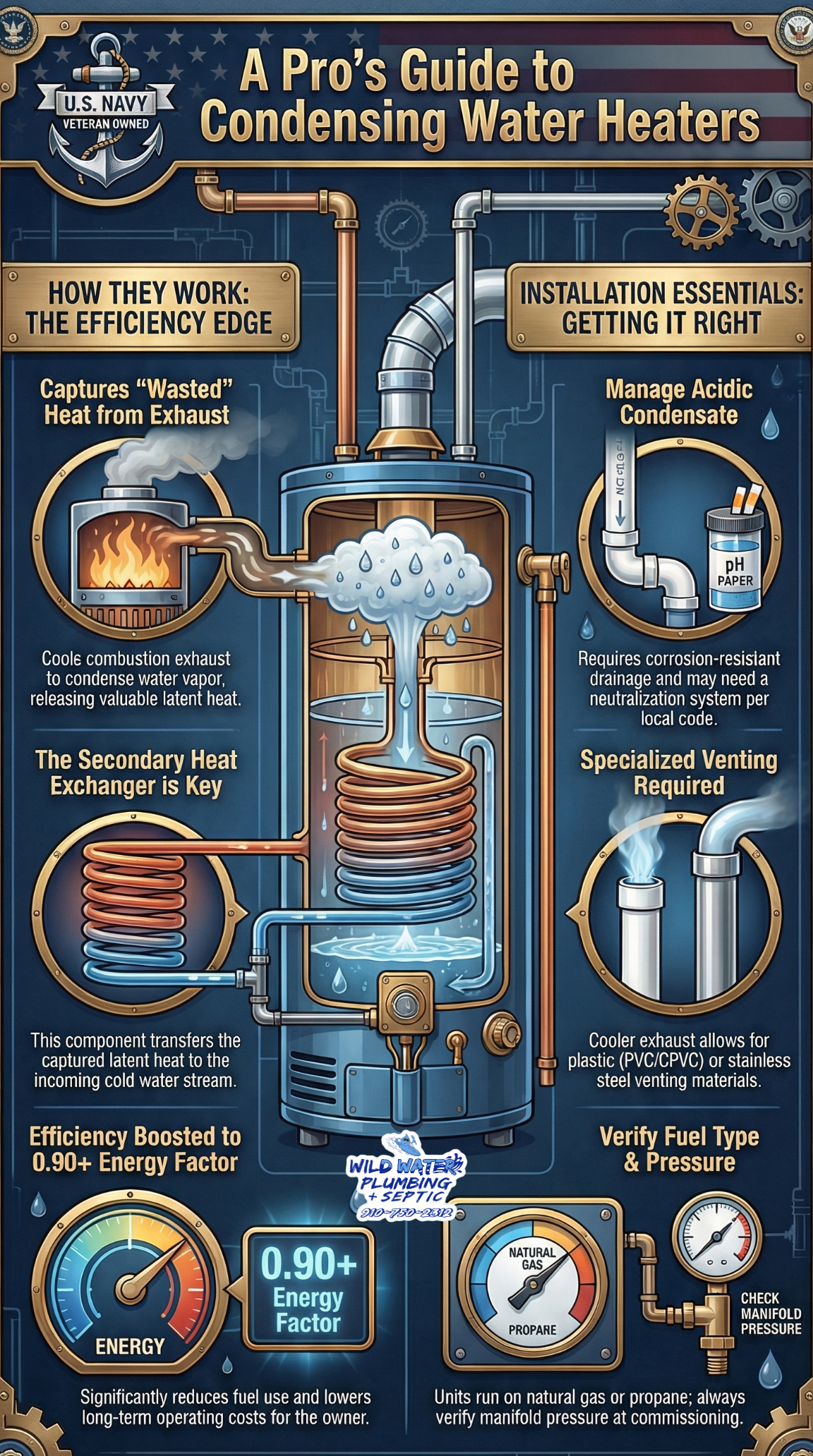
Condensing water heaters capture extra heat by cooling combustion exhaust enough to condense water vapor, thereby reclaiming latent heat with a secondary heat exchanger. That recovered energy raises efficiency well above that of non‑condensing gas units, often pushing the energy factor to near or above 0.90, depending on load. Because condensate is acidic, condensing systems need corrosion‑resistant materials, condensate drainage, and sometimes neutralization all factors that affect installation cost. Venting is different from conventional flues, too: cooler exhaust allows plastic or stainless venting rated for lower temperatures, but local code and permitting determine acceptable venting strategies. For gas‑fueled homes wanting top‑tier efficiency and lower operating costs, condensing units are a strong option; the sections below explain how the second heat exchanger works and what installers must plan for.
How Does the Second Heat Exchanger Improve Efficiency in Condensing Water Heaters?
The second heat exchanger cools the combustion exhaust below its dew point, so water vapor condenses and releases latent heat, which is then transferred to the potable water stream. Recovering this latent energy increases the unit’s thermal output without burning extra fuel, raising the overall energy factor and reducing fuel use per gallon of hot water. Efficiency gains can be several percentage points or even double‑digit improvements over older, non‑condensing models, especially at steady, moderate draw rates, though actual gains depend on load profile and return water temperature. Because condensate is acidic, you’ll want to use compatible materials and to perform periodic checks of condensate traps or neutralizers as part of maintenance planning.
What Are the Fuel Types and Installation Requirements for Condensing Water Heaters?
Condensing water heaters are commonly fueled by natural gas or propane since combustion produces the water vapor that the second exchanger recovers. Installations require corrosion‑resistant condensate drainage, appropriate vent materials for lower‑temperature exhaust, and adherence to local codes that may require specific clearances or condensate-neutralization systems — all of which can increase upfront costs compared with basic gas tanks. Installers should verify manifold pressure and may need conversion kits for different gas types; commissioning must check combustion and venting to meet manufacturer efficiency claims. Because permits and inspections often focus on safe venting and condensate handling, working with experienced installers helps avoid rework and ensures the system performs as promised.
Which Factors Should Homeowners Consider When Choosing a Water Heater?
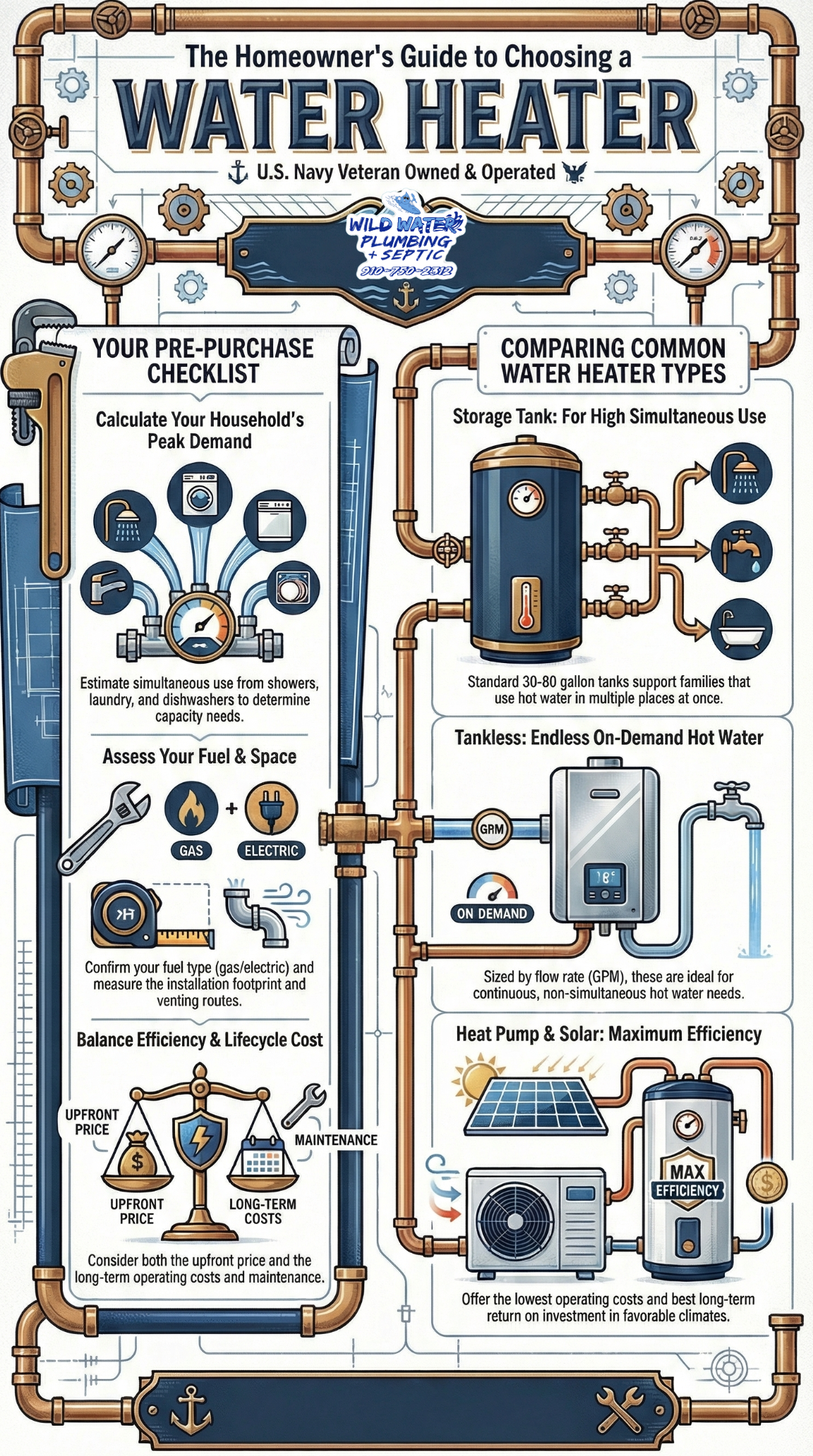
Choosing a water heater comes down to a checklist: fuel availability, energy efficiency, household size and peak demand, installation space and venting, expected maintenance, and total lifecycle cost. Fuel choice affects operating costs and carbon footprint; efficiency ratings and recovery rates determine whether a unit can meet simultaneous demand. Sizing means estimating peak‑hour demand in GPM for tankless or gallons for storage tanks. Physical constraints, closet dimensions, venting routes, and electrical panel capacity often narrow feasible options. The EAV‑style table below summarizes attributes across the main types to guide decision‑making with practical ranges and impacts.
| Type | Attribute (Sizing/Cost/Efficiency/Space) | Typical Value/Range | Impact on Decision |
|---|---|---|---|
| Storage tank | Capacity | 30–80 gallons | Larger tanks support households with high simultaneous demand |
| Tankless | Flow rate requirement | 5–12 GPM peak | Multiple outlets may require multi-unit or larger commercial models |
| Heat pump | Efficiency | COP 2.0–3.0 | Lower operating cost when ambient conditions are favorable |
| Solar thermal | Upfront cost | Higher than conventional | Best long-term ROI in high-sun regions with incentives |
| Condensing | Venting/condensate | Requires neutralizer/drain | Adds installation complexity and cost, but raises efficiency |
- Fuel availability: Confirm whether natural gas, propane, or sufficient electric capacity is available — fuel affects operating cost and what technologies you can choose.
- Household demand profile: Estimate peak simultaneous use (showers + dishwasher + laundry) and decide whether you need stored gallons or tankless GPM capacity.
- Space and venting constraints: Measure the installation footprint and confirm venting or electrical capacity before selecting a high‑efficiency model.
After weighing these factors, many homeowners ask a pro for precise sizing and to balance installation constraints with efficiency goals. Wild Water Plumbing offers site assessments and recommendations tailored to fuel type and capacity needs if you want a professional load calculation or a site visit, we can help translate your household measurements into the most cost‑effective equipment selection.
How Do Fuel Type and Energy Efficiency Impact Water Heater Performance?
Fuel choice affects heating speed and cost. Natural gas and propane supply high BTUs for fast recovery, electric resistance is predictable but often more expensive to run, heat pumps move heat efficiently using electricity, and solar systems cut fuel use with renewable thermal input. Efficiency metrics such as the Energy Factor (EF) for tanks and the COP for heat pumps quantify usable hot water per unit of energy and help estimate operating costs and environmental impact. Faster recovery (BTU/hr) or higher flow capacity (GPM for tankless) affects how quickly hot water returns after heavy use and whether you need supplemental heating. Environmental impact comes down to fuel emissions and the potential to decarbonize with electric heat pumps or solar, where the grid is cleaner. Understanding these links among fuel, efficiency, and performance helps you choose a system that aligns with both budget and sustainability goals.
These efficiency and fuel trade‑offs naturally lead to sizing and space considerations, which determine what’s practical for your home.
Why Are Sizing, Capacity, and Installation Space Critical in Water Heater Selection?
Correct sizing is critical to reliable hot water, especially in Pender, Carteret, Onslow, and New Hanover Counties, where seasonal demand, incoming water temperatures, and household routines can vary. Proper sizing matches peak hour hot water use with a system’s recovery rate or flow capacity, so you do not run out of hot water during busy mornings or back-to-back use.
For storage-tank water heaters, the first-hour rating, based on everyday routines like showers, laundry, and dishwashing, helps determine the right gallon capacity. Tank specifications list both total capacity and first-hour rating, which together show how much hot water the unit can realistically deliver during peak demand. For tankless systems, sizing focuses on gallons per minute and the required temperature rise, based on the local incoming cold water temperature. Tankless specifications show available GPM at different temperature rises, making accurate inlet temperature a key factor in coastal and inland North Carolina homes.
Installation space also plays a major role. Closet dimensions, garage layouts, and venting paths determine whether a system physically fits and whether condensate drains or venting can be routed correctly, especially for condensing or other high-efficiency gas models. When space or electrical or gas capacity is limited, compact designs or hybrid systems may be the better choice. A professional load calculation helps avoid under-sizing or over-sizing, keeps installation straightforward, and extends the long-term performance and reliability of the water heater.
Installation and Maintenance
How Can Professional Installation and Maintenance Enhance Water Heater Longevity?
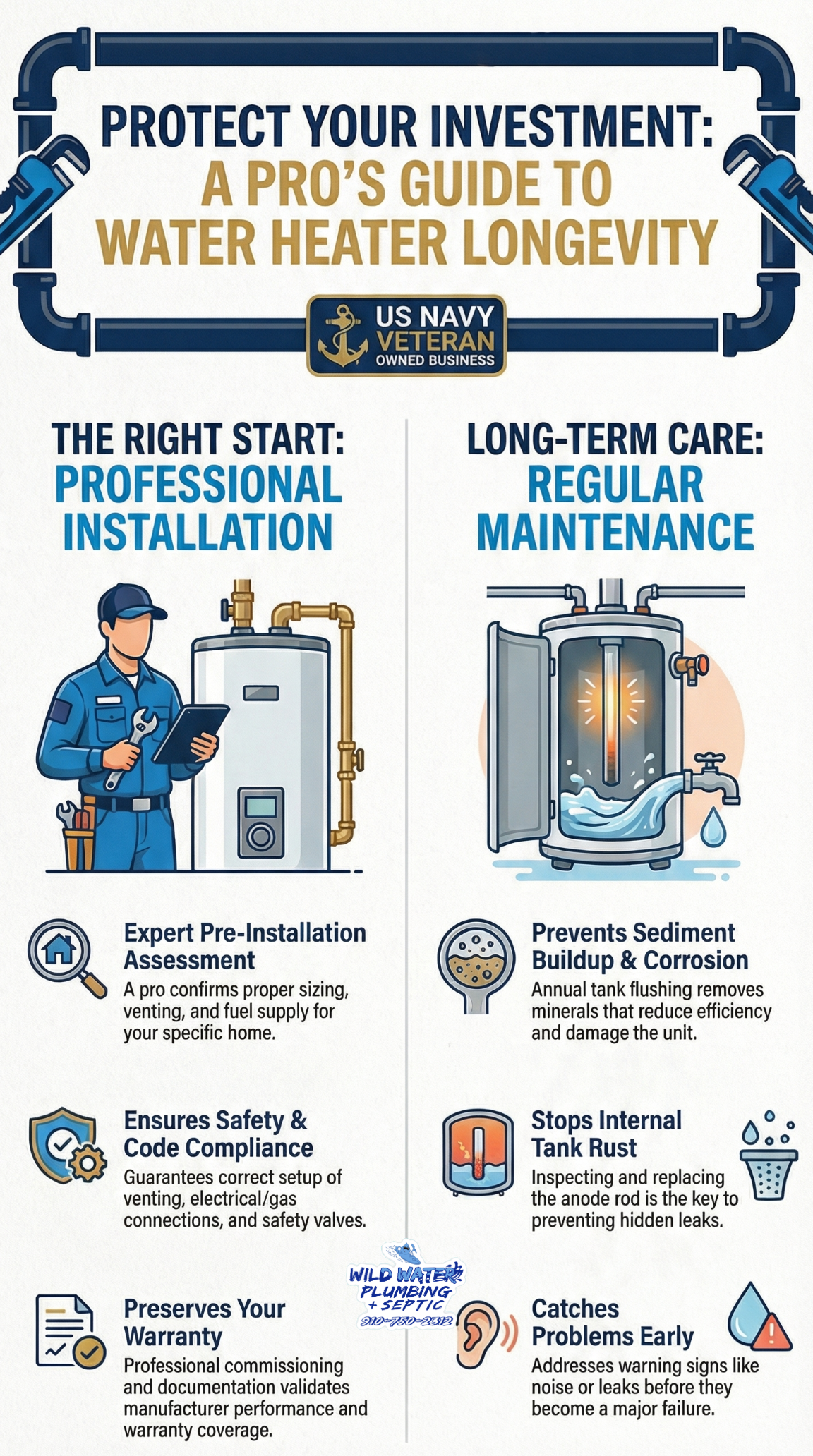
Professional installation and scheduled maintenance extend a water heater’s life, protect warranties, and ensure safety through proper venting, gas or electrical connections, and the proper setup of a pressure-relief valve. Installers perform pre‑installation assessments that include drain and vent routing, electrical load checks, gas manifold sizing, and water line isolation steps that prevent common failures and optimize performance from day one. Routine maintenance, including annual flushing, anode‑rod inspection and replacement, pressure‑relief valve testing, and condensate checks for condensing units, reduces sediment buildup and corrosion, which shortens the useful life. Using a qualified pro also helps ensure compliance with local codes and permits, reducing homeowner liability. Below are the core installation and maintenance practices to expect from a reputable service provider.
- Pre-installation assessment: Confirm sizing, venting paths, electrical or gas capacity, and necessary permits before ordering equipment.
- Commissioning checks: Verify combustion, venting, temperature setpoints, and safety devices after installation to validate manufacturer performance.
- Scheduled maintenance: Annual or biennial tasks, such as flushing, anode checks, and condensate inspection, that preserve efficiency and longevity.
Wild Water Plumbing follows these practical steps and offers scheduled maintenance plans focused on safety, warranty preservation, and dependable performance. Professional installation and ongoing service protect your investment in high‑efficiency systems and reduce the chances of premature replacement.
What Are the Best Practices for Water Heater Installation and Replacement?
Best practices for water heater installation in Pender, Carteret, Onslow, and New Hanover Counties always begin with a site visit. Local homes vary widely in age, construction style, fuel availability, and water quality, so confirming proper capacity, fuel supply, venting path, electrical load, and local code compliance upfront prevents delays and costly changes later. Planning is essential in coastal North Carolina, where garage installations, crawl spaces, humidity, and salt air can affect equipment selection and longevity.
Installers should size the water heater to match actual peak demand, whether that means selecting the correct tank volume and first-hour rating or matching tankless flow capacity to simultaneous fixtures. Gas installations require verification of manifold pressure and pipe sizing, while electric systems must be checked against panel capacity. Venting and condensate drainage must be routed precisely as the manufacturer specifies, particularly for condensing or high-efficiency systems that are common in this region.
During replacement, technicians should safely remove the existing unit and inspect the surrounding area for hidden leaks, corrosion, or water damage that could compromise the new installation. Best practice includes installing a new pressure relief valve, dielectric unions, and an expansion tank when required to protect the plumbing system and maintain code compliance. Once installed, commissioning should include running the system under load, verifying thermostat settings, confirming safety controls, and documenting configuration details to preserve warranty coverage.
Clear communication throughout the process matters just as much as technical work. Homeowners should understand timelines, expected shutdown windows, and post-installation care, such as maintenance schedules and warning signs. When installation is done the first time correctly, it reduces callbacks, improves efficiency, and helps the water heater perform reliably for years in Southeastern North Carolina homes.
How Does Regular Maintenance Prevent Common Water Heater Problems?
Regular maintenance addresses sediment buildup, sacrificial‑anode depletion, valve and thermostat drift, and blocked condensate systems, which reduce performance and lead to failures. Flushing the tank removes mineral buildup that harms heat transfer and promotes corrosion; inspecting and replacing the anode rod prevents internal rust and leaks. For condensing and solar systems, maintenance includes checking condensate drains, neutralizers, pump operation, and collector condition to avoid freeze or corrosion issues. Early warning signs, such as reduced hot water, loud noises, discolored water, or visible leaks, should prompt a service call before a minor issue becomes a failure. A routine maintenance plan reduces the total cost of ownership and keeps systems running efficiently over time.
Cost Considerations and Financing
What Are the Cost Considerations and Financing Options for Water Heater Upgrades?
When planning an upgrade, compare upfront installation cost, ongoing operating expenses, expected maintenance, and likely replacement timelines to estimate the total cost of ownership and payback. Different technologies show different financial profiles: conventional tanks are cheaper up front but cost more to run; tankless and condensing systems cost more to install but typically have lower operating costs; heat pump and solar systems can deliver significant energy savings over time but usually require a larger initial investment. The table below shows typical upfront and operating cost ranges by type, maintenance frequency, and notes on financing or rebate opportunities to help inform ROI calculations.
| Type | Upfront Cost Range | Annual Operating Cost Estimate | Typical Maintenance Frequency | Financing/Rebate Notes |
|---|---|---|---|---|
| Storage tank | Low–Moderate | Moderate–High | Annual flushing | Often limited incentives |
| Tankless | Moderate–High | Lower annual cost | Annual or biennial | Some rebates for high-efficiency models |
| Heat pump | Moderate–High | Low | Annual checks; filter changes | Eligible for electrification rebates in many areas |
| Solar thermal | High upfront | Low (variable) | Annual pump/collector checks | Incentives often available; strong local programs |
| Condensing | Moderate–High | Low–Moderate | Annual condensate checks | Gas-efficiency incentives possible |
How Do Installation, Running, and Maintenance Costs Vary by Water Heater Type?
Installation costs reflect equipment price, labor complexity, and any system upgrades, like‑for‑like tank replacements usually cost less than converting to tankless or condensing systems that require venting, gas, or electrical changes. Running costs depend on local energy prices and efficiency; heat pump water heaters and solar systems often minimize annual utility bills, while electric resistance and older gas tanks can be costlier over 10 years. Maintenance costs vary with system complexity: conventional tanks require flushing and occasional anode replacement, tankless units may require descaling in hard‑water areas, and condensing or solar systems require specialized checks on condensate and collector operation. When estimating the total cost of ownership, project 10–15 year horizons and include expected maintenance and probable component replacements to compare realistic lifecycle costs. Those numbers often motivate homeowners to explore financing and rebate programs to manage upfront investment.
What Financing Programs and Rebates Are Available for Energy-Efficient Water Heaters?
Financing and rebate options for water heater upgrades vary by location and utility provider, but homeowners in Pender, Carteret, Onslow, and New Hanover Counties often have access to a mix of federal, state, and local incentives. These commonly include federal tax credits for electrification or solar water heating, state-level energy efficiency incentives, utility rebates for high-efficiency equipment, and manufacturer-backed financing programs. Available options and eligibility rules can change frequently, so it is essential to verify current programs before making a final decision.
Common financing paths include low-interest home improvement loans, on-bill financing through certain electric utilities, and installment payment plans offered by licensed installers. Heat pump water heaters and solar thermal systems typically qualify for the most substantial incentives because they significantly reduce energy consumption. When properly applied, these rebates and tax credits can shorten payback periods and make higher-efficiency systems more affordable up front.
Navigating incentive programs can be confusing, especially when documentation and installation requirements must be met precisely. Professional installation is vital for qualifying for rebates, as many programs require proof of compliant equipment selection, proper installation, and final inspection. Working with an experienced contractor helps ensure that efficiency ratings, serial numbers, and installation details are adequately documented.
Wild Water Plumbing + Septic helps homeowners evaluate upgrade costs, identify available financing and rebate opportunities, and coordinate the necessary paperwork to capture all eligible incentives. By addressing financing early in the planning process, homeowners can better manage upfront costs and confidently select a water heater that fits both their budget and long-term efficiency goals.
Frequently Asked Questions
1. What are the environmental benefits of using a heat pump water heater?
Heat pump water heaters (HPWHs) are much more energy‑efficient than traditional electric resistance heaters because they move heat rather than create it. That efficiency reduces electricity use and, depending on your region’s energy mix, can lower greenhouse gas emissions. HPWHs also help reduce reliance on fossil fuels and often qualify for energy‑efficiency rebates, making them an attractive option for homeowners focused on both the environment and long‑term savings.
2. How does the installation location affect the performance of a heat pump water heater?
Location matters a lot for HPWH performance. Ideally, install the unit in a space with moderate ambient temperatures — a basement or garage — so it can draw warm air efficiently. In cold or poorly ventilated areas, the unit will run harder and be less efficient, raising energy costs. Adequate airflow and clearance are essential for good operation and longevity.
3. What maintenance is required for solar water heating systems?
Solar water heating systems need routine checks to stay reliable. Inspect collectors for debris or shading, check fluid levels and piping for leaks, and flush systems where sediment builds up, especially in hard‑water areas. Also, verify pump operation and the backup heater before winter. Regular maintenance preserves performance and avoids larger repairs.
4. Can I use a condensing water heater in a home without existing gas lines?
Yes, but it usually requires installing gas lines and ensuring proper venting, which increases upfront cost and complexity. If converting to gas isn’t practical, consider electric condensing options or hybrid systems that deliver similar efficiency without new gas infrastructure.
5. What are the advantages of solar thermal systems compared to photovoltaic systems for water heating?
Solar thermal systems are purpose‑built to capture sunlight as heat and often deliver higher water-heating efficiency than PV systems that first convert sunlight into electricity. Thermal systems can be more cost‑effective for direct hot water in sunny climates. PV systems are more versatile they produce electricity that can power many home systems so the best choice depends on your overall energy goals.
6. How do I know if my water heater is energy-efficient?
Check the Energy Factor (EF) for tanks or the COP for heat pumps higher numbers mean better efficiency. Also consider the unit’s age: older heaters are usually less efficient. Regular maintenance (flushing, insulation checks) affects performance, too. Rising energy bills or reduced hot water often indicate declining efficiency and a possible need to replace the unit.
7. What should I do if my water heater is making unusual noises?
Popping, rumbling, or hissing often point to sediment buildup or other problems. Popping usually means mineral deposits on heating elements; flushing the tank typically helps. If the noise continues, it could be a failing component, a pressure issue, or another mechanical fault call a professional to diagnose and prevent further damage.
Lifespan and Family Sizing
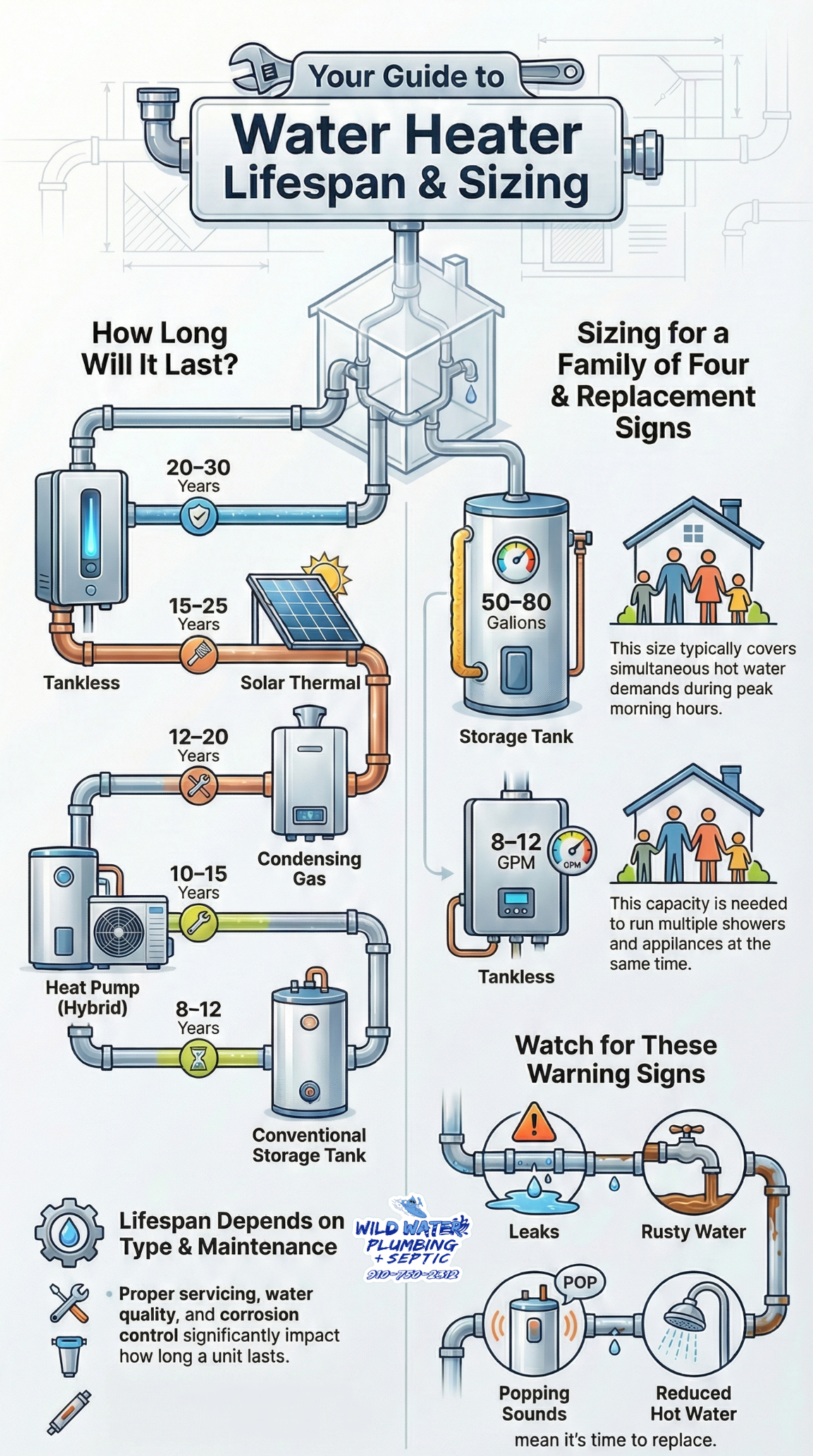
What Is the Average Lifespan of Different Water Heater Types?
Lifespans vary by type: conventional storage tanks usually last 8–12 years (depending on water quality and maintenance), tankless units commonly reach 20–30 years with proper servicing, heat pump water heaters typically last 10–15 years, solar thermal systems can run 15–25 years with appropriate collector and pump upkeep, and condensing gas units generally span 12–20 years. Lifespan influencers include water hardness, maintenance frequency (flushing, anode replacement), corrosion control, and duty cycles. Warning signs that replacement is due include persistent leaks, rust‑colored water, reduced hot‑water volume, sediment-induced popping, or frequent cycling. Spotting these early lets you plan a replacement instead of scrambling during a failure.
Those typical lifespans help with sizing and budgeting decisions and lead to the common question about families of four.
Which Water Heater Type Is Best for a Family of Four?
For a family of four, several factors determine the best choice. A conventional storage tank between 50–80 gallons usually covers simultaneous morning use. A properly sized tankless system needs a combined GPM capacity to meet concurrent showers and appliances, often 8–12 GPM, depending on incoming water temperature, which may require a single larger unit or paired units. Heat pump water heaters work well if you have suitable installation space and ambient conditions, offering lower operating costs for moderate‑to‑high use, though recovery can be slower than high‑BTU gas systems. Condensing gas units give efficient gas performance and faster recovery for very high‑demand households. Trade‑offs include footprint, initial cost, and the possibility of needing multiple tankless units or a hybrid setup to guarantee a continuous supply during peak times. A professional load calculation will ensure the chosen system reliably supports a family of four’s routines.
Wild Water Plumbing + Septic provides consultation and sizing assistance to turn daily hot‑water habits into a recommended capacity and equipment selection. Our technicians run load calculations and explain trade‑offs for tank, tankless, hybrid, and condensing systems to match your household behavior and site constraints.
Summary
Choosing the right water heater can lower energy bills, improve everyday comfort, and extend the life of your plumbing system. This guide gives you the essentials across all major water‑heating technologies so you can make an informed choice for your home. If you’d like personalized help, contact our team for a consultation. We’ll assess your site, walk through options, and recommend the most efficient, cost‑effective solution for your needs. Explore our services today and let Wild Water Plumbing help you choose the water heater that best fits your home.
Stay safe and prepared, Jacksonville.
– Justin Wilder, Owner
📞 Call or text me directly at (910) 750-2312 to schedule an estimate.
Wild Water Plumbing—Local, Veteran-Owned, and Always Ready.
—