THE SHORT VERSION — READ THIS FIRST
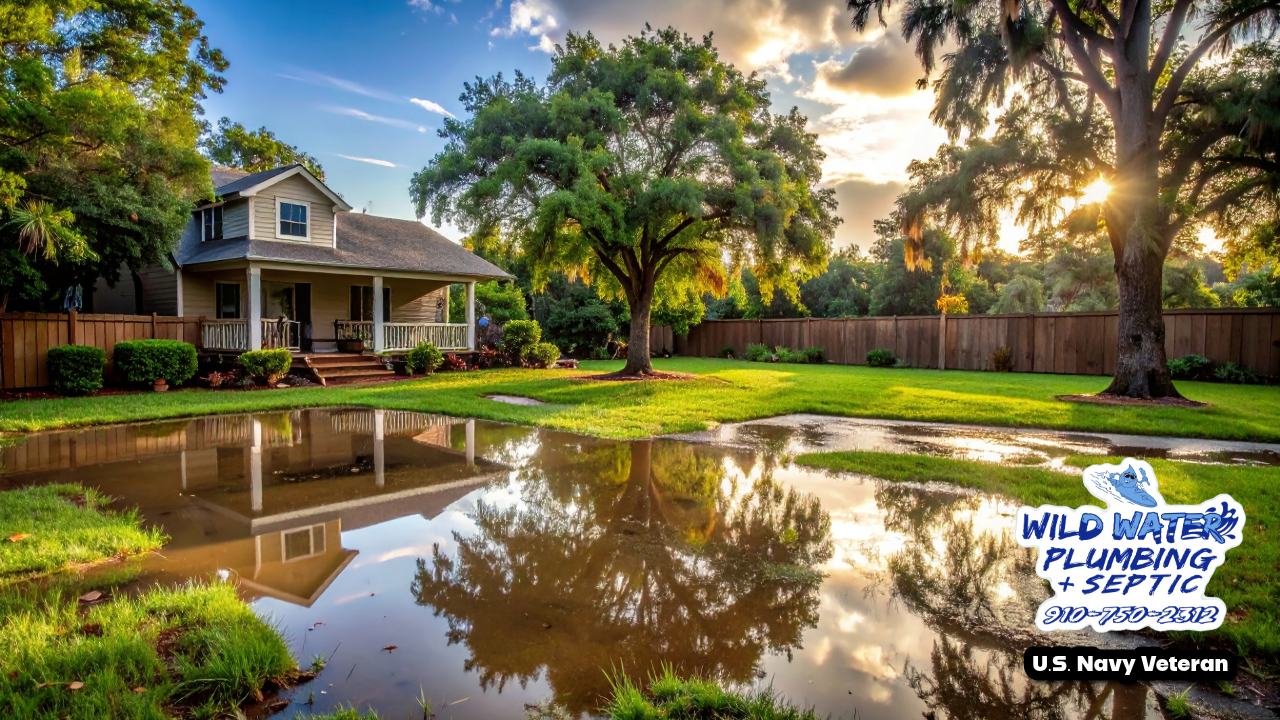
If water pools in your yard after every rain, stays soft for days after the rest of the neighborhood has dried, creeps toward your foundation during storms, or keeps your septic drainfield saturated month after month, your drainage system has either failed or never existed. Across Onslow, Pender, New Hanover, and Carteret Counties, clay-heavy subsoils, high water tables, and increasingly intense rainfall make yard drainage a structural protection your house cannot do without. This guide covers why coastal NC yards flood, the eight warning signs you cannot ignore, what each county’s terrain does differently, what actually fixes it, and when a French drain is the right answer versus when something else is.
📄 TABLE OF CONTENTS — CLICK TO JUMP TO ANY CHAPTER
- Why Coastal Carolina Yards Flood Worse Than Most
- The 8 Warning Signs Your Drainage Is Failing
- Onslow County: Drainage Town by Town
- Pender County: Rural Soil Meets Rapid Growth
- New Hanover County: Urban Density and Old Yards
- Carteret County: Between Sound and Sea
- Drainage Solutions: What Works, Where, and Why
- How Wild Water Diagnoses and Installs Yard Drainage
- Drainage Deep Dives: Town-by-Town Resources
- Summary: What Every Homeowner Needs to Take Away
- Frequently Asked Questions
- References
Chapter 1: Why Coastal Carolina Yards Flood Worse Than Most
Yard drainage problems show up everywhere in the country, but in coastal North Carolina they hit harder and faster than almost anywhere else. Four conditions stack on top of each other in this region, and they affect every residential property to some degree. Understanding the stack is the foundation of every drainage decision that follows.
The four-county region sits entirely within North Carolina’s Coastal Plain. Soils range from fast-draining sandy loams near the coast to dense, clay-heavy profiles inland. Sandy soils drain so fast they cannot support healthy lawn root systems and let pollutants reach groundwater quickly. Clay soils absorb water so slowly that any heavy rain produces standing water that takes days to disappear. Most yards have a layered profile: a thin sandy or loamy topsoil over clay subsoil that acts as a barrier. Water moves down through the top layer, hits the clay, and has nowhere to go except sideways or back up.
The High Water Table
The water table sits within a few feet of the surface across much of the region year-round and rises to within inches of the surface during the prolonged wet seasons coastal NC experiences. When the water table is high, the soil cannot accept more water from above. Rain that would normally percolate down has nowhere to go. That is when puddles form in the same low spots every storm, foundations get hit with hydrostatic pressure, and septic drainfields lose their absorption capacity.
Hurricane and Tropical Rainfall Patterns
Coastal NC averages more than 50 inches of rain per year and absorbs the brunt of late-summer tropical systems. A single hurricane or tropical storm can drop 8 to 15 inches of rain in 24 hours. Hurricane Florence in 2018 produced more than 30 inches in some areas. Storms of that intensity now happen every few years rather than every few decades. Even a property with adequate drainage for normal weather has no chance of handling that volume without proper runoff control, and the cumulative damage from repeated saturation events shortens the life of every system in the yard.
Rapid residential development across all four counties is changing how stormwater moves on established properties. New rooftops, driveways, sidewalks, and patios convert previously absorbent land into impervious surface. Water that used to soak in now runs off, and it runs toward whoever is downhill, which is often an established home that has been there for decades and never flooded before. The pattern is most visible in Porters Neck, where new construction is sending stormwater toward homes that never had a problem. The same dynamic is playing out in Hampstead, Holly Ridge, Sneads Ferry, and along the entire US-17 corridor.
The Septic and Drainage Connection
This is the connection most homeowners miss until it has already cost them money. A septic drainfield can only absorb effluent when the surrounding soil has room to accept water. When yard drainage fails and the soil around the drainfield stays saturated by groundwater coming from outside the system, the drainfield cannot do its job no matter how healthy the tank and distribution components are. Drainage failures and septic failures are linked. Addressing yard drainage is often the first step in saving a struggling septic system, and we cover that side of the equation in our complete septic failure guide for coastal NC homeowners.
Chapter 2: The 8 Warning Signs Your Drainage Is Failing
A failing drainage situation rarely announces itself with one dramatic event. It produces a sequence of signals that get progressively harder to ignore. Homeowners who recognize the early signals and act on them face installation costs measured in single thousands of dollars. Homeowners who wait until the system has caused foundation movement, crawl space mold, or septic drainfield failure face costs measured in tens of thousands across multiple trades.
💧 Warning Sign #1 — Standing Water That Lasts More Than 48 Hours After Rain
Any standing water in a defined area that has not absorbed or evaporated within 48 hours of a normal rain event is evidence that the soil at that location cannot accept more water and that there is no working drainage path moving water away. The 48-hour threshold matters because that is roughly the window in which mosquito eggs hatch and root systems begin to drown. Yards that hold water past 48 hours are not just inconvenient. They are causing biological damage to lawn, trees, and any septic infrastructure below.
💧 Warning Sign #2 — Water Pooling Against the Foundation
Water against a foundation wall produces hydrostatic pressure that pushes against block, concrete, or pier and beam construction continuously. Over time that pressure causes wall cracks, crawl space moisture intrusion, slab settlement, and in older homes wood framing rot at the sill plate. A small puddle that touches the foundation after every storm is doing structural damage even if you cannot see it yet. This is the warning sign most worth acting on immediately.
💧 Warning Sign #3 — Soggy Soft Spots in the Yard Long After Rain Stops
Areas of the lawn that feel spongy underfoot or sink slightly when walked on indicate that the soil profile is holding water below the surface that cannot drain through or escape sideways. These zones often have grass that grows lusher and greener than the rest of the yard because of the constant moisture, which means homeowners sometimes mistake the symptom for healthy lawn. Soft spots typically appear over drainfields, low areas where the water table touches the root zone, or buried debris that traps water.
💧 Warning Sign #4 — Mulch, Topsoil, or Pine Straw Washing Out During Storms
When loose surface material washes off the yard and onto the driveway, sidewalk, or street after a heavy rain, that is visible evidence of surface runoff moving fast enough to carry sediment. Fast surface runoff means water is not soaking in where it lands and is moving toward whatever is downhill. That destination is usually the foundation, the septic drainfield, or a neighbor’s property. The volume that washes mulch out of beds is the same volume hitting the structure of your home.
💧 Warning Sign #5 — Water Marks, Stains, or Efflorescence on Foundation Walls
Horizontal water lines on foundation walls, dark stains on concrete or block, or white powdery deposits called efflorescence all indicate that water has been against the foundation long enough to leave a record. Efflorescence in particular is a chemical signature that water has been moving through the wall material itself, dissolving and redepositing minerals as it goes. By the time these marks are visible, the foundation has been under water pressure for months or years.
💧 Warning Sign #6 — Septic Drainfield That Stays Wet While the Rest of the Yard Dries
A drainfield that remains saturated, soft, or visibly damp days after the surrounding yard has dried is a system whose absorption capacity is already compromised. The cause might be the drainfield itself, but it is just as often a yard drainage problem feeding groundwater into the drainfield from outside. Resolving the drainage situation often restores the drainfield, while replacing the drainfield without resolving drainage produces a new drainfield that fails on the same timeline as the old one.
💧 Warning Sign #7 — Crawl Space Moisture, Mold, or Standing Water
A crawl space that is damp, musty, or actively holding water is telling you the perimeter drainage cannot keep up. Crawl space moisture compromises floor framing, insulation, ductwork, and indoor air quality on every level above. Mold growth in the crawl space sends spores up through every opening into the living space. By the time crawl space moisture is obvious, the yard drainage problem has been operating long enough to require both drainage correction and crawl space remediation. We cover the indoor air-quality dimension in our moldy basement smell guide.
💧 Warning Sign #8 — Erosion Tracks, Gullies, or Exposed Roots Forming in the Yard
Visible erosion channels show where concentrated water flow has been carrying soil away repeatedly. Exposed tree roots that were previously buried indicate that surface soil has been stripped over time. Both signs mean water is moving across the yard in patterns that did not exist when the property was graded. Once erosion starts cutting channels, the channels deepen with every subsequent storm and the velocity of water increases as the gully concentrates flow. The longer this goes uncorrected, the more aggressive the corrective grading and drainage installation has to be.
Chapter 3: Onslow County — Drainage Town by Town
Onslow County’s combination of post-World War II residential expansion, military housing density, and a soil profile that varies dramatically across the county produces some of the most varied drainage situations in coastal NC. The town-by-town story matters here because the right solution in Holly Ridge is different from the right solution in Stella, and both are different from what works in Richlands.
Onslow contains everything from coastal barrier islands (North Topsail Beach) to inland clay-bearing soils (Richlands and Maple Hill) to mid-county military-heavy communities (Midway Park and Tarawa Terrace) to historic waterfront (Swansboro). Each environment has its own drainage signature, but they share one thing: most properties were graded for the climate of 30 to 60 years ago, not for the rainfall patterns of today.
Jacksonville and the Surrounding Suburbs
Jacksonville’s residential areas mix sandy topsoil over clay subsoil throughout most neighborhoods, producing the classic Onslow drainage pattern: water soaks through the top six to twelve inches quickly, then stops at the clay horizon and pools sideways. Older neighborhoods along Henderson Drive, the Bayshore corridor, and the streets around Northwoods commonly have yards that drain well for a few hours and then stay damp for days. Stormwater management in the city dates to the era when much less of the surrounding area was developed, and existing drainage handles the original demand, not the current one.
Hubert and Stella
Hubert sits on soils that vary from sandy near the New River to high-clay further inland. The clay-heavy lots produce yard drainage problems that compound over years and feed directly into septic drainfield saturation. Stella‘s low terrain near the White Oak River floodplain produces the crawl space flooding pattern we cover in our dedicated Stella flooding article. Every Stella property below a certain elevation has water management as a recurring concern, not a one-time fix.
Sneads Ferry and North Topsail Beach
Sneads Ferry’s peninsula geography between the New River and the Intracoastal Waterway puts every property within tidal influence of the water table. The water table rises with the tide twice a day and stays elevated during sustained onshore winds. Drainage solutions in Sneads Ferry have to account for the fact that the receiving soil itself may be temporarily saturated by tidal action rather than rainfall. North Topsail Beach‘s barrier island setting puts every yard in a FEMA flood zone where surface elevation, dune position, and storm surge potential all factor into the design of any drainage system.
Holly Ridge and Stump Sound
Holly Ridge has experienced rapid growth that has added impervious surface across previously absorbent terrain, concentrating runoff in ways that overload yards on established lots. Combined with the area’s clay subsoil, the result is the persistent flooding we cover in our Holly Ridge yard flooding article. Stump Sound properties add tidal influence to the same clay-and-runoff pattern.
Richlands, Maple Hill, and Dixon
Western Onslow’s rural communities have clay-heavy soils that historically absorbed water slowly but absorbed enough of it for the rural lot sizes typical of these areas. Modern household water use combined with reduced lot drainage capacity from compacted soil over decades produces the pattern we document in our Richlands yard drainage article. Maple Hill and Dixon share the same fundamental soil conditions with variations in lot elevation and proximity to creek drainage.
Maysville, White Oak, and Swansboro
Maysville’s properties along the New River share Sneads Ferry’s high-water-table dynamic on a smaller scale. White Oak communities have the dense military housing turnover that produces compacted soils and reduced absorption capacity over time. Swansboro‘s historic waterfront has both old stormwater infrastructure and properties at low elevation relative to the river, requiring drainage solutions that account for the fact that the receiving water level is sometimes higher than the source.
Midway Park, Tarawa Terrace, and Camp Lejeune Adjacent Communities
The communities immediately adjacent to Marine Corps Base Camp Lejeune carry both the soil-compaction legacy of decades of military housing density and the modified stormwater patterns that come from the base’s own infrastructure footprint. Yards in Midway Park, Tarawa Terrace, Half Moon, Bogue, and Verona commonly have drainage histories that pre-date any of the current residents and that have been progressively worsening for years.
Chapter 4: Pender County — Rural Soil Meets Rapid Growth
Pender County contains two dramatically different drainage environments in the same county. The coastal corridor along US-17 is growing fast and adding impervious surface to soils that were never engineered for current densities. The western rural townships sit on some of the most hydraulically challenged soils in the state, where water tables are at or near the surface for much of the year.
From Hampstead’s sandy coastal profiles to Burgaw’s clay-heavy interior to the hydric soils of the Black River watershed in western Pender, the county presents almost every challenging drainage condition coastal NC has to offer. The same drainage approach does not work across these zones, and a contractor unfamiliar with the local variation will recommend the wrong solution for two-thirds of the properties in the county.
Hampstead and Scotts Hill
Hampstead’s rapid development has converted thousands of acres of previously absorbent land into rooftops, driveways, and roads in less than two decades. The runoff that used to soak into now-developed land is concentrating onto established properties downhill of new construction, producing flooding patterns that did not exist a generation ago. We cover the septic-system consequences of this pattern in our Hampstead yard flooding article. Scotts Hill‘s position at the southern edge of the county sits on similar soils with the additional pressure of being downhill of the entire growth corridor.
Burgaw, Rocky Point, and Atkinson
Burgaw’s older residential areas sit on clay-heavy soils that have been compacted by decades of mowing, vehicle traffic, and seasonal wet-dry cycles. The result is soil with significantly reduced absorption capacity compared to the original undisturbed profile. Rocky Point and Atkinson share the same soil-compaction legacy on the older rural lots that make up most of those communities.
Currie, Willard, Watha, and Long Creek
Western Pender County’s rural townships sit on hydric soils with water tables at or near the surface for much of the year. Currie‘s clay-bearing yards produce the surface flooding pattern we cover in our Currie yard flooding article. Willard‘s position relative to the Black River floodplain produces the crawl space flooding pattern documented in our Willard water table article. Watha, Penderlea, and Long Creek share these conditions with local variations in elevation and surface water access.
Surf City, Topsail Beach, and the Coastal Pender Properties
Surf City’s sandy coastal profile drains quickly at the surface but has limited treatment depth above the seasonal high water table. Topsail Beach‘s constrained lot sizes mean drainage solutions have to fit within property lines that may be only a few dozen feet wide, ruling out conventional approaches that work on larger inland lots. Tidal water table fluctuation affects both communities throughout the year.
Chapter 5: New Hanover County — Urban Density and Old Yards
New Hanover is the most urbanized of the four counties and has the longest continuous residential development history. Many properties sit on yards that have been graded and regraded across multiple decades, with drainage solutions installed and then forgotten by successive owners. Add the rapid growth pressure on previously rural fringe areas, and the result is a county where drainage problems can come from any of a dozen different historical layers.
Wilmington’s older residential neighborhoods sit on yards that were graded in the 1920s through 1960s for a city that was smaller, less paved, and lower-density than what exists today. The original grading often relied on perimeter ditches, surface swales, and city stormwater infrastructure that has since been altered, paved over, or never updated. Forest Hills, Sunset Park, Ardmore, Carolina Place, and the neighborhoods adjacent to downtown all have yards whose drainage logic was designed for a different city than the one above ground today.
Wilmington Historic and Mid-Century Neighborhoods
Properties in Wilmington’s older neighborhoods commonly have at least one of three drainage problems: original grading that has settled or been altered, downspouts that empty against the foundation, and yard runoff patterns that did not exist when the surrounding street network was simpler. Most of these problems are correctable with French drains, downspout extensions, and selective regrading, but identifying which combination applies requires evaluating the actual conditions rather than installing a generic solution.
Wrightsville Beach and Figure Eight Island
Wrightsville Beach properties operate on barrier island soils where the water table fluctuates with tides and where storm surge can elevate groundwater rapidly. Drainage solutions here have to account for the fact that the receiving soil may be temporarily saturated by something other than rainfall, and the design has to handle peak conditions rather than average ones.
Carolina Beach and Kure Beach
Pleasure Island’s elevation profile and FEMA flood zone status make every coastal property a candidate for both surface drainage and crawl space water management. We cover the ground-up flooding pattern these properties face in our Carolina Beach flooding article. The combination of storm surge, tidal water table, and rainfall makes Carolina Beach and Kure Beach drainage planning more complex than most inland sites.
Castle Hayne, Murrayville, Wrightsboro, and Northwest New Hanover
Castle Hayne‘s rural and semi-rural character means most properties have larger lots and original grading that has not been altered as aggressively as urban properties. The challenge here is age. Drainage systems and surface grading from decades ago lose function over time, and many homeowners do not know what drainage existed in the first place. Murrayville and Wrightsboro share similar histories on smaller lots.
Porters Neck, Myrtle Grove, and Ogden
The Porters Neck corridor is the New Hanover community where new-construction runoff is most aggressively changing established property drainage. We cover the dynamic in our Porters Neck drainage article and the related drainfield saturation pattern in our Porters Neck drainfield article. Myrtle Grove and Ogden represent later development eras where drainage was engineered but where 20 to 30 years of growth has changed surrounding conditions enough that the original design is no longer adequate.
Chapter 6: Carteret County — Between Sound and Sea
Carteret County’s geography puts almost every residential property within strong influence of either the Bogue Sound, Core Sound, or open Atlantic. Soils are hydric across much of the county, water tables are near the surface most of the year, and tidal fluctuation affects groundwater levels along with rainfall. Drainage in Carteret is less about getting water away from a property and more about managing the constant exchange between yard, water table, and tidal water.
The Down East communities of Carteret County (Davis, Stacy, Sea Level, Atlantic, Smyrna, Otway, Marshallberg, Gloucester, Harkers Island, and Cedar Island) sit on lots so close to tidal water that conventional drainage logic does not apply. The receiving soil is often within a few inches of mean high water. The water table sits inside the drainfield zone for much of the year. Drainage solutions here have to be designed around managing groundwater rather than removing it, and many properties benefit more from elevated landscaping and sump pump systems than from traditional French drains.
Morehead City and Beaufort
Morehead City’s residential neighborhoods include both historic downtown properties at low elevation along the Newport River and newer development further from the water. Beaufort‘s historic district contains some of the oldest residential properties in coastal NC, with yards that have been graded multiple times across multiple centuries and drainage histories that often pre-date current owners by generations. Both communities have a mix of properties that need surface solutions, subsurface solutions, or both.
Newport and Cape Carteret
Newport is Carteret’s primary inland community along US-70, with soils that share characteristics with both Onslow and Carteret depending on elevation. Cape Carteret at the western edge of the county shares the transitional soil profile between the two counties and has properties with drainage situations that range from typical Onslow inland patterns to typical Carteret coastal patterns within a few miles.
Atlantic Beach, Pine Knoll Shores, Indian Beach, and Emerald Isle
The barrier island communities along Bogue Banks operate under barrier island drainage rules. Sandy surface soils drain fast, but the freshwater lens above seawater is thin and the water table responds to tide and wind. Drainage solutions here have to account for vacation rental seasonal occupancy patterns that concentrate water use during peak summer months, increasing the load on any wastewater system that interacts with yard drainage.
Down East Communities: Harkers Island, Davis, Sea Level, and the Core Sound Settlements
The Down East communities along Core Sound have some of the most hydraulically constrained drainage environments anywhere in coastal NC. Harkers Island, Davis, Stacy, Sea Level, Atlantic, Smyrna, Otway, Marshallberg, Gloucester, and Cedar Island all sit on narrow lots between sound and road, with water tables that are often within inches of grade. Drainage planning here is about water management, not water removal, and the solutions usually combine elevation changes, sump systems, and very carefully placed subsurface drains.
Chapter 7: Drainage Solutions — What Works, Where, and Why
“French drain” is a category, not a single product. Within the category there are several specific designs that solve specific problems, and outside the category there are other tools that often work better than a French drain for the actual condition the homeowner is facing. Choosing the right solution starts with diagnosing the actual problem.
The right drainage solution depends on three questions. First, where is the water coming from: surface runoff, groundwater, or both? Second, where does it need to go: a daylight outlet downhill, a municipal storm sewer, a dry well, or a sump pump system? Third, what is the receiving soil capable of accepting: free-draining sand, slow-draining clay, or saturated hydric soil? The answers to those three questions determine which solution actually works on a given property.
Exterior French Drain (Yard Interception)
A perforated pipe in a gravel-filled trench positioned to intercept groundwater moving toward the house or septic drainfield. Works well on properties with clear uphill water source and an available downhill outlet. Requires correct slope, properly sized pipe, geotextile filter fabric to keep silt out of the gravel, and an outlet location that actually moves water away rather than just relocating the problem.
Interior Foundation Drain
A perforated pipe installed along the inside perimeter of a crawl space or basement, tied to a sump pit and pump. Works for properties where exterior drainage is impractical because of lot size, hardscape, or lack of downhill outlet. Captures water that has already reached the foundation and removes it mechanically rather than by gravity.
Footing Drain
A French drain installed at the elevation of the foundation footing, designed specifically to relieve hydrostatic pressure against the foundation wall. Common in new construction and in major foundation repair projects. Often combined with foundation waterproofing on the exterior wall.
Surface Drain Systems
Grated inlets at low spots in the yard, connected by buried solid pipe to an outlet. Captures water before it soaks in. Works for properties where the main problem is fast-moving runoff from defined sources (downspouts, driveways, neighbor’s property) rather than diffuse groundwater. Often the right answer combined with a French drain for properties that have both runoff and groundwater issues.
Downspout Extensions and Yard Drainage Integration
Often the cheapest and most impactful drainage improvement on a residential property. Routing roof water at least 10 feet away from the foundation, ideally to a daylight outlet or a yard drainage system, eliminates the single largest source of foundation water pressure on most homes. If a property only has the budget for one drainage intervention, this is almost always the right first move.
Sump Pump Systems
For properties where the water table is too high or the lot is too flat for gravity drainage to work, a sump pit and pump moves water mechanically. We cover the full sump pump diagnostic and troubleshooting picture in our coastal NC sump pump troubleshooting guide. Sump systems work well in combination with interior foundation drains and are sometimes the only option in low-elevation coastal sites.
Dry Wells and Infiltration Galleries
Underground gravel-filled pits that hold water temporarily and allow it to soak into the surrounding soil over time. Work in sandy soils with deep water tables. Do not work in clay or where the water table is high. Often misapplied because they are inexpensive to install in coastal NC’s sandy soils, even when conditions guarantee they will fail within a few years.
Not every drainage problem needs a French drain. Properties with surface runoff problems often need surface drains, grading correction, or downspout work rather than a buried perforated pipe. Properties where the water table is at the surface much of the year cannot drain by gravity at all and need sump systems or elevation changes instead. Yards where the original grading has settled need regrading first and drainage second. A contractor who recommends a French drain for every drainage problem is selling product rather than solutions.
Chapter 8: How Wild Water Diagnoses and Installs Yard Drainage Systems
The most common frustration homeowners across the region describe when they call us about drainage is that they have already had a contractor look at the property and either recommend something that did not work or quote something that felt like it ignored half the problem. Accurate diagnosis is the foundation of every successful drainage project, and a complete diagnosis is the foundation of an accurate quote.
Every drainage evaluation starts with a site walk that covers the entire property, not just the spot the homeowner identified as the problem. We trace surface water flow paths during or after rain when possible. We identify the source of water reaching the problem area, which is often somewhere the homeowner has not considered. We assess the receiving soil’s actual capacity to accept water. We check downspout discharge points, septic drainfield location relative to drainage paths, and any existing drainage infrastructure that may have stopped working without anyone noticing.
The Drainage Services Wild Water Provides
Our complete range of French drain and yard drainage services covers every stage of evaluation, design, and installation:
- Full property drainage evaluations with written findings and prioritized recommendations
- Exterior French drain design and installation
- Interior foundation drain installation and integration with sump systems
- Footing drain installation for foundation protection
- Surface drain systems with grated inlets and buried discharge piping
- Downspout extension and yard drainage integration
- Sump pump installation, replacement, and battery backup integration
- Septic drainfield drainage protection (interception drains designed to keep groundwater out of the drainfield zone)
- Drainage system maintenance, jetting, and repair
Related Services That Often Connect to Drainage Performance
Drainage problems rarely exist in isolation. Foundation issues, septic problems, and indoor air quality concerns all connect back to how water moves on the property. Our broader service range addresses the system as a whole rather than treating drainage as a standalone trade.
- Septic System Services for drainfield protection and the drainage-septic interaction
- Sump Pump Troubleshooting and Replacement for the mechanical side of crawl space and basement water management
- Sewer Line Camera Inspection when drainage problems suggest sewer line damage from saturated soil movement
Drainage Deep Dives: Town-by-Town Resources
Every community across the four counties has its own drainage story. The articles below take each town one level deeper, with local soil notes, infrastructure history, and the specific failure patterns Wild Water sees on the ground. Pick the article that matches your town to read the full local breakdown.
🌊 Onslow County Drainage Deep Dives
🌾 Pender County Drainage Deep Dives
🏙️ New Hanover County Drainage Deep Dives
🔧 Drainage Diagnostics & Related Resources
Yard Flooding, Foundation Water, or a Soggy Drainfield?
Wild Water Plumbing + Septic designs and installs drainage systems across Onslow, Pender, New Hanover, and Carteret Counties. Site walk, honest diagnosis, and a written plan before any work begins.
Summary: What Every Homeowner Across These Four Counties Needs to Take Away
The eight points every homeowner in Onslow, Pender, New Hanover, and Carteret Counties should carry forward from this guide:
- Coastal plain soils, high water tables, and intensifying rainfall combine to make yard drainage failures more common in this region than in most of the country. The conditions are not a reason for alarm, but they are a reason for awareness.
- The eight warning signs in Chapter 2 appear in a predictable sequence. Recognizing them early converts expensive structural repairs into routine drainage installations.
- Drainage problems and septic problems are connected. Saving a struggling drainfield often starts with fixing the yard drainage feeding it.
- Foundation water is the single most expensive drainage problem to leave alone. Wall cracks, crawl space mold, and slab settlement all trace back to water pressure that drainage could have prevented.
- Every community in the four-county region has its own drainage signature. The right solution in Holly Ridge is different from the right solution in Currie, and both are different from what works in Carolina Beach.
- Not every drainage problem needs a French drain. Surface drains, downspout work, regrading, and sump systems are often better answers, and the diagnosis determines the solution.
- New construction is changing established drainage on properties that never used to have problems. If your yard has started flooding in the last few years, look for what changed uphill.
- The right time to act is before the foundation, the drainfield, or the crawl space pays the price. Drainage caught early is a one-trade fix. Drainage caught late involves foundation contractors, mold remediators, and septic system replacement.
Frequently Asked Questions
What causes a yard to flood after every rain?
Yards flood for one or more of four reasons: clay subsoil that holds water instead of absorbing it, a high water table that leaves no room for rainwater to drain down, runoff from neighboring properties or new construction that sends extra water onto your lot, and poor grading that channels water toward the house instead of away from it. Coastal North Carolina yards usually face several of these at once.
How much does a French drain cost in coastal NC?
French drain costs vary with length, depth, soil conditions, and what the drain connects to. A simple interior perimeter drain might run a few thousand dollars. A long exterior drain through clay soil with a daylight outlet can run higher. A drain that requires a sump pump and pit adds equipment and electrical work. The honest answer comes after a site visit where the actual conditions can be assessed.
How long does a French drain last?
A properly installed French drain with the right pipe, gravel, and filter fabric should function for 20 to 30 years or more. Drains fail early when filter fabric clogs with silt and fines, when tree roots invade the pipe, when the pipe was undersized for the volume of water it has to handle, or when the outlet was installed at the wrong elevation. Most early failures trace to installation shortcuts, not product limitations.
Can I install a French drain myself?
You can dig a trench and lay perforated pipe yourself, but a French drain that actually solves the underlying problem requires correct slope calculation, proper pipe sizing for the watershed area, the right filter fabric for the soil type, an outlet location that works under all conditions, and integration with downspouts and sump systems. Most DIY French drains either fail within a few years or never functioned in the first place because one of those factors was wrong.
Do French drains stop working over time?
French drains lose capacity as filter fabric clogs with fine soil particles, as tree roots invade the pipe, and as the gravel layer compacts. A well-installed drain in stable soil can last decades. A drain installed in fine silty soil or under heavy root pressure can lose significant capacity in 10 to 15 years. Periodic inspection and occasional jetting extend lifespan considerably.
What is the difference between a French drain and a surface drain?
A French drain is a buried perforated pipe surrounded by gravel and filter fabric. It collects water that has already soaked into the ground and routes it elsewhere. A surface drain is a grated inlet at ground level that captures water before it soaks in. The two solve different problems. Surface drains handle visible standing water and runoff. French drains handle subsurface saturation and groundwater. Many properties need both.
Will a French drain protect my septic system?
Yes, in many cases. A drainfield can only absorb effluent if the surrounding soil has room to accept water. When yard drainage fails and the soil around the drainfield stays saturated, the drainfield cannot do its job. Installing a properly located French drain that intercepts groundwater before it reaches the drainfield can restore drainfield function and extend the life of the entire septic system.
Will a French drain protect my foundation?
A French drain installed at the correct depth and location can intercept water before it reaches the foundation, preventing the hydrostatic pressure that causes basement wall cracks, crawl space flooding, and slab moisture problems. The drain has to be positioned correctly relative to the foundation footing and tied to an outlet that actually moves the water away. Drains installed too shallow or too far from the foundation do not provide foundation protection.
How long does French drain installation take?
A typical residential French drain installation takes one to three days depending on length, depth, soil conditions, and access. Short interior perimeter drains can be completed in a day. Long exterior drains through difficult soil with multiple obstacles can take several days. The site visit and project estimate happen first so the homeowner has an accurate timeline before work begins.
Does homeowners insurance cover yard flooding damage?
Standard homeowners policies do not cover damage from surface water, groundwater, or gradual seepage. Flood insurance through the National Flood Insurance Program covers damage from rising surface water but typically does not cover groundwater intrusion. Damage from sudden plumbing failures may be covered, but ongoing drainage problems and the structural damage they cause are usually classified as maintenance issues that fall outside coverage. Verify with your agent before assuming coverage exists.
References
U.S. Environmental Protection Agency. (2022). Soak up the rain: Residential stormwater management practices. EPA Office of Wetlands, Oceans, and Watersheds. https://www.epa.gov/soakuptherain
North Carolina Department of Environmental Quality. (2022). Stormwater best management practices manual for coastal counties. NCDEQ Division of Energy, Mineral, and Land Resources. https://www.deq.nc.gov/about/divisions/energy-mineral-land-resources/stormwater
North Carolina Cooperative Extension. (2021). Yard drainage and grading for residential properties in the Coastal Plain. NC State Extension Publications. https://content.ces.ncsu.edu
U.S. Geological Survey. (2021). Groundwater resources of the surficial aquifer system, Coastal Plain, North Carolina. USGS Scientific Investigations Report 2021-5042. https://www.usgs.gov/centers/sa-water
Federal Emergency Management Agency. (2021). Flood insurance and surface water protection in Special Flood Hazard Areas. FEMA National Flood Insurance Program. https://www.fema.gov/national-flood-insurance-program
American Society of Home Inspectors. (2020). Standards of practice for drainage and grading evaluation. ASHI. https://www.homeinspector.org
Onslow County Planning and Development. (2023). Stormwater management ordinance and residential drainage requirements. Onslow County Government. https://www.onslowcountync.gov
New Hanover County Engineering Department. (2022). Stormwater management for residential properties. New Hanover County Government. https://www.nhcgov.com/engineering