
THE SHORT VERSION — READ THIS FIRST
If your drains are slow, your yard smells after rain, water is pooling near the drainfield, or your toilets gurgle when you run the dishwasher — your septic system is telling you something is wrong. Across Onslow, Pender, New Hanover, and Carteret Counties, failing septic systems and deteriorating sewer lines are among the most common and most expensive problems homeowners face. This guide covers every warning sign, every town, and every option available to you. The sooner you act, the less it costs.
📄 TABLE OF CONTENTS — CLICK TO JUMP TO ANY CHAPTER
- Why Coastal Carolina Septic Systems Fail Faster Than Most
- The 8 Warning Signs You Should Never Ignore
- Onslow County: Town-by-Town Septic and Sewer Challenges
- Pender County: Where Rural Soil and Growth Collide Underground
- New Hanover County: Urban Pressure on Aging Infrastructure
- Carteret County: Tidal Exposure and the Septic Systems Beneath It
- Repair vs. Replace: How to Make the Right Call
- How Wild Water Diagnoses and Fixes the Problem Right
- Septic & Sewer Deep Dives: Town-by-Town Resources
- Summary: What Every Homeowner Needs to Take Away
- Frequently Asked Questions
- References
Chapter 1: Why Coastal Carolina Septic Systems Fail Faster Than Most
Septic systems across the United States share a common set of failure causes: aging components, heavy household use, and deferred maintenance. In coastal North Carolina, those universal causes are compounded by a specific set of environmental conditions that accelerate every failure mode simultaneously. Understanding why the region produces so many septic problems is the first step toward recognizing them before they become emergencies.
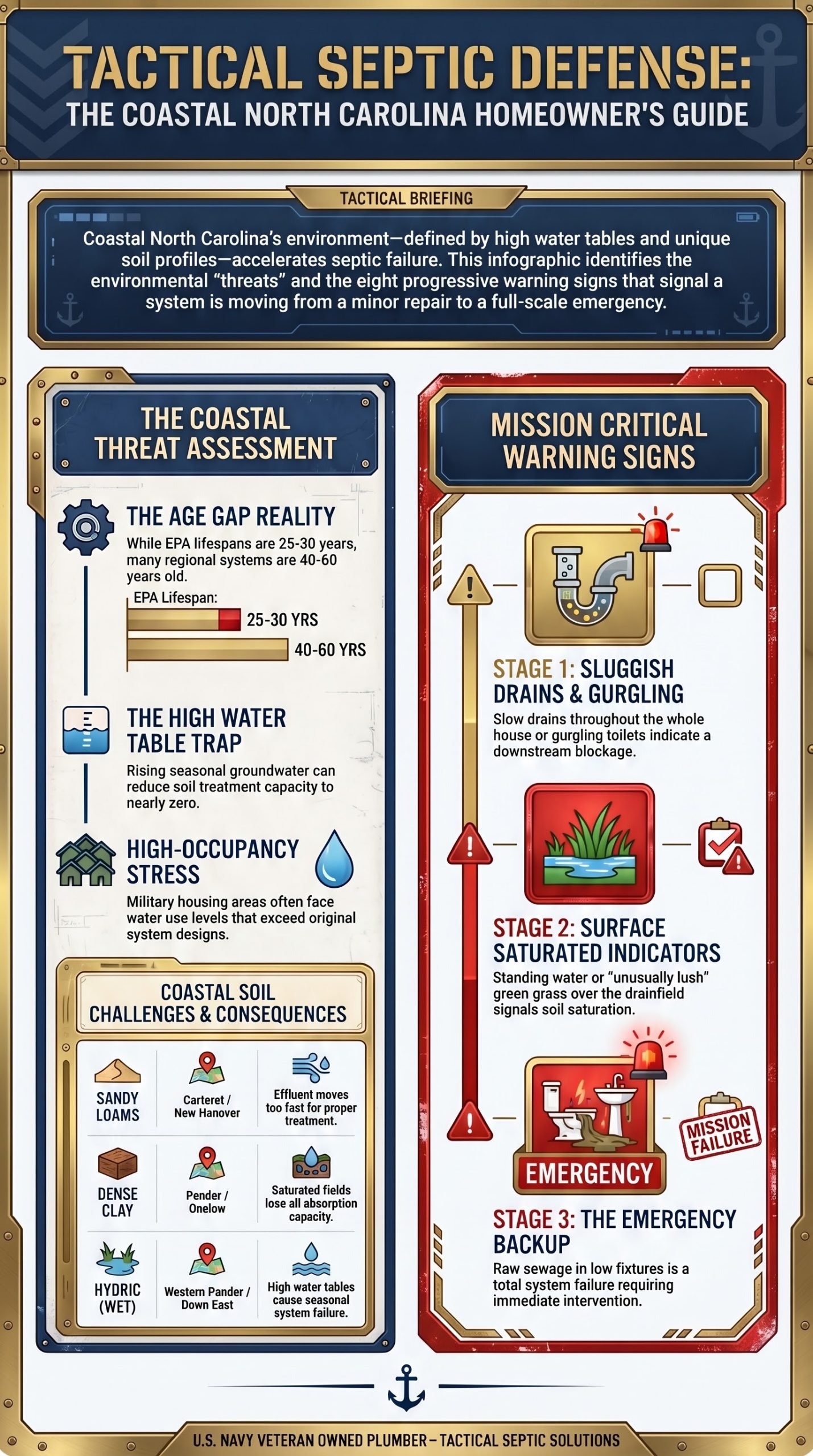
The four-county region covered in this guide — Onslow, Pender, New Hanover, and Carteret — sits entirely within North Carolina’s Coastal Plain. This geological province is characterized by soils that range from well-drained sandy loams near the coast to dense, poorly drained clay-heavy profiles in the inland areas. Both extremes create septic challenges. Sandy soils allow effluent to move through the drainfield too quickly for adequate treatment. Clay soils absorb and release water so slowly that drainfields become saturated during wet seasons, losing all remaining treatment capacity.
The High Water Table Reality
Across much of the coastal plain, the water table sits close to the surface year-round and rises to within inches of it during the prolonged wet seasons that coastal North Carolina experiences. A septic drainfield installed at a depth that provided adequate separation from the water table when it was permitted may have only inches of unsaturated soil above seasonal high groundwater now. When the water table rises into the drainfield’s absorption zone, the field cannot treat effluent at all. This is not a system failure in any mechanical sense — it is a geographic and hydrological reality that affects thousands of properties across all four counties simultaneously every winter and spring.
The Age Factor Across Four Counties
Significant residential development across this region occurred between the 1960s and the 1990s. The septic systems installed during that period used tank materials, drainfield pipe designs, and distribution components that reflected the engineering standards and material technology of their era. Many of those systems are now 40 to 60 years old. The EPA’s general guidance on septic system life expectancy ranges from 25 to 30 years for a system that has received regular maintenance. Systems that have received little to no maintenance over 40 to 60 years are operating at an age that makes failure not a probability but a near certainty for any given component at any given time.
Onslow County’s proximity to Marine Corps Base Camp Lejeune created a pattern of high-occupancy residential use across the county’s housing stock that few other rural North Carolina counties share. Homes in Jacksonville, Hubert, Sneads Ferry, Midway Park, Tarawa Terrace, and communities throughout the county served generations of active-duty families. High occupancy, high water use, and high turnover mean that many septic systems absorbed decades of above-design-load demand before the current homeowners ever took possession.
Climate and Seasonal Stress
The coastal North Carolina climate adds thermal and biological stress to septic systems that inland systems do not experience to the same degree. Summer heat and humidity accelerate organic decomposition inside tanks, potentially producing methane gas and pressure conditions that stress inlet and outlet baffles. Heavy rainfall events in late summer from tropical systems saturate drainfields suddenly and completely. The combination of a warm, wet summer and a high water table the following spring represents the most stressful annual cycle a septic system in this region faces, and it repeats every year.
Chapter 2: The 8 Warning Signs You Should Never Ignore
A failing septic system rarely announces itself all at once. It produces a sequence of signals that begin subtly and escalate progressively. Homeowners who recognize the early signals and act on them face repairs measured in hundreds to low thousands of dollars. Homeowners who miss every signal until the system fails completely face repairs and remediation measured in tens of thousands. These are the eight signals, in approximate order of their appearance in the failure sequence.
⚠️ Warning Sign #1 — Slow Drains Throughout the Entire Home
When a single drain runs slow, you have a localized clog. When every drain in the home slows simultaneously — kitchen sink, bathroom sinks, tubs, and toilets all draining sluggishly at the same time — the problem is downstream of all of them. The septic tank is full, the outlet baffle is blocked, or the drainfield has lost its absorption capacity. This is the single most common first signal of a system approaching failure, and it is the one most frequently dismissed as “just slow drains.”
⚠️ Warning Sign #2 — Sewage Odors Inside the Home
A properly functioning septic system produces no odor inside the living space. When methane and hydrogen sulfide gas from the tank travel back through the drain lines and into the home, the system’s venting or liquid seal has been compromised. This can result from a dry P-trap, a blocked vent stack, or — most seriously — a tank that is so full it is pushing gas back through the household plumbing. Any persistent sewage odor inside the home that cannot be attributed to a dry trap requires a professional evaluation of the septic system.
⚠️ Warning Sign #3 — Gurgling Sounds in Toilets or Floor Drains
Gurgling at a toilet or floor drain after flushing, running the dishwasher, or draining the washing machine indicates that air is being displaced upward through the plumbing system by rising liquid in the septic tank or a blocked main drain line. The gurgling is the sound of that displaced air finding the nearest exit point. In a healthy system, air moves freely through the vent stack. When something is blocking normal airflow — whether a full tank, a blocked outlet, or a saturated drainfield — the air finds its way through the water seals in fixtures instead.
⚠️ Warning Sign #4 — Wet Ground or Standing Water Over the Drainfield
When a drainfield can no longer absorb effluent at the rate the household produces it, effluent backs up and pushes to the surface. Wet ground, spongy turf, or visible standing water over the drainfield area in dry weather — not following heavy rain — is evidence that the field is at or beyond its absorption capacity. This is not a condition that resolves itself or improves with time. It requires professional evaluation of the tank, the distribution system, and the drainfield soil.
⚠️ Warning Sign #5 — Unusually Green or Lush Grass Over the Drainfield
Grass growing dramatically more lush and green over a specific zone of the yard during dry conditions is receiving nutrients from one source: partially treated or untreated septic effluent reaching the surface soil. This is a visible, ground-level indicator of drainfield overload that appears weeks or months before any backup reaches the home. In coastal North Carolina’s warm growing season, this symptom can develop quickly and become obvious if you know what to look for. A patch of grass that always looks better fed than everything around it deserves a closer look.
⚠️ Warning Sign #6 — Sewage Backup into Lowest Fixtures
When raw sewage backs up into the lowest fixture in the home — typically a ground-floor toilet, a floor drain in a utility room, or a laundry sink — the system has crossed from warning to emergency. The entire liquid capacity of the tank and drain lines has been exceeded and waste has nowhere to move except backward. This situation requires immediate professional response. Do not continue running water in the home. Do not use any fixtures. Call a licensed plumber immediately.
⚠️ Warning Sign #7 — Sewage Odors in the Yard
A sewage odor detectable in the yard near the tank access lid, the distribution box, or the drainfield area indicates that the system is venting gases at the surface rather than through the home’s plumbing vent stack. This can result from a cracked tank lid, a damaged inspection riser, surface saturation of the drainfield, or effluent actively ponding at grade. Yard sewage odors are a health and environmental concern beyond just a plumbing problem — untreated effluent at the surface represents a pathogen exposure risk for children, pets, and adults who contact the affected area.
⚠️ Warning Sign #8 — Tank Requiring More Frequent Pumping
A septic tank that needs pumping more often than every three to five years is accumulating solids faster than the design intended, receiving more wastewater volume than the system was sized for, or has a distribution problem that is allowing solids to reach the drainfield prematurely. Frequent pumping is not a long-term management strategy. It is a maintenance response that addresses the symptom while the underlying cause continues to develop. If your Coastal North Carolina tank needed pumping 18 months after the last service, a professional assessment of the full system is overdue.
Chapter 3: Onslow County — Town-by-Town Septic and Sewer Challenges
Onslow County is the largest of the four counties covered in this guide and the most diverse in its combination of urban, suburban, rural, and coastal residential environments. The plumbing challenges its communities face reflect that diversity.
Onslow County contains the city of Jacksonville alongside a broad range of suburban communities, barrier island towns, and rural townships. On-site septic systems serve the majority of the county’s residential properties outside the city limits. Many of those systems were installed during the rapid development that followed Camp Lejeune’s expansion in the post-World War II era and have been serving households continuously for 40 to 60 years.
Jacksonville
Jacksonville’s older neighborhoods — particularly those along Henderson Drive, Northwoods, and the Bayshore Boulevard corridor — have aging sewer infrastructure with root intrusion from the city’s mature tree canopy. Homes outside city sewer service rely on septic systems that frequently face the high-occupancy demands associated with active-duty military households. Jacksonville’s fine sandy soil over clay subsoil creates a drainfield environment where effluent percolates through the top layer quickly but pools at the clay horizon below, producing the saturation pattern that precedes surface failure.
Hubert and Stelle
Hubert’s residential areas near Sneads Ferry Road and NC-172 sit on soils ranging from sandy to high-clay depending on the specific lot. The areas near the New River have a shallow water table that rises aggressively after storm events, pushing drainfields beyond their absorption capacity seasonally. In Stella, the proximity to the White Oak River floodplain means groundwater management is an ongoing challenge for every property with an on-site system.
Sneads Ferry and North Topsail Beach
Sneads Ferry’s peninsula setting between the New River and the Intracoastal Waterway creates a water table dynamic where tidal cycles influence groundwater levels throughout the year. Septic systems here face not just rainfall-driven saturation but tidal-driven water table fluctuation that compounds seasonal stress. North Topsail Beach, as a barrier island community, sits in FEMA flood zones where the relationship between storm surge, groundwater, and drainfield capacity is direct and consequential.
Holly Ridge, Surf City (Onslow Side), and Stump Sound
Holly Ridge’s rapid growth has added significant impervious surface to land that previously absorbed rainfall, concentrating stormwater in patterns that saturate drainfields on established properties. Stump Sound communities face the same soil saturation challenges during and after coastal storm events, with the additional variable of tidal influence on the area’s natural drainage patterns.
Richlands, Maple Hill, and Dixon
Western Onslow County’s more rural communities — Richlands, Maple Hill, Dixon, and the communities surrounding them — have septic systems on larger lots with more soil area available for drainfield placement. The challenge here is age and maintenance history rather than density. Many systems in these communities have operated without inspection or pumping for a decade or more, placing them well into the window where component failures become likely.
Maysville, White Oak, and Piney Green
Maysville’s New River-adjacent properties deal with high water table conditions similar to Sneads Ferry. White Oak townships have a strong military family presence that produces the high-occupancy use patterns described earlier. Piney Green, as one of the county’s densest suburban communities, has a mix of septic and municipal sewer service with older homes in the septic zones operating systems that have never been inspected.
Swansboro, Folkstone, and Verona
Swansboro’s historic and near-historic neighborhoods have both municipal sewer and septic-dependent properties, with the older sewer laterals in the historic areas showing the clay tile and cast iron failure patterns described in our dedicated Swansboro sewer line article. Folkstone homeowners on low-pressure sewer systems depend entirely on grinder pumps whose failure produces immediate whole-house sewage backups. Verona‘s rural character means septic systems with limited maintenance history and aging tanks that have exceeded their design life in many cases.
Midway Park, Tarawa Terrace, and Camp Lejeune Adjacent Communities
The communities directly adjacent to Marine Corps Base Camp Lejeune, including Midway Park and Tarawa Terrace, carry the aging infrastructure legacy of homes that served maximum-occupancy military households for decades. Half Moon, Bogue, and the other smaller communities throughout eastern Onslow County round out a picture of widespread aging septic infrastructure facing both soil-related and demand-related stress simultaneously.
Chapter 4: Pender County — Where Rural Soil and Growth Collide Underground
Pender County presents one of the most interesting septic system landscapes in coastal North Carolina because it contains two dramatically different residential environments in the same county: a rapidly growing coastal corridor where new development is adding density faster than infrastructure can adapt, and a rural interior where older homes sit on soils that were never particularly well suited to conventional septic systems.
Pender County’s soils range from the well-drained sandy loams of the coastal strand to the hydric, poorly drained profiles of the Black River watershed in the western townships. Burgaw and its surrounding communities sit on clay-heavy soils that absorb water slowly. Hampstead and Surf City sit on sandy profiles that absorb water quickly but provide limited treatment depth above the water table. Neither extreme is ideal for conventional septic drainfield performance.
Hampstead and Scotts Hill
Hampstead is the fastest-growing community in Pender County, and its rapid development has introduced hundreds of new septic systems drawing from the same aquifer and discharging to the same soil formations that existing systems have used for decades. The nitrogen loading from dense septic development over sandy coastal soils is a documented concern, and Scotts Hill‘s position at the southern edge of the county means its well-dependent and septic-served properties share both the Castle Hayne Aquifer’s mineral characteristics and the growth pressures affecting the entire US-17 corridor. We cover the detailed water quality implications in our Hampstead well water article.
Surf City and Topsail Beach (Pender Side)
Surf City’s barrier island position places every on-site septic system in a tidal influence zone where the water table fluctuates with lunar cycles as well as rainfall patterns. Topsail Beach at the island’s southern end has an even more constrained soil footprint, with lots so narrow in some cases that drainfield placement and replacement options are limited by physical lot dimensions rather than regulatory requirements.
Burgaw, Rocky Point, and Atkinson
Burgaw’s older residential areas have septic systems installed on clay-heavy soils that compress under decades of hydraulic loading, reducing absorption capacity progressively over time. Rocky Point‘s aging housing stock has sewer laterals and septic systems that reflect construction standards from the 1970s and 1980s, with all the material failures those eras produce. Our Rocky Point sewer line article covers the camera inspection findings in detail. Atkinson‘s older rural homes frequently have galvanized and polybutylene pipe systems whose failures affect septic loading patterns as well as supply performance.
Currie, Willard, Watha, and the Black River Communities
Western Pender County’s rural townships — Currie, Willard, Watha, Penderlea, and Long Creek — sit in some of the most hydraulically challenging soil in the county. The Black River floodplain’s hydric soils have water tables that are near the surface for much of the year, creating conditions where conventional drainfields provide marginal treatment at best during wet seasons. The combination of high water tables, clay-bearing soils, and aging systems in these communities produces the persistent yard saturation and backup patterns described in our Currie drainage article and our Willard flooding guide.
Chapter 5: New Hanover County — Urban Pressure on Aging Infrastructure
New Hanover County is the most urbanized county in the four-county region and, by most measures, the one where aging sewer and septic infrastructure is under the most sustained pressure. The combination of a large, growing city with aging municipal sewer infrastructure in its oldest neighborhoods and a surrounding suburban landscape where private septic systems serve the properties that municipal sewer has not yet reached creates a county-wide infrastructure challenge of significant scale.
The city of Wilmington has been continuously inhabited for more than 250 years. Its oldest neighborhoods contain sewer infrastructure that, while municipal rather than private, faces the same clay tile, cast iron, and root intrusion failure patterns that private septic laterals experience in older communities everywhere. Forest Hills, Sunset Park, Ardmore, Carolina Place, Midtown, and the neighborhoods adjacent to downtown Wilmington all sit above sewer lines that reflect the materials and standards of the era when those neighborhoods were developed. Our dedicated Wilmington sewer line article covers these issues in depth.
Wrightsville Beach and Figure Eight Island
Wrightsville Beach’s position as a high-value barrier island community means that plumbing failures — whether in private systems or in the public infrastructure serving the island — carry financial consequences disproportionate to the physical damage. The salt air corrosion pattern that accelerates every metal component’s failure timeline, detailed in our Wrightsville Beach plumbing article, applies to sewer infrastructure as much as it does to supply lines and water heaters.
Carolina Beach and Kure Beach
Carolina Beach and Kure Beach at the southern end of Pleasure Island occupy low-elevation positions where storm surge and tidal fluctuation affect groundwater conditions regularly. Private septic systems in these communities operate in a FEMA Special Flood Hazard Area where every significant storm event tests the relationship between rising groundwater and drainfield absorption capacity. Our Carolina Beach flooding guide addresses how these dynamics play out in practice.
Castle Hayne, Murrayville, and Wrightsboro
Castle Hayne‘s rural and semi-rural character in the northern county maintains a population of private well and septic-dependent homeowners drawing from the aquifer that bears the community’s name. Murrayville‘s older properties in the northwestern county have septic systems whose age and maintenance history parallel those in Onslow County’s older rural communities. Wrightsboro‘s established suburban neighborhoods carry aging pipe and septic infrastructure from the 1960s through 1980s construction era.
Porters Neck, Myrtle Grove, and Ogden
Porters Neck‘s rapid development corridor is creating the stormwater management challenges for existing properties described in our Porters Neck drainage article. Myrtle Grove and the Monkey Junction area represent some of the county’s densest development from the 1990s and 2000s, where septic systems have absorbed 20 to 30 years of heavy suburban use without comprehensive assessment. Ogden‘s mix of established residential properties and newer development creates a patchwork of infrastructure ages and conditions that makes neighborhood-level generalizations difficult and property-specific assessments essential.
Chapter 6: Carteret County — Tidal Exposure and the Septic Systems Beneath It
Carteret County is the eastern bookend of the four-county region, a maritime county where the boundary between land and water is more negotiable than anywhere else in coastal North Carolina. Its communities range from the commercial port city of Morehead City to the remote Down East communities that occupy the narrow strips of land between the sounds and the open Atlantic. Every one of them faces the septic challenges that come with coastal plain soils, high water tables, and the particular intensity of salt air and tidal influence.
The Down East communities of Carteret County — Davis, Stacy, Sea Level, Atlantic, Smyrna, Otway, Marshallberg, Gloucester, Harkers Island, and Cedar Island — occupy some of the most hydraulically constrained residential land in the state. Lots are narrow, soils are often hydric, water tables are at or near the surface for much of the year, and proximity to tidal water means that every system faces the compound stressor of tidal fluctuation alongside rainfall-driven saturation. Replacement drainfield space on many Down East properties is limited by lot size, and alternative treatment systems are often the only available option when conventional systems fail.
Morehead City and Beaufort
Morehead City and its neighboring community of Beaufort have both municipal sewer service in their developed cores and private septic systems on the residential fringe and on the surrounding islands and peninsulas. The older municipal sewer infrastructure in Morehead City’s historic waterfront area shares the clay tile and cast iron failure patterns of Wilmington’s historic districts. Beaufort’s historic district, with its genuinely historic housing stock, has some of the oldest residential plumbing infrastructure in the four-county region.
Newport and Cape Carteret
Newport is Carteret County’s inland community, positioned along US-70 between Morehead City and the county’s western boundary. Its mix of older residential development and newer growth reflects the same infrastructure age distribution seen in other inland coastal plain communities. Cape Carteret, positioned at the county’s western edge near the Onslow County line, straddles the marine and inland soil conditions that characterize the transition between the two counties.
Atlantic Beach, Pine Knoll Shores, Indian Beach, and Emerald Isle
The barrier island communities along Bogue Banks — Atlantic Beach, Pine Knoll Shores, Indian Beach, and Emerald Isle — are among the most intensively used vacation rental environments in North Carolina. The heavy seasonal occupancy patterns that Surf City experiences in Pender County are replicated and amplified along Bogue Banks, where weekly rental turnover during the summer season pushes septic systems to their absolute demand capacity. Systems that handle a full-occupancy summer season without failure have often done so by operating at the edge of their design parameters, and a single heavy week’s use can push them over that edge.
Harkers Island, Davis, and the Core Sound Communities
The Down East communities along Core Sound — Harkers Island, Davis, Stacy, Atlantic, Sea Level, Smyrna, Otway, and Marshallberg — have some of the most hydraulically constrained septic environments in the state. The combination of narrow lots, near-surface water tables, tidally influenced groundwater, and soils with limited natural treatment capacity means that system failures in these communities produce surface sewage conditions very quickly once the drainfield absorption capacity is exhausted. For these communities, proactive system monitoring is not optional maintenance. It is the only way to stay ahead of conditions that produce surface failures fast.
Swansboro (Carteret Side)
The portion of Swansboro that extends into Carteret County shares the waterfront character and aging sewer infrastructure of the Onslow County portion of the town. The historic downtown area, with its mix of commercial and residential properties, has sewer laterals that reflect the town’s long history. Properties in the Swansboro area benefit from the detailed camera inspection approach described in our Swansboro sewer line article.
Chapter 7: Repair vs. Replace — How to Make the Right Call Without Overpaying
One of the most consequential decisions a homeowner faces when a septic system shows signs of failure is whether to repair the specific problem identified or to evaluate the full system and potentially replace it. Getting this decision wrong in either direction is expensive. Repairing a system that is fundamentally compromised produces a series of additional repairs over the following years that collectively cost more than a timely replacement would have. Replacing a system whose only actual problem was a $300 baffle repair is simply an unnecessary expense.
The right repair-versus-replace decision starts with an accurate inventory of which specific components have failed and which are intact. A failing inlet or outlet baffle, a cracked distribution box lid, a broken cleanout, or a displaced effluent filter are all component-level failures that are repairable at reasonable cost without disturbing the drainfield. A drainfield whose soil has been permanently altered by years of overloading — where the biomat layer that develops in the absorption zone has sealed off soil pore space — is not repairable in any meaningful sense. The soil must either be rested for an extended period or replaced with new field area.
Repairs That Make Sense
- Inlet and outlet baffle replacement — Baffles that have cracked, corroded, or become displaced allow solids to pass directly to the drainfield without proper settling. Replacing a damaged baffle is a straightforward repair that immediately restores the tank’s treatment function and protects the drainfield from premature clogging.
- Distribution box repair or replacement — A distribution box that has settled out of level sends unequal flow to individual drainfield trenches, overloading some while leaving others underused. Leveling or replacing the distribution box restores balanced field loading and can extend drainfield life by years.
- Tank risers and access lids — Cracked or missing access risers allow surface water and vermin to enter the tank and require replacement for safety and system integrity reasons.
- Effluent filter service — Many tanks installed after the mid-1990s include an effluent filter in the outlet baffle. A clogged filter restricts drainage and causes tank backup but is cleaned or replaced at minimal cost.
- Pump replacement in pressure-dosed systems — The submersible pump in a pressure-dosed or mound system has a mechanical service life and requires replacement when it fails, independent of the drainfield condition.
When Replacement Is the Honest Answer
1. Drainfield soil failure: When the soil’s absorption capacity has been permanently reduced by biomat development from years of overloading, no amount of resting, additive application, or repair work restores that capacity. A new drainfield in a fresh soil area of the property is the only lasting solution.2. Tank structural failure: A concrete tank with significant cracking that allows groundwater infiltration or effluent exfiltration, or a steel tank that has corroded through, requires replacement rather than repair.3. System fundamentally undersized: A system permitted for two bedrooms serving a four-bedroom household’s actual use is a capacity problem that component repair cannot address. Upsizing the tank and drainfield to match current household demand is the only path to reliable long-term performance.
Alternative System Options for Constrained Coastal Properties
Many properties in the four-county region — particularly barrier island lots, Down East properties, and urban infill sites in Wilmington and Morehead City — do not have adequate space or soil conditions for a conventional replacement drainfield. For these properties, alternative and innovative system options permitted by the North Carolina On-Site Wastewater Section provide pathways to compliant, functional wastewater treatment on sites where conventional systems are not possible. Low-pressure pipe systems, drip irrigation systems, recirculating sand filters, and constructed wetland systems are all options that have been permitted in these counties for properties where conventional systems cannot be replaced conventionally.
Chapter 8: How Wild Water Plumbing + Septic Diagnoses and Fixes It Right
The most common frustration homeowners across the four-county region express when they call Wild Water is that they have already had someone look at the system and been told something that either did not fix the problem or did not fully explain it. Accurate diagnosis is the foundation of every successful septic repair, and accurate diagnosis requires both the right equipment and the right systematic approach.
Every Wild Water septic evaluation begins with a site visit that covers the full system — not just the component that has produced the most obvious symptom. We locate the tank, the distribution box, and the drainfield area. We observe the yard for saturation, surface effluent, and vegetation patterns. We assess the indoor plumbing symptoms the homeowner describes in the context of where they fit in the failure sequence. Only after this full-system observation do we open the tank and assess tank condition, baffle integrity, effluent filter status, and outlet clarity. This sequence prevents the diagnostic error of finding a single failed component and assuming the rest of the system is healthy.
Camera Inspection for Sewer Lines
For homes on municipal sewer or low-pressure sewer systems, Wild Water’s camera inspection service travels the full length of the sewer lateral from the home’s cleanout to the main connection, producing real-time video documentation of root intrusion, pipe belly, cracks, offset joints, and corrosion. This documentation is provided to the homeowner and can be used for real estate transactions, insurance claims, or contractor pricing comparisons.
Septic System Services Wild Water Provides
Wild Water’s complete range of septic system services covers every stage of diagnosis, repair, and replacement:
- Full system evaluations with written condition assessments
- Tank baffle inspection, repair, and replacement
- Distribution box evaluation, leveling, and replacement
- Drainfield assessment including soil probe evaluation and saturation testing
- Grinder pump and lift station service for pressure-dosed systems
- Full system replacement with Pender County, Onslow County, New Hanover County, and Carteret County Health Department permitting coordination
- Alternative system design and installation for constrained coastal lots
Related Services That Often Connect to Septic Performance
Wild Water’s broader service range addresses the upstream factors that affect septic system health. A household running on iron-heavy well water that is not filtered will have a higher solids load in the tank from iron precipitation. A home with a leaking toilet running 500 gallons per day to the tank will saturate a drainfield faster than any other single factor. A yard without adequate French drain drainage will keep a drainfield soil perpetually saturated regardless of the system’s mechanical condition. Wild Water addresses these connections as part of a complete assessment rather than treating the septic system in isolation from the household and property context it operates within.
- Drain Cleaning — clears the household lines that connect daily use to the septic system
- French Drain Installation — manages groundwater that saturates drainfields from outside the system
- Well Water System Services — addresses upstream water quality that affects tank solids loading
- Toilet Replacement — eliminates running toilet waste that continuously overloads the system
- Water Filtration Systems — reduces iron and mineral solids entering the tank from the water supply
Septic & Sewer Deep Dives: Town-by-Town Resources
Every community covered in this guide has its own septic, drainfield, or sewer story. The articles below take each town one level deeper, with local soil notes, infrastructure history, and the specific failure patterns Wild Water sees on the ground. Pick the article that matches your town to read the full local breakdown.
🌊 Onslow County Deep Dives
- Jacksonville: When Septic Problems Cannot Wait
- Sewage in the Yard: An Onslow County Emergency Guide
- The Hidden Cost of a Slow Drain in Onslow County
- Hubert: The Septic Warning Most Homeowners Miss
- Stella: What Those Gurgling Drains Are Telling You
- Maple Hill: When the Toilet Refuses to Flush
- Swansboro: Sewer Lines Failing Silently Right Now
- Surf City: The Drain Clog That Returns Every Summer
- Surf City Rentals: Why Septic Systems Fail Each Summer
- Folkstone: Grinder Pumps That Fail Without Warning
🌾 Pender County Deep Dives
- Pender County: What a Real Septic Inspection Uncovers
- Burgaw: Septic Systems Built for a Smaller Town Than This
- Hampstead: What Rapid Growth Is Doing Underground
- Rocky Point: Sewer Lines Nobody Has Inspected in Decades
- Currie: Why Yards Flood and Drainfields Saturate
- Willard: The Water Table Nobody Warned You About
🏙️ New Hanover County Deep Dives
- Wilmington: Oldest Neighborhoods, Failing Sewer Lines
- Wrightsville Beach: What Salt Air Is Doing Behind the Walls
- Wrightsville Beach: How the Tide Works Against Every Drainfield
- Carolina Beach: Homes That Flood From the Ground Up
- Carolina Beach: Why Storms Trigger Septic Emergencies
- Kure Beach: What a Real Septic Inspection Uncovers
- Castle Hayne: Plumbing and Septic Risks Hiding in Plain Sight
- Porters Neck: How New Construction Made Drainage Worse
🔍 Diagnostic & Inspection Resources
Is Your System Showing Any of These Signs?
Wild Water Plumbing + Septic serves Onslow, Pender, New Hanover, and Carteret Counties with honest septic evaluations, sewer camera inspections, and full repair and replacement services. The earlier you call, the more options you have.
Summary: What Every Homeowner Across These Four Counties Needs to Take Away
The eight points every homeowner in Onslow, Pender, New Hanover, and Carteret Counties should carry forward from this guide:
- Coastal plain soils, high water tables, and an aging housing stock combine to make septic system failures more common in this region than in most of the country. This is not a reason for alarm but a reason for awareness.
- The eight warning signs described in Chapter 2 appear in a predictable sequence. Recognizing them early converts repairs into scheduled ones.
- Every community in the four-county region has specific soil, hydrological, or occupancy characteristics that affect how its septic systems fail and what the most effective solutions are.
- Drainfield failures are not always permanent. Component repairs — baffles, distribution boxes, pumps — can restore system performance when the drainfield soil itself is still functional.
- Camera inspection of sewer laterals is the single most underused diagnostic tool available to homeowners on municipal sewer. It removes speculation and provides documented evidence of line condition.
- Septic systems cannot be evaluated in isolation from the household and property context they serve. Running toilets, hard water, and poor yard drainage all affect system performance independently of mechanical condition.
- The decision to repair versus replace requires an accurate full-system assessment. Component-level repair on a system in overall decline produces a series of additional repairs. Full system replacement on a system that needed only a baffle repair wastes the homeowner’s money.
- The right time to call is before the backup, not after. Every signal described in this guide precedes the failure event. Every homeowner who acts on those signals avoids the disruption, the emergency cost, and the potential property damage that the failure event produces.
Frequently Asked Questions
What are the first signs of a failing septic system?
The first signs include slow drains throughout the home, gurgling toilets, and sewage odors inside or outside. These early warnings indicate the system is reaching capacity or the drainfield is starting to fail.
Why do septic systems fail faster in coastal North Carolina?
Coastal North Carolina septic systems fail faster due to sandy or clay heavy soils, high water tables, heavy rainfall, and aging infrastructure. These conditions reduce the soil’s ability to properly absorb and treat wastewater.
Is slow drainage always a septic system problem?
No. A single slow drain usually points to a local clog. But if multiple drains across the home are slow at the same time, it is likely a septic tank or drainfield issue.
What causes sewage smells inside a home?
Sewage smells inside the home are caused by gases backing up through plumbing. This can result from a full septic tank, blocked vent pipe, or system failure pushing gases back into the house.
What does standing water in the yard mean for a septic system?
Standing water or soggy ground over the drainfield means the system is no longer absorbing wastewater properly. This is a clear sign of drainfield failure and requires immediate inspection.
How often should a septic tank be pumped?
Most septic tanks should be pumped every 3 to 5 years. If pumping is needed more frequently, it may indicate system overload, improper sizing, or an underlying failure.
Can a septic system be repaired instead of replaced?
Yes, if the issue is limited to components like baffles, filters, or the distribution box. However, if the drainfield soil has failed or the tank is structurally compromised, full replacement is usually required.
What happens if a septic system is ignored?
Ignoring septic issues can lead to sewage backups, property damage, health risks, and costly full system replacements.
How do high water tables affect septic systems?
High water tables reduce the soil’s ability to filter wastewater. When groundwater rises into the drainfield, the system cannot treat effluent properly, which can lead to surface pooling and system failure.
When should I call a septic professional?
You should call a septic professional as soon as you notice slow drains, odors, gurgling sounds, or wet areas in your yard. Early action can help prevent system failure and reduce repair costs.
References
U.S. Environmental Protection Agency. (2021). How your septic system works. EPA Office of Water. https://www.epa.gov/septic/how-your-septic-system-works
U.S. Environmental Protection Agency. (2022). Septic system maintenance and pumping frequency. EPA Office of Water. https://www.epa.gov/septic/care-and-maintenance-septic-system
North Carolina Department of Environmental Quality. (2022). On-site wastewater system rules and permitting for Coastal Plain counties. NCDEQ On-Site Water Protection Section. https://www.deq.nc.gov/about/divisions/environmental-health/on-site-water-protection
Onslow County Health Department. (2023). Environmental health: Septic system permitting and inspection requirements. Onslow County Government. https://www.onslowcountync.gov/1180/Environmental-Health
Pender County Health Department. (2022). On-site wastewater systems: Soil evaluation and permitting guidance for Pender County. Pender County Environmental Health. https://www.pendercountync.gov/health
New Hanover County Health and Human Services. (2022). Environmental health: Septic system regulations for New Hanover County. NHCHHS. https://www.nhcgov.com/hhs
Carteret County Environmental Health. (2022). On-site wastewater system standards and permitting for Carteret County, North Carolina. Carteret County Health Department. https://www.carteretcountync.gov/health
Lesikar, B. J., Enciso, J., & Capareda, S. (2018). Homeowner’s guide to septic systems: Sizing, maintenance, and failure prevention. Texas A&M AgriLife Extension Service. https://agrilifeextension.tamu.edu
National Association of Sewer Service Companies. (2021). Pipeline assessment and certification program: Residential sewer lateral inspection standards. NASSCO. https://www.nassco.org
North Carolina Cooperative Extension. (2021). Septic system performance in Coastal Plain soils: Soil drainage class effects on drainfield longevity. NC State Extension Publications. https://content.ces.ncsu.edu
U.S. Geological Survey. (2021). Groundwater resources of the Castle Hayne and surficial aquifer systems, Coastal Plain, North Carolina. USGS Scientific Investigations Report 2021-5042. https://www.usgs.gov/centers/sa-water
Federal Emergency Management Agency. (2021). Flood insurance and septic system performance in Special Flood Hazard Areas. FEMA National Flood Insurance Program. https://www.fema.gov/national-flood-insurance-program