
THE SHORT VERSION
A pressure tank stores water under pressure so your well pump is not running every time someone opens a faucet. Inside is a bladder that keeps air and water separated, and when that bladder wears out the tank fills with water, the pump short cycles, and that is the fastest way to burn out the pump. Catching it early means replacing a tank, which runs roughly $450 to $1,500 installed for most homes, instead of replacing a tank and a pump. Here is how to tell the tank is the problem, the checks you can safely run yourself, what replacement costs, and what to expect.
What a Pressure Tank Does and Why It Fails
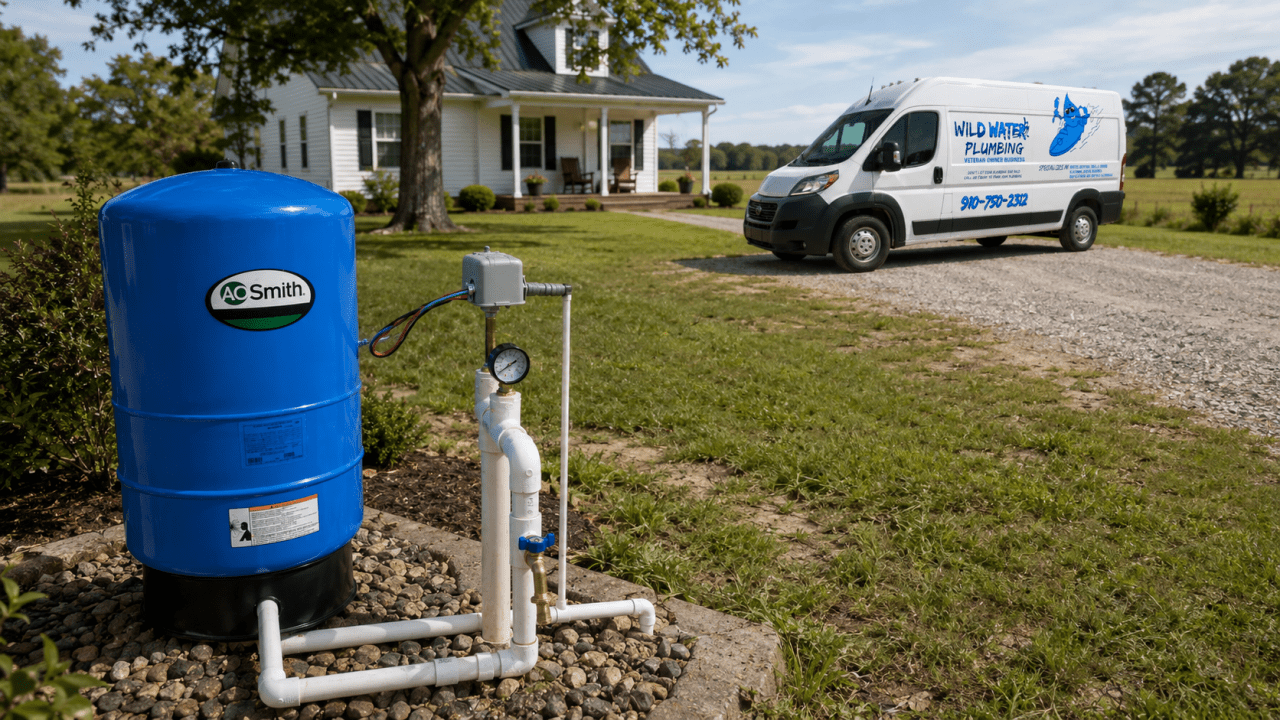
The pressure tank holds a charge of compressed air behind a bladder. When the pump runs, it pushes water into the tank and compresses that air. When you open a faucet, the air pressure pushes water back out, so the pump does not have to start for every small demand. The pump only kicks on when tank pressure drops to the cut-in setting and shuts off at the cut-out setting. That stored cushion of water is what keeps your pump from cycling constantly.
A tank fails when the bladder wears out and ruptures, which lets water fill the air space. That is called waterlogging. Once a tank waterlogs, it can no longer hold the air cushion, and the pump starts short cycling. Tanks also fail from a slowly lost air charge or from corrosion eating through the shell. A pressure tank usually lasts 10 to 15 years, though salt air on the coast and mineral-heavy water both tend to shorten that. A waterlogged tank is also one of the common reasons a well delivers low or no water, which we cover in our guide to no water or a well running dry.
The Signs Your Pressure Tank Is Failing
Rapid Short Cycling
This is the number one sign. The pump turns on and off every few seconds instead of running for thirty seconds or more, and you can usually hear the pressure switch clicking rapidly near the tank. A healthy tank lets the pump run a full cycle. A waterlogged one forces it to restart constantly.
Bouncing or Fluctuating Water Pressure
When the tank cannot hold a steady cushion, your water pressure surges and drops while you shower or run more than one fixture. If you have a pressure gauge on the system, the needle bounces rapidly rather than holding steady.
Sputtering Faucets
A failed bladder lets air mix into the water, so faucets spit and sputter when you first turn them on. Air in the lines, combined with short cycling, is a strong sign the tank is the culprit.
A Heavy or Solid-Sounding Tank
A healthy tank sounds hollow at the top, where the air sits. A waterlogged tank sounds like a solid thud all the way up because it is full of water. The knock test in the next section is the quickest way to check this.
Water at the Air Valve or Visible Rust
If you press the air valve on top of the tank and water comes out instead of air, the bladder has ruptured. Visible rust or corrosion on the outside often means worse corrosion inside, and on the coast that corrosion shows up sooner.
A waterlogged tank sets off a chain reaction. The bladder ruptures, the tank loses its air cushion, the pump short cycles, the motor overheats, and the pump can fail within weeks. If your pump is short cycling, shut it off at the breaker until the tank is fixed. Replacing a tank now is far cheaper than replacing a tank and the pump, and you can see what that bigger repair runs in our breakdown of well pump replacement cost in coastal NC.
How to Check Your Tank Yourself
A few safe checks tell you most of what you need to know before you call:
- The knock test. Tap the tank about four inches from the top and about eight inches from the bottom. The top should sound hollow and the bottom dull and solid. If both sound like the same solid thud, the tank is waterlogged.
- The air valve test. Press the air valve on top of the tank, the one that looks like a tire valve. Air means the bladder is intact. Water means the bladder has failed and the tank needs to be replaced.
- The air pressure check. With the pump off at the breaker and the tank drained, a tire gauge on the air valve should read about 2 psi below the pump cut-in pressure. A reading far off from that points to a lost air charge or a failed bladder.
Keep in mind that a waterlogged bladder tank cannot be repaired in most residential systems, so a failed bladder means a new tank. If the tank passes these checks but you still have low pressure, no water, or a tripping breaker, the problem is more likely the pump or the switch, and the early warning signs of a failing well water system are worth a look.
What Pressure Tank Replacement Costs in Coastal NC
Most pressure tank replacements run about $450 to $1,500 fully installed for a standard residential job. That covers the tank, fittings, the labor to drain and remove the old tank and set the new one, and charging the air to the right pressure. Larger tanks, premium tanks built for a longer life, or a tight spot like a crawl space can push the total toward $2,000 or more. The tank itself is a small share of a standard job, so the labor and access usually matter more than the part.
Source: Angi, HomeGuide, and The Well Guide 2026 pressure tank cost data.
A few things worth knowing. It is often smart to replace the pressure switch at the same time, since an inexpensive switch that lived through the same short cycling has taken the same stress. Sizing matters too: a properly sized or slightly larger tank means fewer pump cycles, and fewer cycles means a longer pump life.
Salt air and humidity are hard on steel pressure tanks and the metal fittings around them, so coastal tanks and fittings tend to corrode years ahead of inland ones. A fiberglass or composite tank does not rust, which makes it a strong fit for homes near the water or in damp crawl spaces. Older steel fittings in the region also sometimes have to be cut rather than unscrewed, which adds a little labor. We help homeowners pick the right tank for their water and their setup through our well water system services.
Our well pump services cover pressure tank replacement, pressure switch and check valve work, pump repair and replacement, and service line repair. Our well water system services cover full-system diagnostics, tank sizing, and getting your pressure steady again. We test the whole system first, so you fix what actually failed. We serve Onslow, Pender, and New Hanover Counties and the Cedar Point area of Carteret County.
📖 The pressure tank is one part of a whole well system. Our complete guide covers every common well water problem across the region, every warning sign, and every option: Well Water Problems: The Complete Coastal NC Homeowner Guide.
Shut the pump off at the breaker, then call us before a tank problem becomes a pump problem. Wild Water Plumbing and Septic handles pressure tank diagnosis and replacement across Onslow, Pender, New Hanover, and the Cedar Point area. Call 910.750.2312 or request a service visit online.
Frequently Asked Questions
What are the signs of a failing well pressure tank?
The clearest sign is rapid short cycling, where the pump turns on and off every few seconds instead of running for thirty seconds or more. Other signs include water pressure that bounces or surges while you run a faucet, sputtering air from the taps, a tank that sounds solid instead of hollow when you tap the top, water coming out of the air valve on top of the tank, and visible rust on the tank. Most of these point to a failed bladder, which means the tank needs to be replaced.
How do I know if my pressure tank is waterlogged?
The quickest check is the knock test. Tap the tank about four inches from the top and about eight inches from the bottom. The top should sound hollow, because that is where the air is, and the bottom should sound dull and solid, because that is where the water is. If both spots sound the same solid thud, the tank is full of water and the bladder has failed. You can confirm by pressing the air valve on top of the tank like a tire valve. If water comes out instead of air, the bladder is ruptured and the tank needs to be replaced.
How much does it cost to replace a well pressure tank in coastal North Carolina?
Most pressure tank replacements run about $450 to $1,500 fully installed, including the tank, fittings, labor, and setting the air charge. Larger tanks, premium tanks built for long life, or tight access like a crawl space can push the total toward $2,000 or more. The tank itself is a small part of the cost on a standard job, which is why replacing a failing tank early is far cheaper than waiting for it to take the pump down with it.
How long does a well pressure tank last?
A well pressure tank typically lasts 10 to 15 years, though some fail sooner. On the coast, salt air and humidity corrode steel tanks and fittings faster than they would inland, and mineral-heavy or acidic water shortens tank life too. A tank that is more than 15 years old is on borrowed time even if it still seems to be working, so it is worth budgeting for replacement before it fails.
Can a waterlogged pressure tank be repaired?
In most residential tanks, no. Once the bladder inside ruptures and the tank waterlogs, the bladder is not field-repairable, so the whole tank has to be replaced. Sometimes a tank that has only lost its air charge can be recharged, but that is usually a sign the bladder is about to fail. The safest move is to replace a waterlogged tank promptly, both to restore steady pressure and to stop the short cycling that wears out the pump.
Why does a bad pressure tank damage my well pump?
When the bladder fails and the tank waterlogs, the tank can no longer hold a cushion of pressurized water between pump cycles. The pump then has to restart for every small water demand, which is called short cycling. Short cycling overheats the motor and wears the bearings far faster than normal, and it can destroy a pump in a matter of weeks. That is why a short-cycling pump should be shut off at the breaker until the tank is fixed, and why replacing a failing tank early protects a much more expensive pump.
Should I replace the pressure switch when I replace the tank?
It is often worth it. The pressure switch is an inexpensive part that sits right next to the tank, and if it has been in service through the same short-cycling that killed the tank, it has taken the same stress. Replacing both at once, especially if the switch is more than about five years old, saves a second service call and a second round of labor a few months down the road.
Can I replace a well pressure tank myself?
It is possible for an experienced homeowner, but it carries real risks. The work involves a pressurized system, electrical connections at the pressure switch, and a heavy, awkward waterlogged tank, and the air pre-charge has to be set correctly for the new tank to work and protect the pump. Setting that charge wrong or miswiring the switch can leave you with the same short-cycling problem you started with. For most people, professional installation is worth the cost, and it keeps the manufacturer warranty valid.
References
Angi. (2026). How much does a well tank replacement cost? Angi Cost Guides. https://www.angi.com
HomeGuide. (2026). Cost to replace a well pressure tank. https://homeguide.com
The Well Guide. (2026). Well pressure tank replacement cost and sizing. https://www.thewell.guide
National Ground Water Association. (2021). Wellowner.org: Pressure tanks and well system components. NGWA. https://wellowner.org
North Carolina Cooperative Extension. (2021). Private well systems: Pressure and pump care for Coastal Plain homeowners. NC State Extension Publications. https://content.ces.ncsu.edu