
THE SHORT VERSION
When you have no water from your well, the cause is one of two things: your equipment failed, or the well itself ran low and the pump is pulling air instead of water. Telling those two apart is the first job, and there is a simple test for it. This guide walks through both sets of causes, the checks you can safely do yourself, the one thing you should never do (keep running a pump with no water), and the point where it is time to call. If your faucets sputtered air right before the water quit, skip ahead and shut your pump off now.
First, Is It the Pump or the Well?
The single most useful question to ask is whether the water stopped suddenly or faded gradually. Water that quit all at once usually means an equipment problem: an electrical fault, a failed pressure switch, a stuck valve, a broken pipe, or a failed pump. Water that faded over time, or only disappears during heavy use, usually means the well is running low. A quick rest test sorts it out. Shut the pump off, use no water for one to two hours, then turn it back on and open a faucet. If water comes back, the well level dropped and recovered, so the well ran low and the pump is fine. If it is still dry, the problem is in the equipment.
A submersible pump is cooled by the water around it. Run it dry and the motor can overheat in as little as 2 to 5 minutes, which turns a free fix, waiting for the well to recover, into a full pump replacement. If your faucets spit air before the water stopped, or the pump is clearly running but nothing comes out of the tap, shut the pump off at the breaker and leave it off until you know what is going on.
Source: well service troubleshooting guidance and EPA private well operation guidelines, 2026.
When It Is Your Equipment (Sudden Loss)
No Power to the Pump
A well pump needs electricity, so the first suspects are a tripped breaker, a well shut-off switch that got bumped off, a power outage, or a failed control box or capacitor. Check the double-pole breaker labeled for the well and reset it once. If it trips again right away, stop. Repeated tripping usually means a fault in the pump motor or wiring, and resetting it over and over is a fire hazard. That one is a call to a professional.
A Failed Pressure Switch
The pressure switch is the small part mounted near the pressure tank that tells the pump when to run. Its electrical contacts corrode over time, and salt air on the coast speeds that up. A switch with burned or pitted contacts can fail to start the pump at all, which leaves you with power at the panel but no water at the tap.
A Waterlogged Pressure Tank
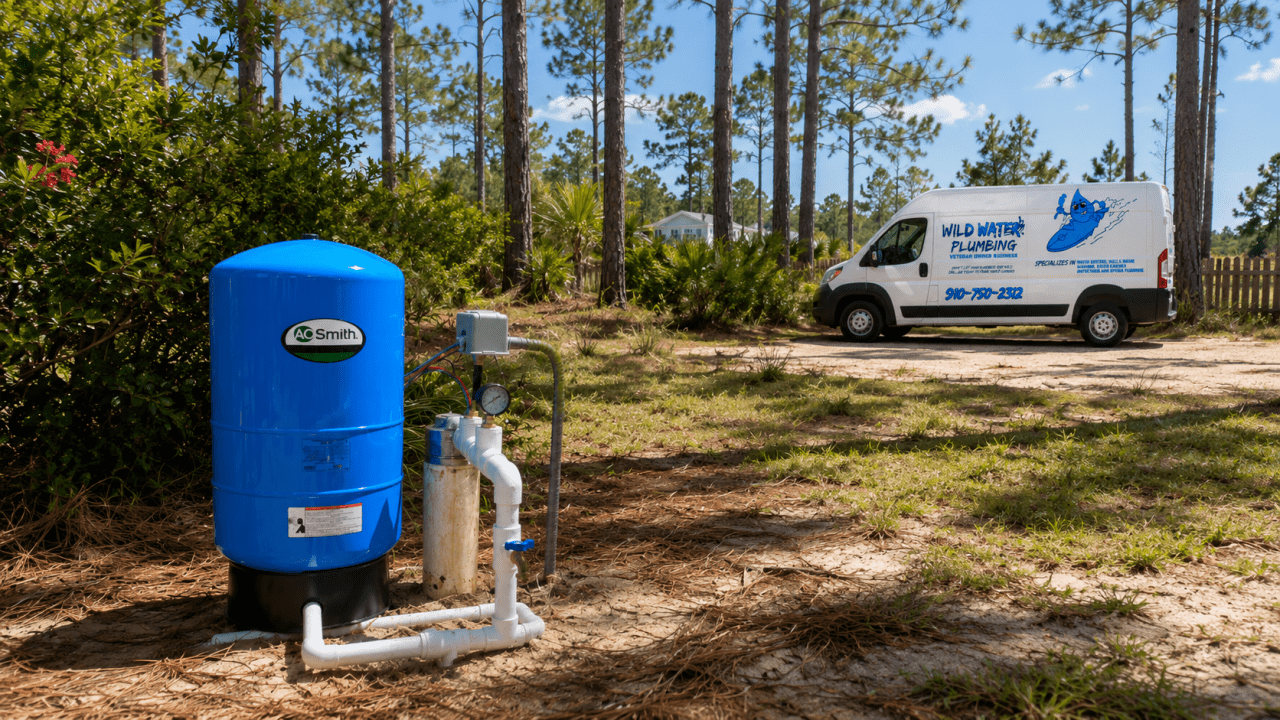
The pressure tank holds a charge of compressed air behind a bladder so the pump does not have to run for every small water demand. When the bladder fails, the tank fills with water, the pump short cycles, and household pressure swings or drops. A waterlogged tank is one of the most common well problems, and it is usually cheaper to fix than the pump. Our guide to well pressure tank replacement covers the signs and the cost.
A Stuck Check Valve or a Line Leak
A check valve stuck closed, or a cracked line between the well and the house, lets the pump move water without ever delivering it to your faucets. A buried line leak often shows up as a wet or soggy patch in the yard between the well head and the house. Keep in mind that anything inside the well bore, including the pump, the drop pipe, and the down-well check valve, takes a pump hoist and a licensed well pro to reach. If the pump turns out to be worn out or burned up, our breakdown of well pump replacement cost in coastal NC walks through what a replacement runs and what drives the price.
When It Is the Well Itself (Running Dry)
A Dropping Water Table
During a drought or a long dry stretch, the static water level in the ground can drop below the pump intake. The pump runs, but it pulls air. This is seasonal in a lot of cases, with the level dropping in dry months and recovering when the rain returns. In this region groundwater tends to sit lowest in late summer and early fall.
More Demand Than the Well Can Supply
Filling a pool, running irrigation for hours, doing several loads of laundry at once, or a hidden leak can all pull water out of the well faster than it refills. A well should recover from heavy use within a few hours. If it does not, the aquifer is running low, and a neighbor drawing hard from the same aquifer can add to the problem.
A Pump Set Too High
If the pump sits too high in the well casing, it runs out of water sooner than it should during dry periods or heavy use. The long-term fix is lowering the pump deeper into the well or, in some cases, deepening the well itself, which runs roughly $500 to $2,000 depending on depth and conditions.
Source: HomeGuide and well service cost data, 2026.
The water table here is usually high, so homeowners are often surprised when a well runs low. Two things cause it. A dry summer drops the level below the pump, and the fast growth in communities like Hampstead, Castle Hayne, and Porters Neck means more homes drawing from the same aquifer system than there used to be. Saltwater intrusion is a separate issue, and that one gives you bad water rather than no water. We cover the full picture in our complete guide to well water problems across coastal North Carolina.
What You Can Safely Check Yourself
Before you call anyone, there are a handful of safe checks worth running. They solve a surprising number of no-water calls on their own:
- Check the breaker for the well pump and reset it once. If it trips again, stop and call a pro.
- Make sure the well shut-off switch near the pressure tank is in the on position, since it gets bumped off easily.
- Confirm no main or inline valve near the tank or pump got turned during recent plumbing work.
- Listen at the pressure tank. Silence means a power or switch problem. Clicking with no pump means the switch is trying but the pump is not responding. The pump running with no water means the well is low or there is a leak or closed valve.
- Walk the ground between the well head and the house and look for a wet or soggy patch that would point to a line leak.
- If you think the well ran low, shut the pump off, let it rest several hours, and test it once. Do not keep cycling it.
If the breaker keeps tripping, you smell anything burning, the trouble is below the well cap, or the well still has not recovered after resting overnight, it is time to bring in a professional. For the early signals that tend to show up before a pump quits completely, see our guide to the warning signs of a failing well water system.
When the fix is below the well cap or in the well itself, we handle it. Our well pump services cover pump repair and replacement, pressure switch and check valve work, pressure tank service, and service line leaks. Our well water system services cover full-system diagnostics, static water level testing, and getting a low-producing well back into service. We serve Onslow, Pender, and New Hanover Counties and the Cedar Point area of Carteret County.
📖 No water is one of many well problems coastal homeowners run into. Our complete guide covers every common issue, every warning sign, and every option across the region: Well Water Problems: The Complete Coastal NC Homeowner Guide.
First, do not keep running the pump if it is pulling air. Then call us. Wild Water Plumbing and Septic diagnoses and fixes no-water and low-water well problems across Onslow, Pender, New Hanover, and the Cedar Point area. Call 910.750.2312 or request a service visit online.
Frequently Asked Questions
Why does my well suddenly have no water?
A sudden loss of water from a well usually points to the equipment rather than the well itself. The most common causes are a tripped breaker or other electrical fault, a failed pressure switch, a waterlogged pressure tank, a check valve stuck closed, a broken drop pipe inside the well, or a leak in the line between the well and the house. Because the water stopped all at once, the first things to check are the breaker and the well shut-off switch, then whether the pump is running at all.
Why is my well running out of water?
A well runs low when the water level in the ground drops below the pump intake, so the pump pulls air instead of water. This happens during droughts and dry stretches, after heavy water use like filling a pool or running irrigation for hours, or when more homes are drawing from the same aquifer than it can keep up with. If your water fades during heavy use and comes back after the well rests, the well level dropped temporarily rather than the equipment failing.
How can I tell if my well is drying up or if it is the pump?
The fastest test is to shut the pump off, use no water for one to two hours, then restart it and open a faucet. If water flows normally, the well level dropped and recovered, which means the well ran low rather than the pump failing. If the pump runs but still delivers no water after resting, the problem is in the equipment. A well company can confirm by measuring the static water level in the well with a depth sensor.
What should I do first if my well stops producing water?
Start with the simple checks. Look at your electrical panel for a tripped breaker on the well pump and reset it once, but if it trips again, stop and call a professional, because repeated tripping can be a fire hazard. Make sure the well shut-off switch near the pressure tank is on and that no valve got bumped closed. Then listen at the pressure tank to hear whether the pump is running. If you suspect the well ran low, shut the pump off so it does not run dry while you sort out the cause.
Can a well that ran dry recover?
Often, yes. A well that ran low from drought or heavy use usually recovers once the water level rises again, sometimes within a couple of hours and sometimes over a day or more during a severe drought. Shut the pump off, let the well rest, and test it once rather than running the pump every few minutes. If the well does not recover after resting overnight, or if it keeps running dry, it may need the pump lowered or the well deepened, which is a job for a licensed well professional.
Is it bad to keep running my well pump when there is no water?
Yes, and this is the one thing to avoid. A submersible pump is cooled by the water around it, so running it dry lets the motor overheat in as little as a few minutes, which can turn a free fix like waiting for the well to recover into a full pump replacement. If your faucets sputtered air before the water quit, or the pump is running but nothing comes out, shut the pump off at the breaker and leave it off until you know the cause.
Why would a well run dry in coastal North Carolina?
It surprises people because the water table here is usually high, but coastal wells still run low for two reasons. A dry summer or drought drops the static water level below the pump, and the rapid growth in areas like Hampstead, Castle Hayne, and Porters Neck means more homes drawing from the same aquifer. Groundwater levels in this region tend to be lowest in late summer and early fall, which is when most low-water calls come in.
Who should I call when my well stops producing water?
Any repair below the well cap, including the pump, the drop pipe, or a down-well check valve, needs a licensed well professional with the right equipment, not a do-it-yourself fix. Wild Water Plumbing and Septic handles well pump repair and replacement, pressure switch and tank service, line leaks, and low-producing wells across Onslow, Pender, and New Hanover Counties and the Cedar Point area of Carteret County. If you have no water and someone in the home has a medical need for it, treat it as urgent.
References
U.S. Environmental Protection Agency. (2022). Operation and maintenance of private drinking water wells. EPA Office of Water. https://www.epa.gov/privatewells
National Ground Water Association. (2021). Wellowner.org: Troubleshooting well system and water supply problems. NGWA. https://wellowner.org
U.S. Geological Survey. (2021). Groundwater levels and drought conditions in the North Carolina Coastal Plain. USGS Water Resources. https://www.usgs.gov/centers/sa-water
North Carolina Cooperative Extension. (2021). Private well systems: Low water and pump problems for Coastal Plain homeowners. NC State Extension Publications. https://content.ces.ncsu.edu
Angi. (2026). Well water stopped working: Causes and what to do. Angi Home Guides. https://www.angi.com