
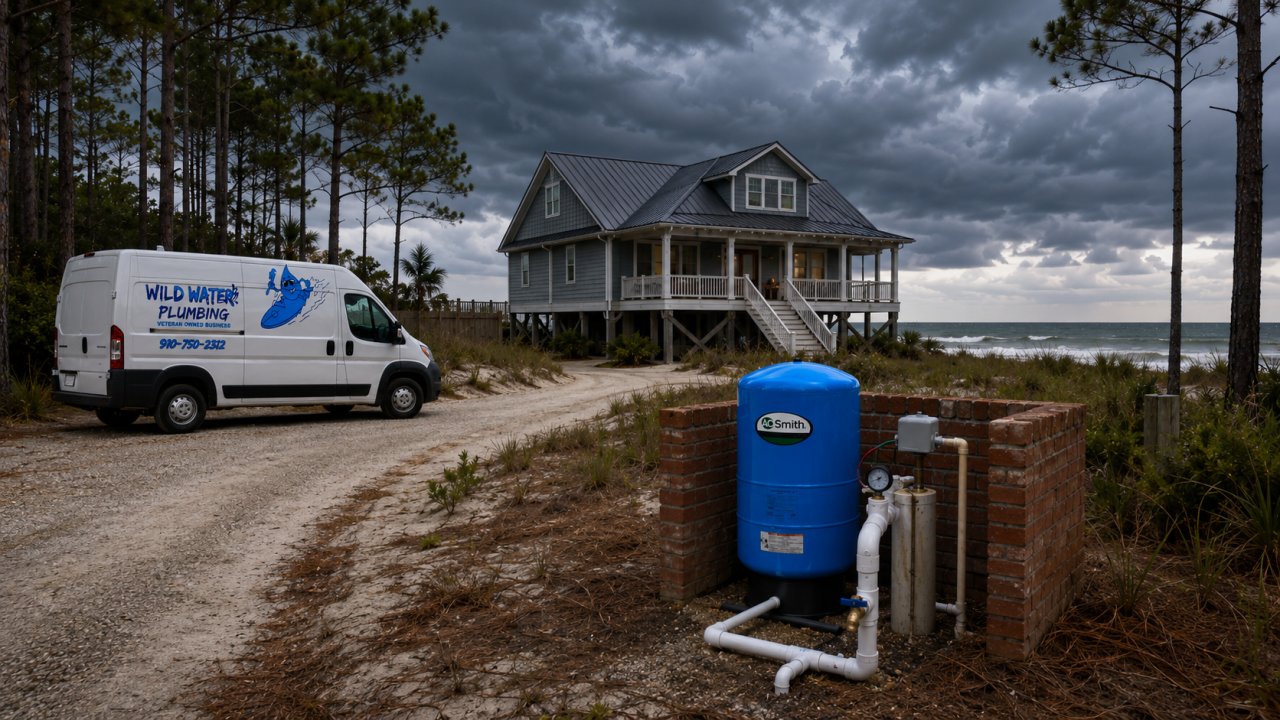
If you're reading this on your phone with a faucet that just coughed air at you, skip to the table below. It sorts the twelve most common well water problems by what you're seeing at the tap and tells you what usually fixes each one.
I'm Justin Wilder. I own Wild Water Plumbing + Septic in Jacksonville, and I've spent years pulling pumps, replacing pressure tanks, and standing in yards from Richlands to Hampstead explaining why a well that ran fine in April is sputtering in September.
Three different problems look almost identical from the kitchen sink: a well that is drying up, a pump that is failing, and a well screen that is clogged. All three sputter, fade, and throw sediment. The fixes have nothing in common, and I've watched homeowners buy a new pump for a well that only needed a rest.
This guide covers each one, how I tell them apart on a service call, what the water is telling you when it turns black or grey, and what solves it here in Onslow, Pender, and New Hanover Counties. About 2.4 million North Carolinians drink from a private well, one in four of us, and nobody monitors those wells except the people who own them. That's you, so let's make sure you know what you're looking at.
Jump to what you're dealing with
- Well water problems and solutions at a glance
- No water at all in the house
- Is my well drying up?
- How many gallons per minute should a well produce?
- Signs of a failing well pump
- What the pressure tank does
- Low water pressure on a well
- Symptoms of a clogged well screen
- Black, grey, yellow, muddy, or slimy water
- When a whole neighborhood loses water
- What I see by county
- How to keep a well from failing
- Frequently asked questions
Well water problems and solutions at a glance
Find what you're seeing in the left column. The middle column is the cause I find most often on a call, not the only possibility. The right column is the fix that usually follows.
| What you notice | Most likely cause | What fixes it |
|---|---|---|
| Faucets sputter and spit air, worst in the evening | Water level dropping below the pump intake (drying or low yield well). Sometimes a leak or bad check valve on the drop pipe. | Run the two hour test below. Lower the pump if the well allows, add a low water cutoff, or add a storage tank. |
| Water runs fine, then quits after a long shower or the sprinkler, and comes back an hour later | Slow recovery rate. The well refills slower than you are using it. | Spread demand out. Storage tank with a booster pump. Well contractor for rehabilitation or deepening. |
| No water at all and the pump is silent | Tripped breaker, failed pressure switch, bad control box or capacitor, or a dead motor. | Reset the breaker once. If it trips again or nothing changes, call. |
| No water, and the pump hums or runs without stopping | Pump cannot reach cut out pressure: dropped water level, split drop pipe, stuck check valve, or worn impellers. | Turn the pump off so it does not run dry, then call for diagnosis. |
| Pump clicks on and off every few seconds | Waterlogged pressure tank or a failed pressure switch. This is what burns out pumps. | Knock test on the tank. Replace the tank or switch before the pump fails. |
| Pressure has faded slowly over months, and you saw more sand for a while | Clogged well screen or a failing gravel pack. Yield is falling, not the aquifer. | Yield test, then well rehabilitation by a certified well contractor. |
| Fine grey silt or sand in the water | Sediment getting past the screen or a corroded casing, or a pump set too close to the bottom. | Inspect the well. A sediment filter buys time; it is not the fix. |
| Water turned black, brown, or orange | Manganese (black), iron (orange or brown), iron bacteria, or sediment stirred up by a dropping water level. | Get it tested. Treatment sized to the result, not the color. |
| Cloudy or muddy after heavy rain | Surface water getting in through a cracked casing, loose cap, or failed grout. | Stop drinking it. Test for coliform. Repair the wellhead and disinfect. |
| Rotten egg smell | Hydrogen sulfide from sulfur bacteria. If only the hot water smells, it is the water heater anode rod. | Test, then treat. Anode rod replacement if it is only the hot side. |
| Electric bill jumped and nothing else changed | Pump running far longer than it should: bad tank, a leak, or a low water level. | Diagnosis of tank, switch, and drop pipe before anything is replaced. |
| Neighbors are losing water too | Shared aquifer dropping, a new large withdrawal nearby, saltwater moving in, or same age pumps failing together. | See the neighborhood section below. Measure static water levels and compare notes. |
No water in the house and you're on a well: what to check first
No water at all from a well is almost always electrical or mechanical, not a dry aquifer. Aquifers drop over weeks and give you weeks of warning. Water that worked last night and not this morning points at the breaker, the pressure switch, the control box, or the pump motor. Check the pump breaker first and reset it exactly once, then read the pressure gauge on the tank.
Work through it in this order. Stop at the first thing that explains what you're seeing.
- The breaker for the pump. Reset it once. If it trips again, stop there. That's a motor or wiring fault, and repeated resets cook what is left of the motor.
- The pressure gauge on the tank. Zero with the breaker on means the pump isn't running or isn't moving water. Normal pressure with dry taps means the problem sits between the tank and the house: a closed valve, or a broken line under the yard. Our water line repair page covers that one.
- The pressure switch. Power off, pull the cover, look for burned or pitted contacts and ants. Yes, ants. They pack the contacts in this climate and the pump never gets the signal to start.
- Listen at the wellhead when the switch calls for the pump. Silence with power at the switch means the control box, the capacitor, or the motor.
- If none of that turns anything up, it's the water level itself, and that's the two hour test further down this page.
| What you're seeing | What it usually is | What to do right now |
|---|---|---|
| No water, pump is completely silent | Tripped breaker, failed pressure switch, bad control box or capacitor, dead motor | Reset the breaker once. If nothing changes, leave it off and call. |
| No water, pump hums or runs and won't stop | Pump can't reach cut out pressure: dropped water level, split drop pipe, stuck check valve, worn impellers | Shut the pump off at the breaker so it doesn't run dry, then call. |
| Air and sputtering, then nothing | Water level has fallen below the pump intake | Pump off. Give the well two hours. If water returns, it's a supply problem. |
| Water quit, came back on its own an hour later | Recovery rate. The well refills slower than you use it. | Read the drying up section below. The pump is probably fine. |
| No water and the power is out | No power means no pump. The tank holds a few minutes of water and that's it. | Nothing to fix. Keep drinking water on hand during storm season. |
One thing worth saying plainly, because it costs people pumps every year: a submersible pump is cooled by the water around it. If it's running and not moving water, turn it off. A pump that runs dry through an afternoon can be a pump you're replacing the following week. Ask us about a low water cutoff control while we're there. It shuts the pump down before it runs dry and restarts it once the well recovers.
Everything past the breaker is our work. A well pump runs on 240 volts next to water, and it isn't the place to learn.
How do I know if my well is drying up?
A well that is drying up sputters air at the faucets, loses pressure late in the day or after heavy use, throws sand or cloudy water, and runs the pump longer than it used to. The tell that separates it from a bad pump is recovery: water comes back after the well rests for an hour or two. A dead pump doesn't recover.
Seven symptoms of a well drying up
- Faucets sputter and spit air. The pump intake is pulling from a water level that keeps dipping below it. This is usually the first sign, and it's usually worst in the evening after a full day of use.
- Water quits after heavy use, then comes back. A long shower, a load of laundry, and the sprinkler in the same hour drain the well faster than it refills. An hour later it runs fine. That's a recovery rate problem, and it means the well is producing water, just not fast enough.
- Pressure drops at the same time every day. Late afternoon, when everybody's home. The well can keep up with one fixture and not three.
- Sand, silt, or cloudy water shows up. As the water level falls, the pump pulls from closer to the bottom of the well, where sediment settles.
- The pump runs longer or doesn't shut off. It's chasing a cut out pressure it can't reach without water to push.
- The electric bill climbs. Longer run times show up on the power bill before they show up anywhere else.
- The neighbors have the same problem. Wells on the same aquifer drop together. There's a whole section on that below.
Why is my well running out of water?
Around here it comes down to four things, and they stack on top of each other.
- Late summer. Most of the rain that falls on the coastal plain never reaches the deep aquifers. It evaporates, runs off, or moves through the shallow groundwater to a creek, and recharge to the confined aquifers below is slow. A dry August pulls the shallow water table down fast, and the dry well calls I get bunch up in August and September for exactly that reason.
- A shallow well. Older wells around Jacksonville, Richlands, and Rocky Point often sit in the surficial aquifer, the first water below the sand. It's the layer that responds fastest to drought.
- More demand than the well was built for. A well drilled for a two bedroom house in 1985 is now feeding a family of five, an irrigation system, and a pressure washer. The well didn't change. The house did.
- A screen that is clogging. This one fools people. Scale, silt, and iron bacteria slowly choke the slots that let water into the well. Yield falls a little every year, and from the kitchen it looks exactly like the aquifer dropping. There's a section on the well screen further down.
What happens when you run out of well water?
The pump keeps running. That's the problem. A submersible pump depends on the water around it to stay cool, and when the level drops below the intake, the motor overheats. Some pumps have a thermal overload that shuts them down. Plenty of older ones don't, and a pump that runs dry for an afternoon can be a pump you're replacing the following week.
If you're getting air and sputtering, turn the pump off at the breaker and give the well a few hours. If the water comes back, you've bought time to plan. Ask us about a low water cutoff control while you're at it. It shuts the pump off before it runs dry and restarts it after the well recovers. It's a small part that protects the expensive one.
Is it the well, the pump, or the screen? The two hour test
Before anyone pulls a pump, do this. It's the same first read I do on a service call.
- Turn the pump off at the breaker and don't use any water for two hours. Overnight is better. If you have an above ground jet pump, skip the breaker and just leave the water alone, because a jet pump can lose its prime.
- Turn the pump back on, let the tank fill, then open an outside hose bib all the way into a bucket and watch the clock.
- Read the result.
- Strong flow for a good while, then sputtering. The well refilled while it rested, then you drained it again. That's a supply problem: a drying well or a low yield well. The pump is probably fine.
- Weak or sputtering right away, even after resting. The well had time to refill and you still can't get water out. Look at the pump, the pressure tank, the pressure switch, or a leak in the drop pipe before blaming the aquifer.
- Water starts gritty and then clears. Sediment settled in the well while it rested. That's a screen or casing problem, or the pump is set too close to the bottom.
None of this is a lab test. It's the read that keeps people from paying for a pump they didn't need, and it tells me which direction to start in before I'm in your driveway.
How many gallons per minute should a well produce?
Your well's tested yield is already written down. North Carolina requires every domestic well to be tested for capacity after it's drilled, running for at least an hour with the discharge rate recorded in gallons per minute, and that number goes on the well construction record. What matters for a house is whether the well keeps up at peak demand, usually a shower and an appliance at the same time, and whether it produces enough over a full day.
Two different numbers decide whether a well is big enough, and people mix them up constantly.
- Gallons per minute is the rate. It decides whether the shower fades when the washer fills.
- Gallons per day is the total. It decides whether you run out by evening.
A well with a modest rate can still run a household fine if the daily total is there, because a storage tank and booster pump collect water all day at whatever rate the well manages and then feed the house at full pressure. That's the fix I reach for most on a low yield well, and it beats drilling in a lot of cases.
Where to find your own numbers:
- The well construction record. Yield test result, total depth, casing depth, and the screened interval. Your county health department's Environmental Health office keeps these, and the state maintains records as well.
- The plate on your pump. North Carolina requires a pump installation information plate showing the installer's name and certification number, the date the pump was installed, the depth of the pump intake, and the horsepower. Go read it. It answers how old your pump is and how deep it's set, which are the two things I ask on the phone and almost nobody knows.
- The static water level. A well contractor measures it and compares it against the level recorded when the well was drilled. That comparison is what tells you whether the aquifer actually dropped or your well is fouling.
Write all of it down somewhere you can find in September.
What can be done about a low producing well?
In rough order of cost, low to high:
- Spread demand out. Laundry in the morning, showers at night, irrigation on a timer at 4 a.m. Cheap, and often enough for a well that's borderline.
- A low water cutoff on the pump. Protects the pump from running dry so a bad week doesn't turn into a pump replacement.
- Lower the pump. If the well is deep enough and the pump is set high, dropping it (with the right pipe, and a check that the pump is rated for the depth) gets you into water that's still there in September. We do this.
- A storage tank and booster pump. The well trickles into a holding tank all day at whatever rate it can manage, and a booster pump feeds the house from the tank at full pressure. This is the fix for a well that produces enough water per day but not enough per minute.
- Well rehabilitation. A certified well contractor cleans a clogged screen with chemical treatment and surging. It restores yield on wells that fouled rather than dropped.
- Deepen the well or drill a new one. Also a certified well contractor's job. Around here that often means getting out of the surficial aquifer and into the Castle Hayne aquifer, which the state's Division of Water Resources lists as the most productive aquifer in North Carolina.
We handle the pump, the controls, the pressure and storage side, and any treatment. We don't drill. When a well needs deepening we'll say so plainly and work with the driller so the pump and pressure system match the new well. Our well water systems page covers what a complete system includes.
What are the signs of a failing well pump?
A failing well pump gives you no water with the breaker on, weak pressure at every tap, a pump that runs without stopping or clicks on and off every few seconds, grinding or rattling from the well or pump house, and an electric bill that jumps. Two of those signs are usually caused by something else that is killing the pump, so check the pressure tank before you order a new one.
Eight signs of a bad well pump
- No water at any tap, and the breaker is on. Pump motor, the capacitor in the control box, or the wiring down the well.
- The pump hums but doesn't move water. A seized motor or a jammed impeller.
- Low pressure at every fixture. Worn impellers can't build pressure. It can also be the tank or a leak in the line, which is why we test before we pull.
- Short cycling. On, off, on, off every few seconds. Almost always a waterlogged pressure tank or a bad switch, and it will burn the pump out.
- Runs constantly. The pump can't reach cut out pressure. A leak in the drop pipe, a stuck check valve, a worn pump, or a water level it can't keep up with.
- Grinding, rattling, or a rhythmic knock. Bearings, a failing motor, or cavitation from pulling air.
- Air spurting from faucets with the water level normal. A failed check valve or a split in the drop pipe letting air into the line.
- Electric bill up with nothing else changed. A pump working harder than it should shows up on the bill first.
Our well pump repair and installation page has the thirty second pressure tank check I ask every caller to do. If you'd rather work through it step by step, the well pump troubleshooting guide goes from the breaker to the control box, and this article on why well pumps fail covers the causes in more depth.
Why is there suddenly no water coming from my well?
Sudden loss of water points away from the aquifer and toward something electrical or mechanical, because wells drop over weeks rather than overnight. The order to check it in is at the top of this page under no water in the house and you're on a well: breaker, pressure gauge, pressure switch, then the wellhead.
How long should a well pump last?
A submersible pump typically runs 8 to 15 years. A jet pump, around 10. A pump that has been short cycling on a bad tank can fail years early. Age matters less than how many times a day the motor has been starting, which is why we test the tank and the switch before anybody talks about pulling a pump.
What does the pressure tank do, and how do I know if it's the problem?
The pressure tank stores water under air pressure so the pump doesn't start every time you open a tap. When its internal bladder fails, the tank fills with water, stops holding pressure, and the pump starts and stops every few seconds. That's short cycling, and it's the single most common reason I replace pumps that were otherwise fine.
The pressure switch turns the pump on at the cut in pressure and off at the cut out, commonly 40 and 60 psi. Between those two numbers the tank is doing the work, pushing stored water out on a cushion of air. A healthy system cycles a handful of times an hour and runs for minutes at a time.
The thirty second tank check
Pump off. Knock on the side of the tank near the top, then near the bottom. Hollow up top and dull down low is healthy. Dull from top to bottom means the bladder is gone and the tank is full of water. Second check, if you want it: with the pump off and the pressure bled down, press the pin in the air valve on top of the tank. Air is good. Water means the bladder has failed.
Pressure pump with a tank vs without one
A conventional pump needs a tank. Run one without a working tank and it will short cycle itself to death. Constant pressure systems, which pair a variable speed pump with an electronic controller, use a much smaller tank because the pump changes speed to match demand instead of starting and stopping. They give you a steady shower when the washer kicks on, and they cost more up front. Worth talking about if you're replacing a pump anyway. Not worth adding to a system that's fine.
Why is my water pressure low on a well?
On a well, weak pressure is usually the pressure tank or the pressure switch rather than the pump. There's no utility to call, because your pressure is made on your own property: the pump pushes water into the tank, the switch decides when to start and stop, and the tank holds pressure between cycles. A failed bladder, a switch set low, or a clogged sediment filter will all read as low pressure at every tap while the pump itself tests fine.
Your pressure is never one number. The switch starts the pump at a cut in pressure and stops it at a cut out, commonly 30 and 50 psi or 40 and 60, so the gauge should swing slowly between those two while you use water. What the gauge does tells you where to look.
| What the gauge does | Most likely cause | What it needs |
|---|---|---|
| Swings fast, pump clicks on and off every few seconds | Waterlogged tank or failed bladder | Knock test, then tank replacement before it takes the pump with it |
| Never gets above about 40 psi, pump shuts off anyway | Switch set low or drifting | Switch adjustment or replacement |
| Reads fine at the tank, weak at the taps | Clogged sediment filter, scaled fixtures, or a restriction in the house piping | Change the cartridge first, then look at the piping |
| Climbs slowly and the pump runs a long time | Worn impellers, a split drop pipe, a stuck check valve, or a falling water level | Diagnosis at the wellhead |
| Strong at first, fades the longer you run water | Recovery rate. The well can't keep up with sustained demand. | The two hour test above, then storage or a lower pump setting |
Change the sediment cartridge before you conclude anything. A packed filter looks exactly like a failing pump from the kitchen sink, and it's the cheapest thing on this page.
If the pressure problem turns out to be inside the house rather than at the well, our guide to the warning signs of low water pressure walks through the fixture side: aerators, shutoff valves, water heater, and the pipe itself.
What are the symptoms of a clogged well screen?
A clogged well screen shows up as a slow loss of yield over months or years: pressure that fades under load, a pump that runs longer to fill the tank, deeper drawdown, and sometimes a burst of sand followed by less water than before. It looks like a well drying up, except the neighbors are fine and it doesn't track the weather.
What a well screen is, and where it is
Your well is a steel or PVC casing that runs from the wellhead down into the aquifer. At the bottom, in the water bearing sand or limestone, the casing has a screened section: a length of slotted pipe, often surrounded by a gravel pack, that lets water in and keeps sand out. How deep depends on the well. The screen sits wherever the driller found water, and on your well log it's listed as the screened interval.
Over years, three things plug it. Mineral scale from iron and calcium. Fine sediment packed into the slots. And iron bacteria, which build a rust colored slime that also makes the water smell and stain. The pump still works. There's just less water reaching it.
Can I clean a well screen myself?
No. The screen is at the bottom of the well, under the pump. Cleaning it means pulling the pump, treating the well with acid or chlorine based chemicals in the right dose, surging to break the buildup loose, and pumping the waste out. That's well rehabilitation, and it's licensed well contractor work. What you can do is catch it early. If your recovery is worse than it was 2 years ago and the pump tests fine, ask for a yield test before the well gets to the point where it can't be saved.
Well screen replacement
Replacing the screen means pulling the casing or relining the well, and on most residential wells that costs more than a new well. So the honest answer is usually this: rehabilitate the well if it can be saved, drill a new one if it can't. We're the wrong people to sell you either one. What we'll do is tell you which of the two you're looking at, based on what the pump and the water are doing.
Why is my well water black, grey, muddy, or full of dirt?
Black well water is usually manganese, or bacterial slime breaking loose from inside the well. Grey silt means fine sediment is getting past the screen. Muddy water after rain means surface water is getting into the well, which is a safety problem, not a nuisance. Orange or brown is iron. Any sudden change in color is a reason to stop drinking the water and get it tested.
- Black, all of a sudden. Two common causes. Manganese that has been in the water all along oxidizes and turns black when it meets air, and stains black. Or a dropping water level or a struggling pump has stirred up sediment and bacterial slime that had settled at the bottom of the well. If it came on suddenly along with sputtering, it's the second one, and it means the well or the pump needs attention, not just a filter.
- Fine grey silt or sand. Sediment that the screen and gravel pack should stop is getting through. A failed screen, a corroded casing, or a pump set too close to the bottom. A sediment filter buys time but doesn't fix it, and sand grinds up pump impellers.
- Muddy or cloudy after heavy rain. Surface water is reaching the well through a cracked casing, a loose or damaged well cap, failed grout, or a wellhead that sits in a low spot and floods. Stop drinking it. Coliform bacteria travel with that water.
- Orange, red, or brown. Iron. Iron bacteria if there's slime in the toilet tank. It stains everything, it's harmless to drink, and it's treatable.
- Rotten egg smell. Hydrogen sulfide from sulfur bacteria in the well. If it's only in the hot water, it's the water heater's anode rod, which is a different and much smaller fix.
- Blue green stains on fixtures. Low pH water dissolving the copper in your own pipes. Common in Onslow County. A neutralizer corrects it and protects the plumbing.
Why does my well water feel slimy?
Two very different causes, and they're easy to tell apart. If the slick feeling comes with rust colored staining, a smell, and slime in the toilet tank, it's iron bacteria building a biofilm inside the well and the plumbing. That's a shock chlorination and treatment conversation. If the water feels slippery and everything else looks fine, and you have a softener, that's the softener doing its job. Softened water feels that way because the hardness minerals that make soap rinse off quickly are gone. A softener that suddenly feels much slicker than it used to is worth checking for a stuck regeneration cycle.
Why is my well water yellow?
Yellow or tea colored water with no grit in it usually means tannins, which are organic compounds leached from decaying plant matter in the ground. We sit in blackwater country here, so shallow wells near swampy ground and creek bottoms pick them up. Tannins stain laundry and taste earthy, and a standard iron filter won't touch them. Yellow that settles out or leaves orange staining is iron instead, and that's a different filter. Get the water tested so you're treating the right one.
How do I get sediment out of my well water?
A sediment filter ahead of the house catches sand and silt, and a spin down filter with a flush valve handles heavy sand better than a cartridge you'd be changing weekly. Both of them manage the symptom. Sand in the water means the screen, the gravel pack, or the casing is letting it through, or the pump is set too close to the bottom of the well, and sand grinds up pump impellers on its way to your filter. Filter it so you have water, then find out why it's there.
How long does it take for well water to clear up?
After the pump has been pulled or the well disturbed, run an outside hose bib and give it a few hours of steady flow. Most stirred up sediment clears in that window. If it's still cloudy the next day, or it clears and then comes back every time the pump runs hard, it isn't settling and something is feeding it. Cloudy water that shows up after heavy rain is a different problem entirely, and that one means stopping drinking it until it's tested.
Is the water still safe to drink?
Not until a test says so. Color, smell, and grit are nuisances. The things that make people sick (coliform bacteria, E. coli, nitrate, arsenic, lead) have no taste or color at all, and they often arrive at the same time as the visible stuff, because the same crack in the casing lets both in.
Getting a test isn't through us. Call the Environmental Health office at your county health department. North Carolina runs its private well program through NCDHHS and the local health departments, and the state recommends testing for coliform bacteria every year, metals and nitrates every 2 years, and pesticides or volatile chemicals every 5 years. Test again whenever the well floods, you replace the pump or any part of the system, or the water changes.
Bring the result to us and we'll size treatment to it. Buying a filter based on what the water looks like treats the problem you can see and ignores the one you can't. If drinking water at the kitchen tap is the worry, a kitchen sink reverse osmosis system handles that one tap without changing the rest of the house.
What happens when a whole neighborhood starts having well failures?
When several wells on one road fail in the same season, the cause is almost always shared. The aquifer they all draw from dropped, a new large withdrawal nearby is pulling it down, saltwater is moving into a coastal aquifer, or every house was built the same year with the same pump and they're all reaching end of life together.
The aquifer dropped. Drought, or a run of dry summers. Shallow wells go first and deep wells last. Recovery follows the rain, sometimes months behind it.
A new big user moved in. A subdivision, a farm irrigation system, a municipal or industrial well. Pumping a high volume well pulls the water level down in a cone around it, and that cone can reach private wells a good distance away. Onslow County sits inside the state's Central Coastal Plain Capacity Use Area, where large groundwater withdrawals are permitted and tracked by NCDEQ's Division of Water Resources for exactly this reason.
Saltwater. Near the coast, pumping too hard on the freshwater lens lets salt move in from below or from the sound. The aquifers under the Castle Hayne already hold saltwater across much of coastal North Carolina. Once a well turns brackish, it rarely turns back.
Same age, same pump. A subdivision built in 2010 with the same pump in every yard will produce a run of pump failures around year 12 to 15 that has nothing to do with the aquifer.
What to do. Compare notes with the neighbors: when it started, how deep their wells are, and what changed nearby. Ask a well contractor to measure your static water level and compare it with the level on your well log. If the level has dropped across the road, contact the Division of Water Resources regional office; they track groundwater levels and permit large withdrawals. If it's the pumps, that's us.
Well water problems I see by county
Onslow County
Jacksonville, Richlands, Hubert, Sneads Ferry, Swansboro. Sandy soil and a lot of shallow wells. Iron, manganese, and low pH water are the everyday complaints, with sulfur smell close behind. Older wells in the surficial aquifer are the first to sputter in a dry August. Because Onslow is inside the Central Coastal Plain Capacity Use Area, large water users here are permitted and tracked, which is worth knowing if your whole road drops at once.
Pender County
Hampstead, Burgaw, Rocky Point, Surf City. Iron and sulfur inland. Close to the Intracoastal, saltwater is the concern. Across much of coastal North Carolina the aquifers below the Castle Hayne already hold saltwater, according to USGS, so coastal wells tend to stay shallow, and shallow wells feel drought and surface contamination first. In the farm country around Burgaw, test for nitrates.
New Hanover County
Castle Hayne, Ogden, and the unincorporated areas north of Wilmington. Most private wells here draw from the Castle Hayne aquifer, which gives good volume and hard water. Iron runs higher near the aquifer's recharge areas and drops off as the water moves through the limestone. Scale on the water heater and a softener are the usual story. PFAS has been in the news for this county's river water. A private well isn't drawing from the river, but if you're near a known contamination site, ask the county health department whether PFAS testing makes sense for you.
Cedar Point
Between the White Oak River and Bogue Sound, which means storm surge and flooding reach wellheads that inland wells never see. Test after every storm. Salt is the other worry. A well that starts tasting salty needs a conversation about depth, not a filter. We cover Cedar Point from the Jacksonville shop.
How to keep a well from failing
- Test every year for bacteria, every 2 years for metals and nitrates, and after any flood. County health department, not us.
- Walk to the wellhead twice a year. Cap tight, no cracks in the casing, ground sloping away, nothing stored on it or against it.
- Knock on the pressure tank once a month. Hollow on top, dull on the bottom. Thirty seconds.
- Watch the gauge. If the needle swings fast and the pump clicks often, call before the pump pays for it.
- Change sediment cartridges on schedule. A packed filter looks exactly like low pressure.
- Write things down. The well log, the pump install date, the tank date, and every test result. A 12 year old pump on a 1990s well is information you want in your hand before September.
- Keep chemicals, fuel, and the septic drain field away from the wellhead. What goes on the ground goes in the well.
When to call Wild Water
Call when the pump won't run, when it won't stop, when the tank fails the knock test, when the water changes, or when you've done the two hour test and want the next answer. We diagnose the whole system, tank and switch included, before anyone talks about pulling a pump, and you get the price before the work starts.
We repair and replace well pumps, pressure tanks, switches, controls, and water lines, install low water cutoffs and constant pressure systems, and size well water treatment to your county test result. We don't drill wells and we don't run the water test. When you need either one, we'll say so and point you to the right people.
Same day service is often available across Onslow, Pender, and New Hanover Counties, plus Cedar Point. Veterans, ask about our veteran discount program.
Frequently Asked Questions
How do I know if my well is drying up?
The first signs are faucets spitting air, pressure that fades in the evening or after heavy use, and cloudy or sandy water, with everything back to normal after the well rests for an hour or two. That recovery is what separates a drying well from a failing pump. A pump that has failed stays failed.
Why is my well running out of water in late summer?
Very little rain reaches the deep aquifers of the coastal plain. Most of it evaporates, runs off, or drains through shallow groundwater to a creek. A dry August pulls the shallow water table down quickly, and shallow wells feel it first. Demand also peaks in summer with irrigation and a full house.
Can a dry well come back?
Often, yes. If the well went dry because of drought or heavy use, the water level recovers when the rain returns or the demand drops. If it went dry because the screen is clogged or the aquifer has permanently dropped, it needs rehabilitation, a lower pump setting, or a deeper well. A well that has gone brackish from saltwater rarely comes back.
What are the first signs of a failing well pump?
Low pressure at every tap, a pump that runs without stopping, short cycling every few seconds, grinding or rattling noises, and an electric bill that climbs. Check the pressure tank before replacing the pump, because a waterlogged tank causes two of those signs and will destroy the new pump the same way it destroyed the old one.
Why is there suddenly no water coming from my well?
Sudden loss of water usually means an electrical or mechanical failure rather than a dry well. Check the pump breaker first and reset it once. If the breaker holds and there is still no water, the pressure switch, control box, or pump motor has failed, or a line is broken. Aquifers drop over weeks, not overnight.
What are the symptoms of a clogged well screen?
Gradual loss of yield over months or years, a pump that runs longer to fill the tank, pressure that fades under load, and sometimes a burst of sand followed by less water than before. It resembles a well drying up, but it does not follow the weather and the neighbors' wells are fine.
Where is the well screen located, and can I clean it myself?
The screen is the slotted section of casing at the bottom of the well, in the water bearing layer, below the pump. Cleaning it means pulling the pump and treating the well with chemicals and surging, which is licensed well contractor work. It is not a homeowner job.
Why is my well water black all of a sudden?
Sudden black water is usually manganese oxidizing when it meets air, or sediment and bacterial slime stirred up from the bottom of the well by a dropping water level or a struggling pump. If it arrived along with sputtering, the well or pump needs attention. Stop drinking it and get it tested before choosing any treatment.
Is well water safe to drink after it turns cloudy or changes color?
Not until a test says so. The contaminants that cause illness, including coliform bacteria, nitrate, arsenic, and lead, have no taste or color, and they often enter through the same crack or bad cap that let the sediment in. Contact the Environmental Health office at your county health department for testing.
What is the purpose of a pressure tank on a well?
The pressure tank stores water under air pressure so the pump does not start every time a tap opens. It smooths out pressure and limits pump starts. When its bladder fails, the tank waterlogs, the pump short cycles, and the motor burns out. Knock on the tank: hollow at the top and dull at the bottom is healthy.
How do I know if I have well water?
Look for a pressure tank, usually a blue or grey cylinder in a garage, closet, crawl space, or pump house, and a capped pipe sticking out of the ground somewhere in the yard. If you have no monthly water bill from a utility, you are on a well.
What if my well fails inspection when selling a house?
A failed well inspection usually means a bacteria hit, a low yield result, or a wellhead that does not meet current standards. Bacteria is often fixed by disinfecting the well and repairing the cap or casing, then retesting. Low yield may need rehabilitation or a storage tank. Get the written result and call us before agreeing to any repair credit.
Why is there no water in my house when I have a well?
No water at all is almost always electrical or mechanical rather than a dry well, because aquifers drop over weeks and give warning. Reset the pump breaker once. If it trips again, stop and call. If the breaker holds, read the pressure gauge on the tank: zero means the pump isn't running or isn't moving water, and normal pressure with dry taps means the problem is between the tank and the house.
Why is my water pressure low on a well?
Low pressure on a well is usually the pressure tank or the pressure switch, not the pump. A failed bladder lets the tank waterlog so it can't hold pressure, a switch set low stops the pump early, and a clogged sediment filter chokes flow to the whole house. Watch the gauge while you run water, because how it moves tells you which of the three it is.
How many gallons per minute should a well produce?
Your well's tested yield in gallons per minute is recorded on the well construction record, because North Carolina requires every domestic well to be capacity tested for at least an hour after it's drilled. Rate matters for running two fixtures at once and daily total matters for running out by evening. A low rate well can still serve a house with a storage tank and booster pump.
How do I find out how deep my well is and how old my pump is?
The well construction record held by your county health department's Environmental Health office lists total depth, casing depth, the screened interval, and the yield test result. For the pump, read the installation plate on it. North Carolina requires that plate to show the installer's name and certification number, the install date, the depth of the pump intake, and the horsepower.
Why does my well water feel slimy?
Rust colored staining and slime in the toilet tank alongside the slick feeling means iron bacteria growing inside the well and the plumbing, which needs shock treatment and a plan. A slippery feel with otherwise normal water usually just means a working softener, since softened water rinses soap off more completely.
Why is my well water yellow?
Yellow or tea colored water with no grit usually means tannins, organic compounds from decaying plant matter, which are common in shallow wells near swampy ground in coastal North Carolina. They stain laundry and an iron filter won't remove them. Yellow water that settles out or leaves orange stains is iron instead, and needs different treatment.
How do I get sediment out of my well water?
A sediment filter or a spin down filter with a flush valve ahead of the house will catch sand and silt. That handles the symptom. Sand in the water means the well screen, gravel pack, or casing is letting it through, or the pump sits too close to the bottom, and sand wears out pump impellers, so the source still needs finding.
Do droughts affect well water?
Yes, and shallow wells feel it first. Very little rain reaches the deep aquifers of the coastal plain, so a dry summer pulls the shallow water table down quickly while deeper wells hold on longer. Recovery follows the rain, sometimes by months. Wells that go brackish from saltwater rather than dry rarely recover.
Related pages and guides
Sources
- NC Administrative Code 15A NCAC 02C .0110, Well Tests for Yield (every domestic well tested for capacity, at least one hour, discharge recorded in gallons per minute): Well construction standards, 15A NCAC 02C
- NC Department of Environmental Quality, Water Well Construction (pump installation information plate: installer name and certification number, install date, pump intake depth, horsepower): files.nc.gov
- NC Department of Health and Human Services, Private Wells program: epi.dph.ncdhhs.gov/oee/programs/wellwater.html
- NC Division of Public Health, Testing Private Well Water (recommended testing schedule): epi.publichealth.nc.gov/oee/wellwater/howtotest.html
- NC Department of Environmental Quality, Division of Water Resources, North Carolina Aquifers (Castle Hayne productivity, coastal plain recharge): ncwater.org
- NC DEQ, Capacity Use Areas (Central Coastal Plain Capacity Use Area): deq.nc.gov
- U.S. Geological Survey, Regional study of the Castle Hayne aquifer of eastern North Carolina (saltwater in underlying aquifers): usgs.gov
- NC State Extension, Ground Water in the Coastal Plain of North Carolina (hardness, iron, and chloride patterns): content.ces.ncsu.edu
- Drinking Water Disparities in North Carolina Communities Served by Private Wells (2.4 million residents, one in four): pmc.ncbi.nlm.nih.gov