
Ditch and Culvert Cleaning • Veteran Owned
The Pipe Under Your Driveway Is Probably Half Full of Dirt.
Roadside ditches silt in a little at a time, and the pipe that runs under your driveway silts in with them. Nothing looks broken until the water backs up. We clear ditches and driveway culverts for homeowners across Onslow, Pender, and New Hanover Counties, plus Cedar Point.
Free evaluations • We check who owns the ditch before we dig • Licensed and insured

How Much Dirt Does It Take to Stop a Pipe?
Less than you would think. A homeowner looks in the end of a culvert, sees some daylight left at the top, and reasonably assumes it is still mostly working. It is not. Water in a pipe does not lose capacity in a straight line as dirt builds up under it. It falls off a cliff.
Silted to 25%of the pipe diameter
72% of capacity left
Silted to 50%of the pipe diameter
36% of capacity left
Silted to 75%of the pipe diameter
9% of capacity left
Two things happen at once when silt settles in the bottom of a pipe. The opening gets smaller, which is the part you can see. And the water that is left has to drag itself across a wide flat bed of dirt instead of a narrow rounded invert, which is friction you cannot see. Put those together and a pipe with a quarter of its diameter still open is not running at a quarter of its capacity. It is running at roughly a tenth.
This is why it seems to fail overnight. For years the ditch fills slowly and nothing changes, because a pipe at seventy percent of capacity still handles an ordinary rain. Then one summer it crosses a line, and the first real storm after that puts water where it has never been. Nothing about the pipe changed that week. It had been losing ground the whole time.
Figures calculated with Manning's equation for a circular pipe, holding slope and roughness constant and treating the silt bed as no rougher than the pipe wall itself. A real bed of packed dirt and leaf litter is rougher than that, so the losses on an actual pipe are likely worse than the numbers above. Manning's equation is the same standard method the state uses to size drainage structures; see the NCDOT Guidelines for Drainage Studies and Hydraulic Design.
Two Jobs That Usually Come as a Pair
Most calls start with one and end with both, because a silted ditch and a silted pipe feed each other.
The ditch itself
The shallow grassed channel between your lawn and the road. It was cut with fall in it so water moves along to the next low point. Every mowing season it collects a little clipping, a little leaf, a little washed in sand, and every year it sits a fraction higher. Eventually the bottom of the ditch is level with the yard and the water has no reason to go anywhere. We cut the profile back in and restore the fall.
The driveway culvert
The pipe that carries the ditch under your driveway apron so you can drive over it. It is the narrowest point in the whole run, which makes it the first place sediment drops out and the last place anyone looks. We clear it end to end, pull the debris well back from the channel so it cannot wash straight back in, and tell you honestly what shape the pipe is in once we can see it.
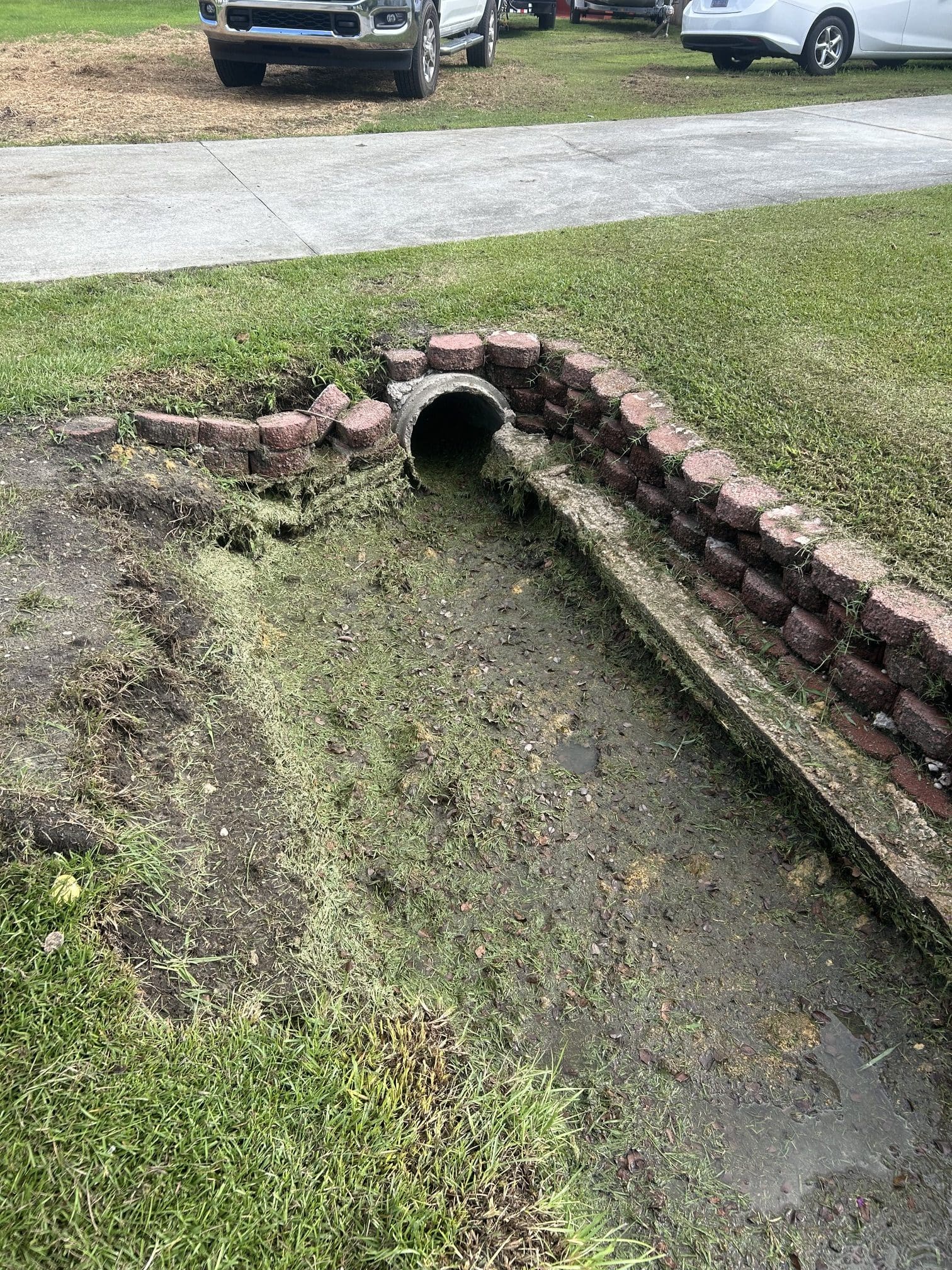
This is what three quarters full looks like from the outside. There is still daylight in the top of that pipe, and it was moving almost none of the water it was built to move.
Who Owns the Ditch in Front of Your House?
It depends on who maintains the road, and it is worth knowing before you pay anybody, including us.
Broadly there are three situations. If your street is state maintained, the roadside ditch sits in the state right of way and the North Carolina Department of Transportation maintains it. If your street belongs to a town, the town's public works department does. If you are on a private road or in a subdivision that never turned its streets over, the ditch belongs to whoever the plat says it belongs to, which is often the homeowners association or the individual lot owners.
The driveway pipe is usually the odd one out. It exists so that you can get across the ditch to your own property, and in most arrangements the responsibility for keeping it clear sits with the property owner even though the pipe is physically inside the right of way. That is the piece homeowners most often did not know was theirs.
If your road is state maintained, ask NCDOT first.
The state runs a form for reporting a blocked culvert or ditch on a state maintained road, and it costs you nothing to use it. We would rather you tried that and called us if it does not get you anywhere. Where we are genuinely useful is the driveway pipe, private and subdivision streets, and the stretch of ditch that runs across your own land. See the NCDOT road maintenance and reporting FAQs.
We check this before we quote. If the work belongs to somebody else we will say so on the visit rather than after the invoice, and if permission or a permit is needed to work in the right of way we will tell you what we know and what still has to be confirmed.
Signs Your Ditch and Culvert Have Silted In
None of these need a rain gauge or a tool. Walk out to the road on a dry day and look.
Water still sitting in the ditch days later
A working ditch is dry within hours of the rain stopping. Standing water in the channel on a clear day means the water has nowhere to go, not that it rained hard.
You cannot see through the pipe
Look in one end of the driveway culvert. If you cannot see a clean circle of daylight through the far end, something is in there and it is costing you far more capacity than it appears to.
A notch cut into the edge of your driveway
When the pipe cannot take the flow, water climbs and runs over the driveway instead, and it takes the shoulder with it. That scalloped edge is the pipe telling you it gave up.
Grass and weeds growing in the ditch bottom
Plants need soil and they need the ground to stay put. A ditch carrying water properly scours itself. One growing a healthy crop has been still long enough for silt to settle and root.
The ditch bottom is level with your yard
Stand at the road and look along the line. If you cannot see a channel, there is not one anymore. Years of clippings and washed in sand have filled the profile flat and taken the fall out with it.
Water runs across the driveway in a storm
This is the last stage. The pipe has stopped carrying a meaningful share of the flow, so the driveway apron has become the spillway, and everything downstream of you is getting water it was not meant to get.
Watch
See it at the roadside
The signs above are easier to recognize once you have seen them. Take a look, then walk out to your own road and check the six things on this list.
- Look in one end of the driveway pipe on a dry day
- Check whether a clean circle of daylight comes through the far end
- Look along the ditch line for a channel you can actually see
One Job, Start to Finish
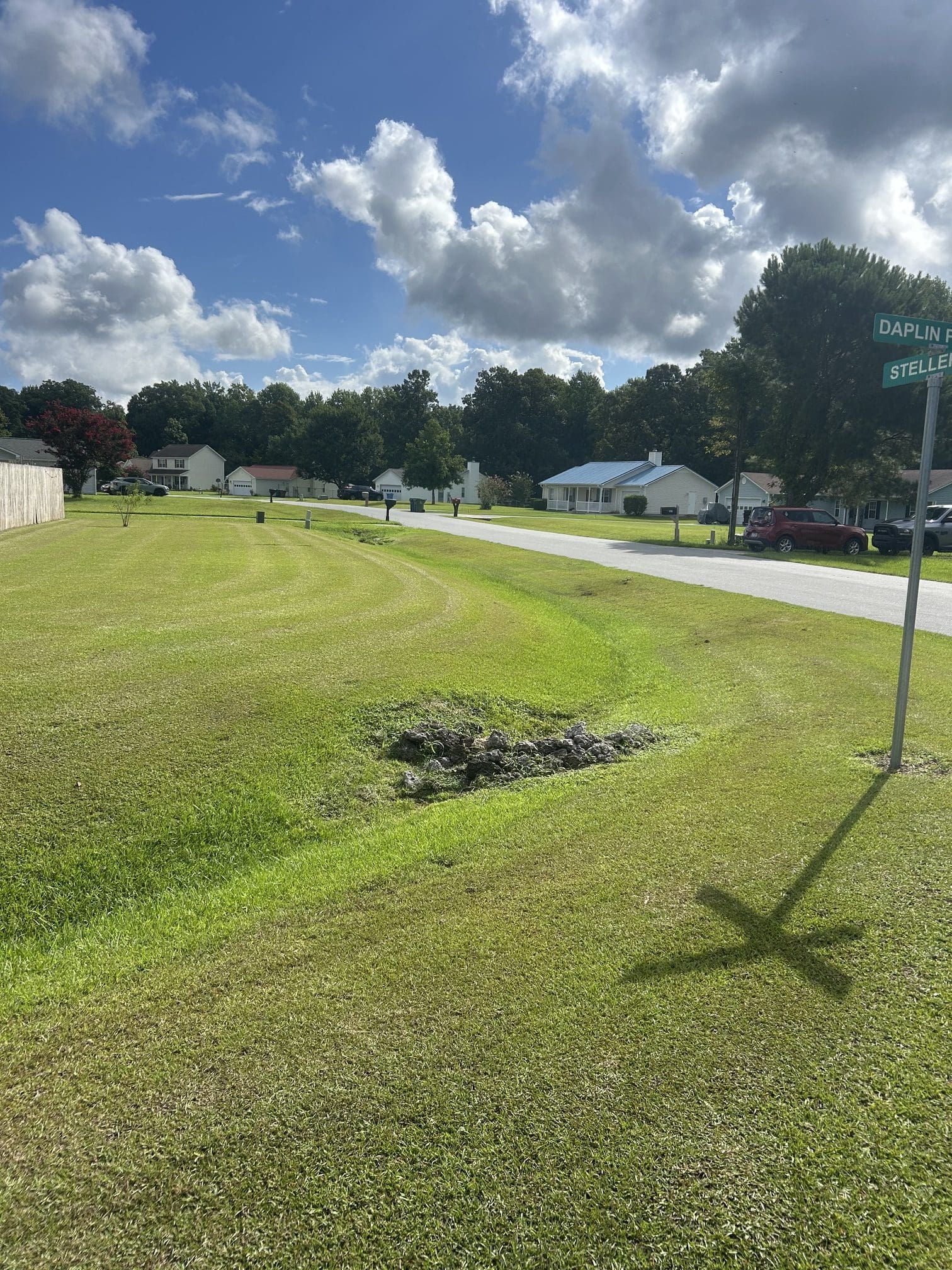
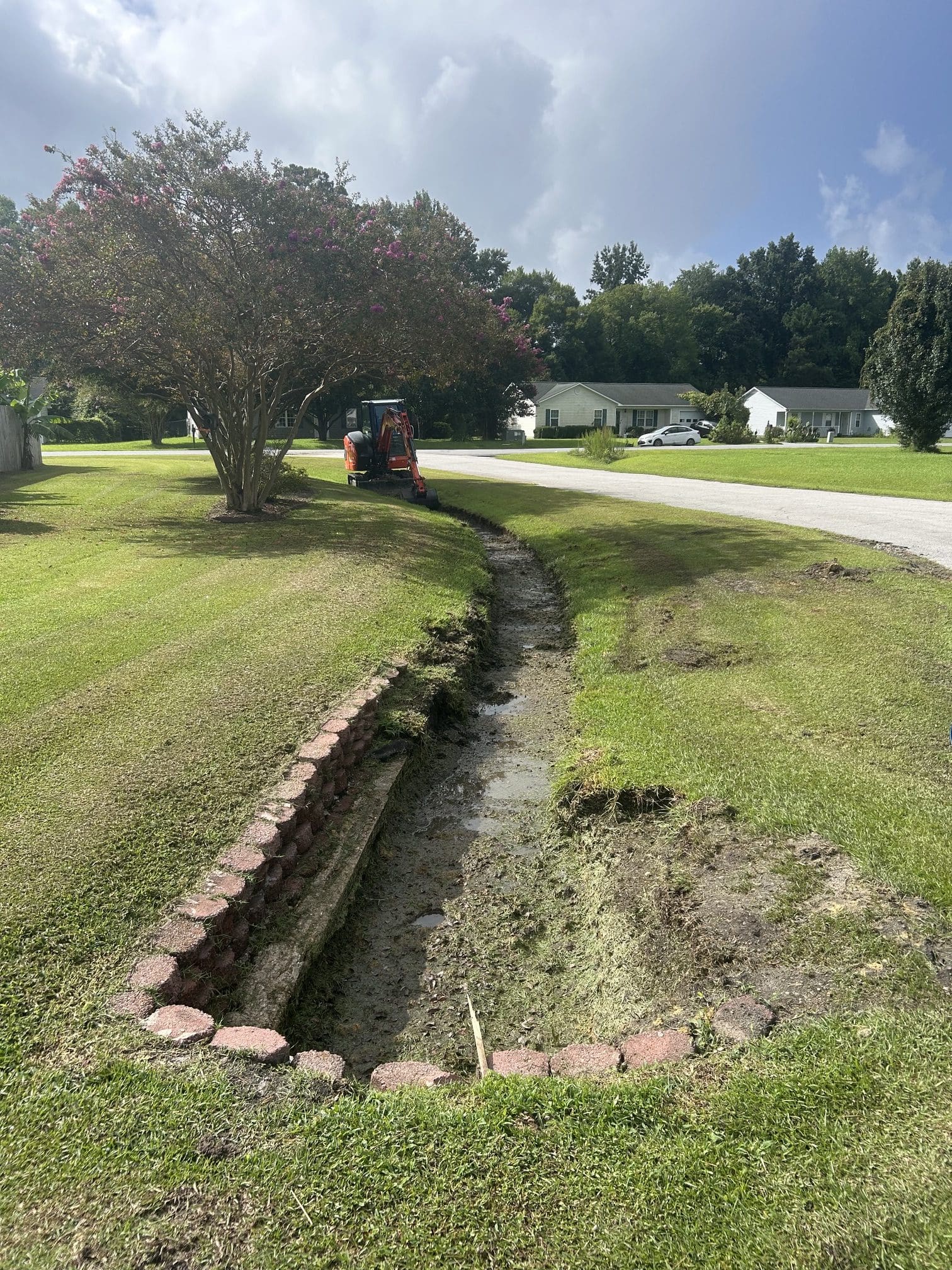
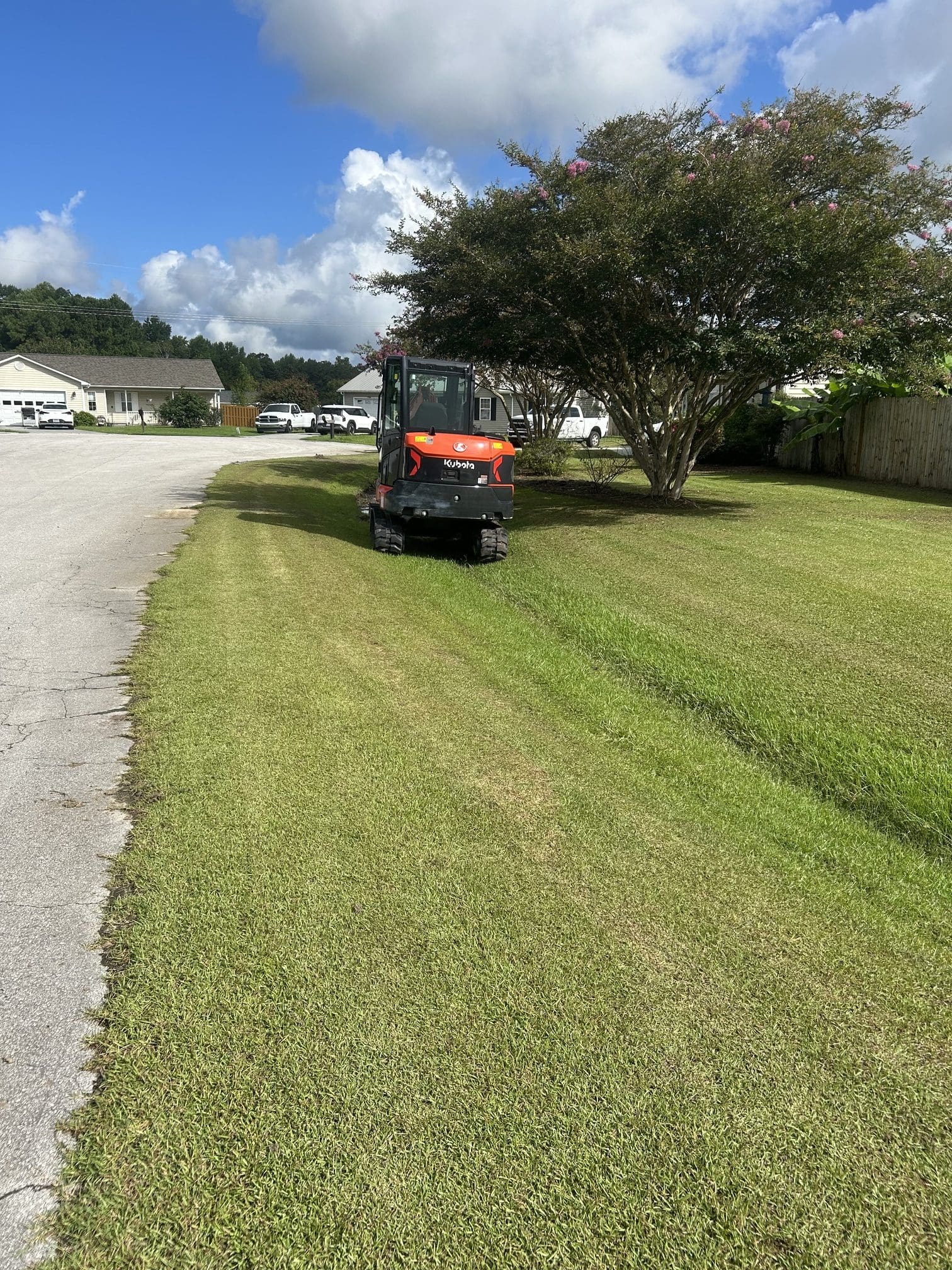
A residential ditch line and driveway culvert in a subdivision much like yours. These are our own photographs from the work, not stock. The pipe from this same job is the one pictured further up the page.
What a Blocked Ditch Line Takes Out With It
The pipe is rarely the only casualty by the time anyone calls.
The driveway and its shoulders
Water that cannot get through the pipe goes over the top instead. It undercuts the apron, scours out the shoulder either side, and works at the base under the asphalt or concrete until the edge starts to break away.
The pipe itself
A pipe that holds standing water and packed wet sediment year round is a pipe corroding or degrading from the inside where nobody can see it. Clearing a silted pipe is maintenance. Replacing a collapsed one is a much bigger day.
Your yard and your drain field
The ditch is where your yard sheds its water. Block the outlet and the water backs up onto the ground instead, and saturated ground over a drain field means soil that cannot take in and treat what the septic system sends it.
Everyone downstream
A ditch line is a shared system running lot to lot. Water held up at your pipe ponds behind it, and water that jumps your driveway arrives at your neighbor concentrated and moving fast instead of spread out and slow.
How We Work a Ditch Line
The digging is the easy part. Knowing where the water is supposed to end up, and what is buried between here and there, is the part that matters.
Confirm whose it is
Before anything else we work out who maintains the road and therefore the ditch, and we tell you what we find even when the answer is that you should call someone else first.
Walk the line and find the outlet
We follow the channel from your property to wherever it is meant to discharge. A pipe cleared into a ditch that is blocked further along has not been fixed, it has just been moved.
Locate what is buried
Septic tank, drain field lines, water service, and any utility crossing the ditch get located before the machine moves. This is the step that separates a ditch cleaning from an expensive afternoon.
Clear, regrade, and haul off
We clear the pipe end to end, cut the channel profile back in with continuous fall, and take the spoil away from the drainage path so the next rain does not wash it straight back where it came from.
Not Sure What Is Under Your Driveway?
We will come out, look through the pipe, walk the ditch line to the outlet, and tell you plainly what is wrong and whose it is to fix.
Call 910.750.2312 Book a Free EvaluationWhat the Ditch Lines Look Like Where You Are
The same service, but what comes out of the pipe is different county to county.
Onslow County
The subdivisions around Jacksonville were laid out with open roadside swales and a driveway pipe at every lot, which is the exact arrangement that silts in quietly over decades. Most of these pipes have never been cleared since the day they went in.
Jacksonville drainage guide →Pender County
The dense clay around Burgaw and inland Pender holds water for days rather than hours, so a ditch here is wet far longer after each storm and sediment has that much more time to settle out and pack down instead of moving along.
Burgaw drainage guide →New Hanover County
Older Wilmington neighborhoods run a mix of piped storm drainage and original open ditch, often on the same street. Sandy soil moves easily in heavy rain, which means the pipes here take on sediment fast once the channel loses its fall.
Wilmington drainage guide →Cedar Point
Sandy ground near the sound washes into a channel readily, and the water table sits close enough to the surface that a ditch bottom can be near standing water before it has silted at all. There is less room for error in the fall here.
Cedar Point service area →Wild Water Plumbing Reviews
Google reviews from our customers.
Schedule Your Free Ditch and Culvert Evaluation
Fill out the form below and we will get right back to you. Prefer to talk? Call 910.750.2312.
Frequently Asked Questions
How do I know if my driveway culvert is blocked?
Look in one end on a dry day. If you cannot see a clean circle of daylight through the far end, sediment is sitting in it. Standing water in the ditch after the rain has stopped, a scalloped notch worn into the edge of your driveway, or water running over the driveway during a storm all point the same way.
Who is responsible for the ditch in front of my house?
It depends on who maintains the road. On a state maintained road the roadside ditch sits in the state right of way and is maintained by the Department of Transportation. On a town street it is the town. On a private or subdivision street it belongs to whoever the plat assigns it to. The driveway pipe is usually the exception, because responsibility for keeping it clear generally sits with the property owner even though the pipe is inside the right of way. We confirm this before we quote.
How often should a roadside ditch be cleaned out?
There is no single interval, because it depends on how much sediment your ditch receives and how much fall it started with. The practical approach is to look at the pipe once or twice a year and after any major storm, and to act when you can no longer see clean daylight through it rather than waiting for water to back up.
Does a partly blocked pipe really matter if water still gets through?
Yes, and by more than it looks. Capacity in a pipe does not fall in a straight line with the amount of dirt in it. Sediment reduces the opening and at the same time forces the remaining water across a wide flat bed, which adds friction. Using Manning's equation at constant slope and roughness, a pipe silted to half its diameter carries roughly a third of its clean capacity, and a pipe silted to three quarters of its diameter carries roughly a tenth.
Will cleaning the ditch help my septic system?
It can, indirectly. Your drain field needs soil that is able to take in and treat wastewater, and soil that is already saturated with surface water cannot do that well. If a blocked ditch is holding water on your ground, clearing it removes one source of that saturation. It will not fix a drain field that has failed for other reasons, which is a separate assessment.
Do you replace culvert pipe, or only clean it?
Our focus is clearing and regrading. Once the pipe is open we can see its actual condition, and if it turns out to be crushed, corroded through, or too small for the water it has to carry, we will tell you what we found and talk through the options with you rather than clearing it and saying nothing.
What time of year is best for ditch cleaning?
Late winter and early spring are easiest, because the ground is workable and you are ahead of the summer and hurricane season rainfall. That said, the best time is whenever you notice the pipe is closing up. Waiting for the storm that proves the point is the expensive way to schedule it.
Do you serve my county?
Yes. We work across Onslow, Pender, and New Hanover Counties, including Greater Jacksonville, North Carolina and the surrounding communities. In Carteret County we serve Cedar Point.
Related Guides and Services
French Drains • Septic Systems • Sump Pumps • Drain Cleaning • Service Areas
Let Us Open That Pipe Back Up
We look through the pipe, walk the line to the outlet, locate your septic and utilities before the machine moves, and haul the spoil away from the water instead of piling it beside the channel.
Call 910.750.2312 Schedule ServiceWild Water Plumbing + Septic • U.S. Navy Veteran Owned and Operated by Justin Wilder • Serving Onslow, Pender, and New Hanover Counties, plus Cedar Point, North Carolina
Licensed and insured. NC License No. [ADD LICENSE NUMBER] • 200 Valencia Dr Unit 313, Jacksonville, NC 28546
Veteran Owned Plumbing Repair, Inspection, & Installation Services.
Plumbing Services
Additional Services
Plumbing Tips



PENDER, CARTERET, NEW HANOVER & ONSLOW COUNTIESAffordable Plumbing Services For Greater Jacksonville, North Carolina
