THE SHORT VERSION
The communities immediately adjacent to Marine Corps Base Camp Lejeune (Midway Park, Tarawa Terrace, Half Moon, Bogue, Verona) face drainage conditions that did not exist when the neighborhoods were first developed. Decades of dense military housing turnover have compacted the soils. The base’s own infrastructure footprint has modified the surrounding stormwater patterns. Adjacent civilian development has added runoff from sources the original neighborhoods were never designed to handle. The result is drainage problems on established properties that have been progressively worsening for years, and the right solution requires understanding what made the conditions different rather than applying generic suburban drainage practices.
What Decades of Military Housing Density Has Done to These Soils
Midway Park and Tarawa Terrace were built in eras when military housing density was higher than typical suburban residential development, with smaller lots, more vehicle traffic per square foot of yard, and more foot traffic on the same paths over decades. The result is soil compaction that has accumulated continuously since the neighborhoods were first established. The original soil structure that would have absorbed water at its natural rate no longer exists in most of these yards. The soil under the lawn looks like ordinary soil, but performs like a much denser material because the void space between particles has been progressively reduced.
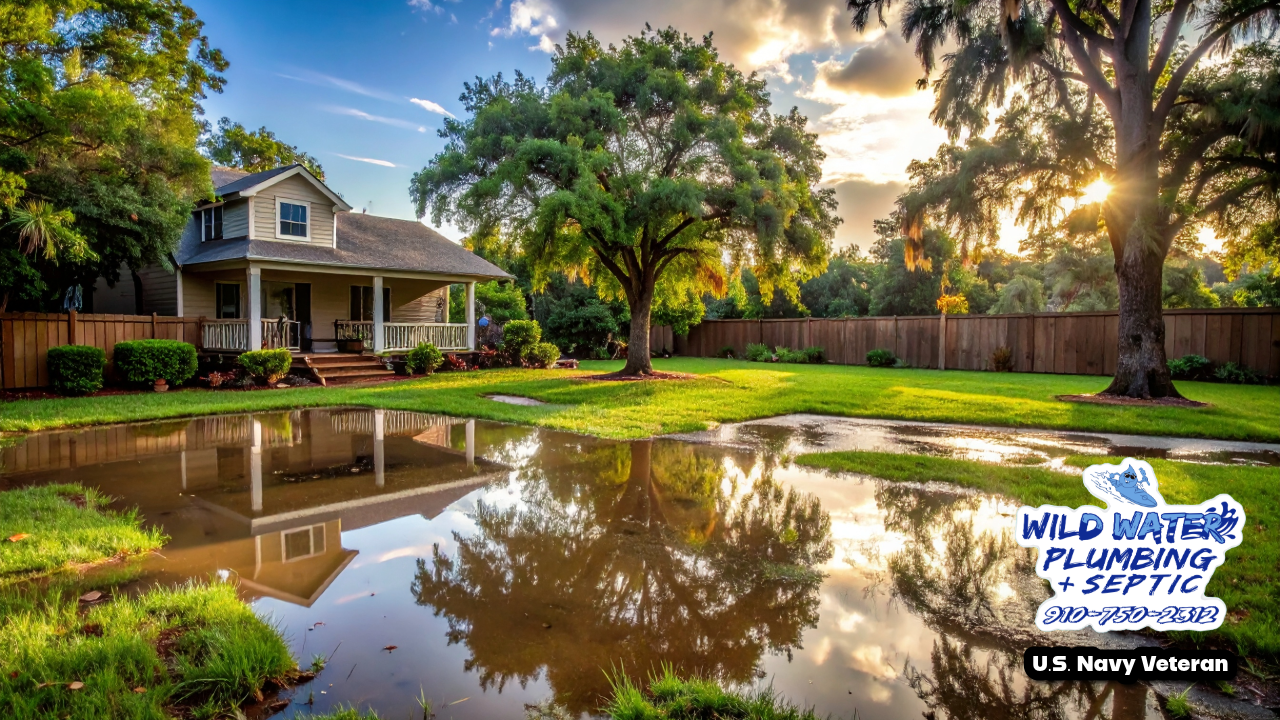
A Midway Park or Tarawa Terrace yard with compacted subsoil can show no surface symptoms during dry weather and look like any other suburban lawn. The problem only becomes visible during and after rain, when the same yard that handled storms 30 years ago now stays wet for days instead of hours. The cause is not the rain. It is the soil’s reduced ability to accept what falls on it. The yard is operating at a fraction of its original absorption capacity, and the loss accumulated gradually over decades of high-density residential use.
How Camp Lejeune’s Footprint Affects Adjacent Civilian Drainage
The base manages its own stormwater within the installation, while the surrounding civilian areas use county- and municipal-level infrastructure. As the base has expanded and renovated over the decades, the way surrounding stormwater flows has shifted in ways that are not always obvious from the surface. A property that drained to a particular path in the 1980s may now drain differently because of changes upstream that the homeowner cannot see. The cumulative effect is that adjacent civilian properties face runoff patterns that have evolved continuously throughout the base’s history.
Three Drainage Patterns Specific to Military-Adjacent Communities
Compacted Yards That Absorb Water Slowly
The single most common pattern is yards that should drain well based on their visible characteristics but instead stay wet for days. Surface regrading does not fix this because the underlying soil is the problem. A French drain cut deep enough to reach below the compacted layer, backfilled with open-graded aggregate, gives water a route through the compacted zone. This intervention often produces dramatic improvement on properties where surface measures alone have failed.
Runoff From Higher-Density Areas
Properties at lower elevations in military-adjacent neighborhoods receive runoff from higher-elevation areas that have even denser development. The lower property’s drainage system was designed for its own runoff, not for the additional volume arriving from uphill. The fix involves an interception drain at the uphill property line to capture the incoming water before it reaches the home.
Crawl Space Moisture From Foundation Saturation
The same compacted soil that produces yard drainage problems pushes water against foundations and into crawl spaces. Most military-adjacent homes have crawl spaces, and crawl space moisture is one of the most common homeowner complaints in these communities. The fix combines yard drainage improvements (to prevent new water from entering) with crawl space remediation (vapor barrier, sump pump if needed, moisture control).
Some older military-adjacent properties use individual septic systems, and the drainfields are subject to the same compacted soil conditions that cause yard drainage problems. The full septic failure picture is in our coastal NC septic failure guide. The drainage protection options that extend drainfield life are the same as on other coastal Onslow properties.
French Drain Strategies for Military-Adjacent Properties
French drain installations in Midway Park, Tarawa Terrace, and the surrounding communities typically focus on three placements: a curtain drain at the uphill property line to intercept incoming runoff, a perimeter foundation drain to capture water before it reaches the structure, and a yard interception drain at low points where water concentrates. The discharge usually goes to a roadside ditch or to a designated downhill area of the lot. The trench depth is set deep enough to reach below the worst of the compacted layer, which on these properties typically means 3 to 4 feet rather than the 2 feet that would work on a less compacted lot.
Our French drain and yard drainage services cover Midway Park, Tarawa Terrace, Half Moon, Bogue, Verona, and the surrounding Camp Lejeune-adjacent communities. Services include full property drainage evaluations, French drain design and installation for compacted soils, curtain drains for incoming runoff, perimeter foundation drains, surface drain systems, crawl space sump systems, and septic drainfield protection where applicable.
📖 Military-adjacent community drainage is one chapter in a broader coastal NC drainage picture that varies by town, soil profile, and development history. The complete coastal NC drainage cornerstone covers the eight warning signs and county-by-county breakdown: Why Coastal NC Yards Flood: The Complete French Drain and Yard Drainage Guide.
Wild Water Plumbing and Septic designs drainage solutions for compacted soils and modified runoff patterns throughout Midway Park, Tarawa Terrace, and the surrounding Onslow County communities. Veteran-owned, and proud to serve the families who serve.Call 910.750.2312 or request a drainage evaluation online.
Frequently Asked Questions
Why do Midway Park and Tarawa Terrace homes have so many drainage problems?
The communities adjacent to Marine Corps Base Camp Lejeune (Midway Park, Tarawa Terrace, Half Moon, Bogue, Verona) were built around dense military housing patterns that produced soil compaction over decades of high-density residential use. The neighborhoods also sit downstream of Camp Lejeune’s own stormwater infrastructure footprint, and the surrounding development has changed runoff patterns significantly over time. The combination of compacted soils, modified runoff, and lot density that exceeds typical residential standards produces drainage problems that did not exist when the communities were originally designed.
What is soil compaction and why does it matter in military housing areas?
Soil compaction is the loss of soil structure that occurs when ground is repeatedly walked on, driven over, mowed, or subjected to construction and renovation. Compacted soil absorbs water more slowly than its original structure would, holds water longer once saturated, and has reduced biological activity that further degrades drainage. In Midway Park and Tarawa Terrace, decades of military housing density and turnover have produced soils that drain significantly worse than they did when the communities were built.
Does Camp Lejeune’s stormwater infrastructure affect adjacent civilian properties?
The base’s own stormwater system handles runoff within the installation footprint, but the surrounding civilian properties operate on county and municipal infrastructure that may not have been designed for the cumulative runoff patterns the developed area now produces. Properties adjacent to the base footprint sometimes face runoff patterns that have shifted as the base’s infrastructure has evolved over the decades. The specific effects vary by location and direction relative to the base.
Are drainage problems worse in older or newer military-adjacent homes?
Older homes typically face more accumulated soil compaction and have stormwater infrastructure that was designed for earlier conditions. Newer homes have better baseline stormwater engineering but may face the same underlying soil conditions and may also be downhill of older, more compacted areas. The specific problems vary property by property, but the overall drainage profile of the area trends toward more challenging conditions in the older sections.
Does Wild Water Plumbing service Midway Park and Tarawa Terrace?
Yes. Midway Park, Tarawa Terrace, Half Moon, Bogue, Verona, and the surrounding military-adjacent communities are all part of our core Onslow County service area. We provide drainage evaluation, French drain installation, sump pump systems, septic services, sewer line camera inspection, and full residential plumbing throughout these neighborhoods.
What drainage solution works best for compacted military housing area soil?
The most effective approach combines a French drain cut deep enough to reach below the worst of the compacted layer with surface drainage improvements that handle runoff before it soaks in. Surface regrading alone rarely produces lasting improvement on heavily compacted lots because the underlying soil is the problem. A trench cut through the compacted layer, backfilled with open-graded aggregate, gives water a route to travel that the surrounding compacted soil cannot provide.
Do military housing area homes have specific sewer line concerns?
Older homes in Midway Park and Tarawa Terrace commonly have sewer lines made of clay tile, orangeburg, or cast iron, all of which fail in characteristic ways as they age. A camera inspection identifies the current condition. Properties that have been through multiple owners and renovations may have undocumented modifications to the sewer system that camera work reveals.
Are drainage problems related to crawl space moisture in these communities?
Yes, almost always. The same conditions that produce yard drainage problems (compacted soil, slow drainage, accumulated runoff) push water against foundations and into crawl spaces. Crawl space moisture in Midway Park and Tarawa Terrace properties is typically a symptom of yard drainage failure, and addressing the yard drainage often resolves the crawl space problem at the same time. A vapor barrier and sump pump may still be needed for ongoing moisture management.
References
U.S. Department of Agriculture Natural Resources Conservation Service. (2020). Soil survey of Onslow County, North Carolina. USDA-NRCS Web Soil Survey. https://websoilsurvey.sc.egov.usda.gov
North Carolina Cooperative Extension. (2021). Soil compaction in residential settings: Causes and remediation. NC State Extension Publications. https://content.ces.ncsu.edu
Onslow County Planning and Development. (2023). Stormwater management ordinance and residential drainage requirements. Onslow County Government. https://www.onslowcountync.gov
U.S. Environmental Protection Agency. (2022). Soak up the rain: Residential stormwater management practices. EPA Office of Wetlands, Oceans, and Watersheds. https://www.epa.gov/soakuptherain