THE SHORT VERSION
Topsail Beach properties are subject to three drainage constraints at once. The barrier island geometry limits most lots to 50 to 75 feet wide, which rules out conventional drainage solutions that require yard space to function. The water table sits within a few feet of the surface and rises with the tides. Storm surge during tropical events elevates groundwater dramatically across the entire island. Drainage solutions on Topsail Beach have to be designed specifically for these conditions, and the contractor who applies inland or mainland templates here produces systems that fail when they matter most.
What Makes Topsail Beach Drainage Different
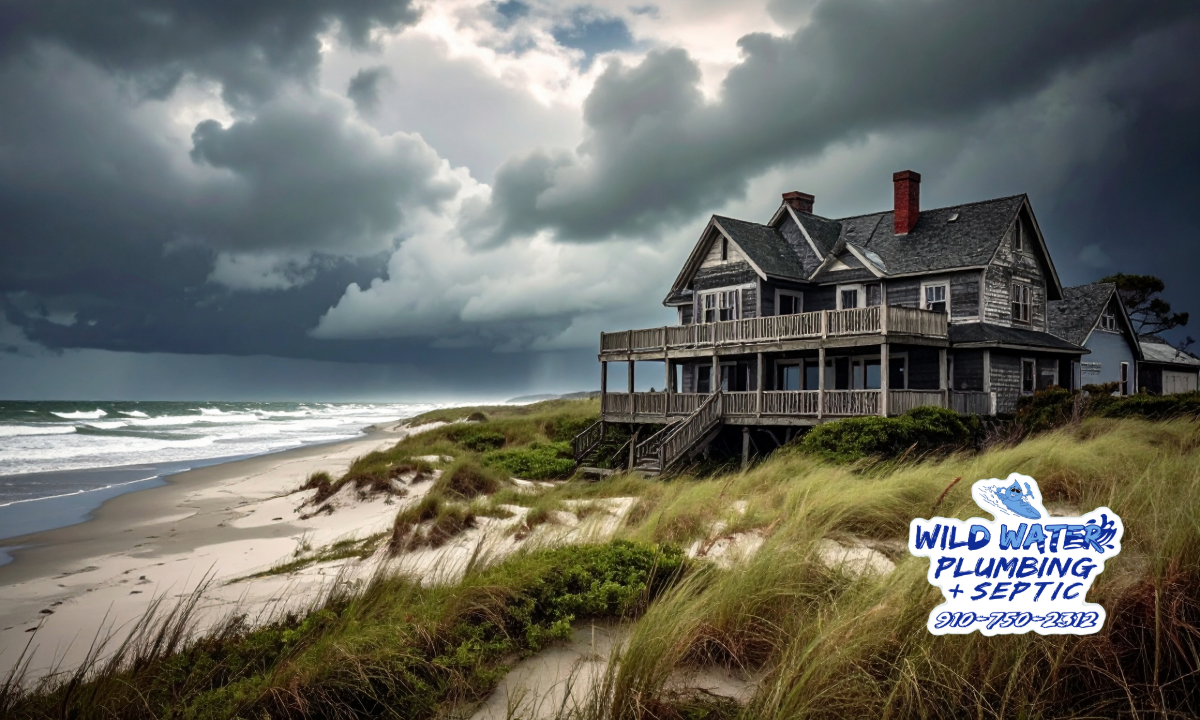
Topsail Beach occupies a narrow strip of barrier island between the ocean and Topsail Sound. Lot widths are constrained by the island’s geometry. Backyard space, where mainland properties typically run a French drain, often does not exist or is shared with the dune system that protects the property from the ocean. Front yard space leads to the only access road, where surface drainage and any discharge piping has to coexist with utilities and pedestrian use. The result is a drainage design problem with very different parameters than a comparable mainland property.
First, lot size: Narrow island lots do not have room for conventional drainage, which requires 20+ feet of clearance from the foundation. Second, water table: the regional water table lies within a few feet of the surface and rises with tidal cycles and during storm events. Third, storm surge: during tropical events, the water table can rise to or above grade level on lower-elevation lots, meaning gravity drainage has nowhere to discharge during the very period when it is needed most.
The Topsail Beach Drainage Solution Set
Perimeter Foundation Drains Tied to Sump Pumps
The primary drainage approach on most Topsail Beach properties is a perimeter foundation drain (interior or exterior depending on construction) that collects groundwater and routes it to a sump pit. From the sump, a properly sized pump with battery backup moves the water through a discharge line to the street, the sound, or another available outlet. This design works because it does not require yard space, does not depend on gravity discharge during storm conditions, and continues to function when grid power fails during the storms that test the system.
Surface Drains for the Small Yard Areas
What yard space exists on a Topsail Beach property often pools water during heavy rain because the small footprint cannot absorb the volume fast enough. Grated surface inlets connected to the same sump pump system or to a separate discharge line capture this surface water before it migrates toward the foundation. The inlets are placed at the natural low points where water collects.
Routed Discharge Lines
The discharge from the sump pump has to terminate at a location where the water does not simply re-enter the soil near the foundation. On Topsail Beach, this often means running the line under the foundation skirting and out to the street side of the property, or routing through landscaping to a designated outlet. The line is buried below grade where possible, sloped for positive drainage, and includes a check valve to prevent backflow during high water conditions.
Topsail Beach faces hurricane exposure annually and has repeatedly experienced major storm impacts. Drainage systems on Topsail Beach properties have to be designed and maintained for these conditions. Battery backup on sump pumps is essential, not optional. Annual pre-season testing of all drainage components is the maintenance step that determines whether a property comes through a major storm dry or faces weeks of moisture damage. Vacation rental properties, especially, benefit from automated systems that operate without owner presence during off-season storm events.
Elevated Piling Foundations and Drainage
Most newer Topsail Beach homes are built on elevated piling foundations to raise the floor above FEMA-required base flood elevations. The structure stays dry during flood events, but the area beneath the elevated floor still faces moisture concerns from groundwater, salt air, and storm exposure. Storage and mechanical equipment located beneath the elevated floor needs the same moisture management considerations a crawl space would: vapor barriers where applicable, drainage of the ground beneath, and elevation of any equipment that cannot tolerate exposure to flood water.
The Vacation Rental Drainage Challenge
Many Topsail Beach properties operate as vacation rentals, which adds two specific drainage considerations. First, the systems have to operate automatically without owner intervention because the property is unoccupied during many storm events that test the drainage. Second, the rental income depends on the systems being functional when guests arrive, which means failures discovered between rentals can directly affect revenue. Vacation rental properties particularly benefit from sump pump systems with battery backup, remote monitoring via smart home integration, and annual professional inspections that catch problems before they affect guest stays.
Our French drain and yard drainage services in Topsail Beach include barrier island drainage design, perimeter foundation drains for narrow lots, sump pump systems with battery backup, surface drain systems, discharge line routing through constrained lot conditions, and seasonal inspection programs for vacation rental properties. Our sewer line camera inspection covers pre-purchase work for buyers entering the Topsail Beach vacation rental market.
📖 Topsail Beach narrow-lot drainage is one chapter in a broader coastal NC drainage picture that varies dramatically by town and lot conditions. The complete coastal NC drainage cornerstone covers the eight warning signs and county-by-county breakdown: Why Coastal NC Yards Flood: The Complete French Drain and Yard Drainage Guide.
Wild Water Plumbing and Septic designs drainage solutions for barrier island lots throughout Topsail Beach and the surrounding coastal Pender County.Call 910.750.2312 or request a drainage evaluation online.
Frequently Asked Questions
Why is drainage harder on Topsail Beach lots than on the mainland?
Topsail Beach lots are constrained by barrier island geometry. The town occupies a narrow strip between the ocean and the sound, with many lots only 50 to 75 feet wide and limited backyard space. Conventional drainage solutions that need 20 to 30 feet of clearance from the foundation to discharge often will not fit. The water table sits within a few feet of the surface and rises with tidal cycles in the sound. Storm surge during tropical events can elevate groundwater dramatically. All of these constraints together require drainage approaches designed specifically for narrow-lot barrier island conditions.
Can a Topsail Beach property have a French drain on a small lot?
Yes, with careful design. French drain installations on narrow Topsail Beach lots typically use a perimeter foundation drain tied to a sump pump system that discharges through a routed line to the street, the sound, or another available outlet. The trench depth is set above the seasonal high water table so the drain can function during peak conditions. The pump handles cases where gravity discharge is not available. The combination provides drainage protection within the lot’s space constraints.
How does storm surge affect Topsail Beach drainage?
Storm surge during tropical events raises the water level on both the ocean and the sound sides of the island simultaneously, elevating the regional water table across the entire community. During major events, the water table can rise to grade level or above on lower-elevation lots. Drainage systems on Topsail Beach properties have to be designed for these conditions even though they only occur a few times per decade, because that is exactly when the system is needed.
Do most Topsail Beach homes have crawl space or slab construction?
Most Topsail Beach homes are built on elevated piling foundations to raise the floor above FEMA-required flood elevations. Crawl spaces in the traditional sense are uncommon, but the area beneath the elevated structure faces moisture concerns from the high water table, salt air, and storm exposure. Some older Topsail Beach properties on lower elevations may have crawl space construction with the standard coastal moisture concerns.
Does Wild Water Plumbing service Topsail Beach NC?
Yes. Topsail Beach is part of our Pender County service area. We provide drainage evaluation, French drain installation for barrier island lots, sump pump systems, sewer line camera inspection, and full residential plumbing throughout Topsail Beach and the surrounding coastal Pender communities.
Are sewer line problems common in Topsail Beach vacation homes?
Yes. Topsail Beach has a high concentration of vacation rental properties that face heavy seasonal use, salt air corrosion, and infrequent off-season maintenance. Sewer lines on these properties commonly need camera inspection because issues that would be detected quickly in an owner-occupied home can go unnoticed for months in a vacation property. Pre-purchase camera inspections are especially valuable on Topsail Beach because the rental income depends on the systems working when guests arrive.
What drainage solutions fit on a Topsail Beach vacation rental property?
Vacation rental properties on Topsail Beach typically benefit from sump pump systems with battery backup and automatic operation, perimeter drains tied to the sump, and surface drains for the small yard areas. The systems run automatically without owner intervention, which is essential for properties that are not occupied during many of the storm events that test the drainage. Remote monitoring through smart home systems is increasingly common on higher-end rentals.
How often should Topsail Beach drainage systems be inspected?
Annual inspection before hurricane season is the minimum standard. Salt air accelerates wear on mechanical components, and the systems work hard during the storms that affect the area, so wear accumulates faster than it would on inland properties. Battery backup systems should be tested annually and replaced on a 3 to 5 year cycle. Discharge lines should be cleared and checked for obstructions before each storm season.
References
Federal Emergency Management Agency. (2021). Flood Insurance Rate Maps and Special Flood Hazard Areas in Pender County. FEMA. https://www.fema.gov
North Carolina Floodplain Mapping Program. (2022). Coastal barrier island flood risk and drainage standards. NCFMP. https://ncfloodmaps.com
North Carolina Department of Environmental Quality. (2022). Coastal Area Management Act standards and barrier island development. NCDEQ Division of Coastal Management. https://www.deq.nc.gov
Pender County Planning. (2023). Coastal and barrier island residential drainage standards. Pender County Government. https://www.pendercountync.gov