THE SHORT VERSION, READ THIS FIRST
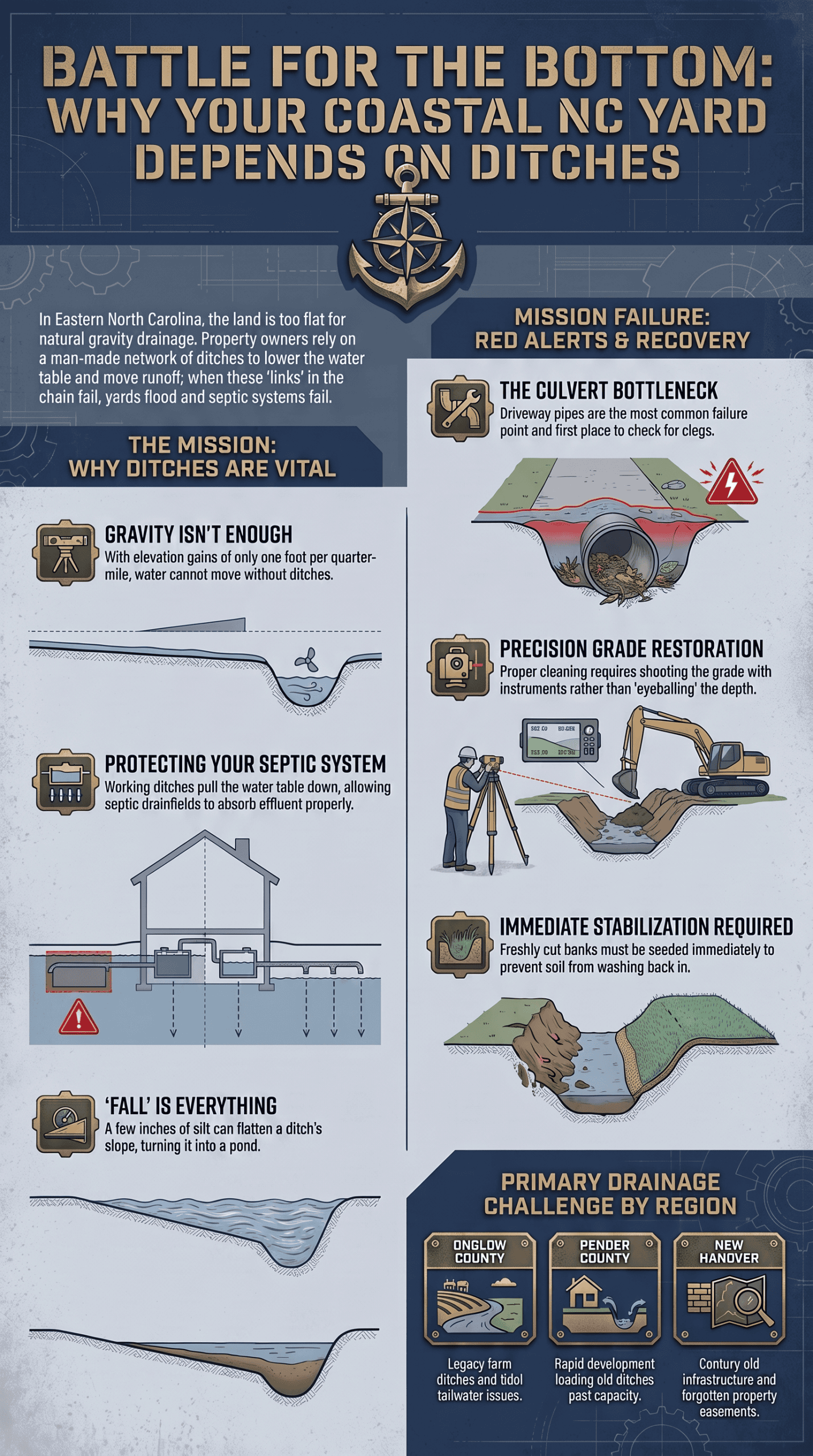
Almost nothing in Eastern North Carolina drains on its own. The land is too flat and the water table sits too high for gravity to do the work by itself, so generations of farmers, road crews, and developers dug ditches to move water off the ground and out toward the creeks and sounds. Those ditches are still doing the job today, and most of them have not been touched in years. When a ditch silts in, grows over, loses its fall, or gets plugged at a driveway pipe, the water stops leaving. It backs up into yards, sits on septic drainfields, pushes against foundations, and floods the road. This guide covers why the region depends on ditches, the warning signs that yours has quit working, what actually causes ditch failure, who is responsible for maintaining it, and what proper ditch cleaning involves.
📄 TABLE OF CONTENTS, CLICK TO JUMP TO ANY CHAPTER
- Why Eastern North Carolina Runs on Ditches
- The 8 Signs Your Ditch Has Stopped Working
- What Actually Causes a Ditch to Fail
- Who Is Responsible for the Ditch
- County by County: How Ditch Problems Differ
- What Proper Ditch Cleaning Involves
- How Wild Water Approaches a Ditch Job
- Drainage Deep Dives: Town by Town Resources
- Summary: What Every Property Owner Needs to Take Away
- Frequently Asked Questions
Chapter 1: Why Eastern North Carolina Runs on Ditches
I have been working on drainage across Onslow, Pender, and New Hanover Counties long enough to know that the single biggest misunderstanding homeowners have about water on their property is this: they think the yard is supposed to drain by itself. Out here, it mostly is not. The land in the Coastal Plain is close to flat. You can walk a quarter mile and gain a foot of elevation. Water does not run downhill fast when there is barely a downhill, and when the water table is already sitting a couple of feet under your boots, there is nowhere for it to soak to either.
Nearly every neighborhood, farm road, and country lot in this region sits inside a network of man made ditches. Some were cut a century ago to make farmland workable. Some were cut by the road department to keep the pavement from washing out. Some were cut by a developer as a condition of getting a subdivision approved. They connect to each other, they connect to roadside ditches, and eventually they connect to a creek, a canal, or a sound. Your yard is one link in that chain whether you know it or not. When a link two properties away plugs up, the water stops moving on your side of the fence too.
Flat Ground Means Fall Is Everything
A ditch works because of fall, which is the slope from the upstream end to the outlet. On flat ground that fall might only be an inch or two over a hundred feet. That is a workable grade when the ditch bottom is clean. It is not a workable grade once three or four inches of silt have settled into the bottom. A small amount of sediment that would mean nothing in the mountains is enough to flatten a Coastal Plain ditch completely and turn it from a channel into a long, narrow pond.
The Water Table Sets the Ceiling
Around here the seasonal high water table comes up close to the surface for part of the year. That matters for ditches in a way most people do not expect. A ditch does not just carry the rain that falls into it. It also intercepts groundwater moving sideways through the soil and gives it somewhere to go. A properly cut ditch actually pulls the water table down in the ground on either side of it. When the ditch silts in and holds standing water, it stops lowering the water table and starts feeding it instead. That is the moment your yard changes character.
Most of the ditch networks in this region were sized for farmland and woods. Farmland soaks up a lot of rain before any of it runs off. Rooftops, driveways, parking lots, and roads soak up none of it. As the corridor along US 17 and the areas around Jacksonville, Hampstead, and Holly Ridge have filled in, the same old ditches are being asked to carry far more water than they were cut to handle. The ditch did not get worse. The job got bigger. You can see how this plays out on individual properties in our breakdown of Porters Neck drainage problems that new construction made worse.
Where Ditches and Septic Systems Meet
This is the connection that costs people the most money. A septic drainfield only works if the soil under it has room to accept water. The ditch at the back of the property is often the only thing keeping the water table below that drainfield. Let the ditch fill in, and the water table comes up, and the drainfield loses its ability to absorb anything. I have replaced systems that failed for no reason other than a plugged ditch a hundred feet away. If you want the full picture of how that failure presents, read our guide to the signs of a failing septic system in coastal North Carolina.
Chapter 2: The 8 Signs Your Ditch Has Stopped Working
A ditch does not fail all at once. It fails a little every year until one wet season makes it obvious. These are the signals I look for when I walk a property, and they show up in roughly this order.
💧 Sign 1: Water Standing in the Ditch When It Has Not Rained
A working ditch on flat ground may stay damp, but it should not hold a standing pool days after the last rain. Standing water in a dry stretch means the bottom has lost its fall somewhere, or the outlet end is higher than the water sitting in the channel. This is the earliest and most reliable sign, and it is the one people most often dismiss as normal.
💧 Sign 2: Water Backing Up Out of the Ditch Into the Yard
Once the channel cannot hold the volume, the water leaves the ditch and spreads sideways into the lawn. If the high water mark in your yard is getting farther from the ditch every year, the ditch is losing capacity every year. This is the point where the problem stops being a drainage nuisance and starts threatening the drainfield and the structure.
💧 Sign 3: The Ditch Has Filled With Cattails, Reeds, or Woody Growth
Vegetation in a ditch is not just cosmetic. Dense stands of reeds and cattails slow the water down, and slow water drops its sediment, which raises the bottom, which slows the water further. Woody growth is worse because the root systems hold the silt in place and the trunks catch every piece of debris that floats by. A ditch full of saplings has already been out of service for several seasons.
💧 Sign 4: Your Driveway Culvert Is Silted, Crushed, or Half Buried
The pipe that runs under your driveway is the narrowest point in the entire ditch line, which makes it the first thing to plug and the most common single cause of a backed up ditch. Look at both ends. If you cannot see daylight through it, if the bottom third is packed with sand, if the end is crushed or rusted through, or if you cannot find the ends at all, that pipe is the bottleneck. Everything upstream of it is being held back by a piece of pipe you can usually see from the road.
💧 Sign 5: The Ditch Banks Have Sloughed In
Steep ditch banks in sandy soil do not stay steep. They slump, especially after a saturated stretch followed by a hard rain. Every slump drops bank material straight into the channel bottom. If the ditch looks shallower and wider than you remember, and the sides have that rounded, collapsed profile instead of a clean cut, the ditch has been filling itself in from the sides.
💧 Sign 6: The Drainfield Stays Soft While the Rest of the Yard Dries
When the ditch stops holding the water table down, the drainfield is usually the first part of the property to notice. Soft ground, greener grass, or a faint odor over the field while the rest of the yard has dried out points to a saturated absorption area. Replacing the field without fixing the ditch just puts a new field on the same failing timeline.
💧 Sign 7: Your French Drain or Yard Drain Outlet Is Underwater
Buried drainage has to discharge somewhere, and out here that somewhere is usually the ditch. If the outlet pipe is submerged in standing ditch water, the drain behind it cannot move anything. I get called out for failed French drains that were installed correctly and are working exactly as designed, and the actual problem is a receiving ditch that came up higher than the outlet. The full picture on residential systems is in our complete French drain and yard drainage guide for coastal NC.
💧 Sign 8: The Road Floods at the Same Spot Every Storm
If the pavement in front of your property holds water in the same place after every heavy rain, the roadside ditch has lost its capacity in that stretch. Road flooding is a public safety issue as well as a property one, and it usually means the problem is bigger than any single lot. That changes who needs to be involved, which I cover in Chapter 4.
Chapter 3: What Actually Causes a Ditch to Fail
Every failed ditch I have looked at traces back to one or more of the following. Usually several at once, because they feed each other.
Sedimentation, the Slow One
Sand and silt wash into the ditch from the banks, from the road shoulder, from bare yards, and from any construction happening upstream. On flat grade the water does not move fast enough to carry that material through to the outlet, so it drops out and stays. This is the default failure mode. Left alone, every ditch in this region silts in eventually. The only question is how many years it takes.
Vegetation and Woody Encroachment
Grass in a ditch is fine and actually helps hold the banks. Reeds, cattails, and brush are a different matter. They cut the flow speed, trap sediment, and eventually build a mat that the water has to go around instead of through. Once trees establish in the channel, restoring the ditch means removing the root balls, not just cutting the tops.
Blocked, Undersized, and Failed Culverts
Driveway pipes and cross pipes are the choke points. They get packed with sand, crushed by heavy trucks, rusted through at the bottom, set at the wrong elevation, or they were simply too small for the water they now have to pass. A pipe that was adequate when the neighborhood had ten houses is not adequate now that it has ninety.
Beaver Activity
This one surprises people who have not dealt with it, but beavers are a serious and recurring cause of drainage failure in Eastern North Carolina. They will dam a ditch or a culvert inlet within a season and flood acres of ground behind it. Removing the dam without addressing the animals just means rebuilding the same dam in a few weeks. There are state and federal programs that deal with this specific problem, and I have flagged that for verification in the notes below rather than describe the process from memory.
Somebody Filled It In
It happens more than you would think. A previous owner did not like the ditch across the back of the lot, or wanted a wider yard, or wanted to build a shed there, so they pushed dirt into it. That severs the drainage path for everyone upstream. When I trace a neighborhood flooding complaint back to its source, a filled ditch section is one of the more common findings.
Nobody Was Ever Assigned to Maintain It
Farmland gets subdivided into lots. The ditch that the farmer cleaned out with his own equipment every few years now runs across the back of eight separate residential properties, and none of those eight owners knows the ditch is theirs to maintain, or that it is connected to anything. Ten years go by. That is the story behind a large share of the ditch work we do.
Chapter 4: Who Is Responsible for the Ditch
This is the first question almost every homeowner asks me, and it deserves a careful answer rather than a confident one, because it depends on where the ditch physically sits and what documents govern the property.
Broadly, a ditch on your property falls into one of a few categories: it sits within the road right of way and is maintained by the state or the municipality, it sits within a recorded drainage easement that names a responsible party, it sits on your land with no easement and is yours to maintain, or it is part of a subdivision stormwater system that a homeowners association is obligated to keep up. Your recorded plat, your deed, and your subdivision covenants are the documents that answer this. A survey will tell you exactly where the right of way line falls relative to the ditch.
What This Means Practically
Before spending money on a ditch, find out whether it is yours to spend money on. I have watched homeowners pay to clean a stretch that the road authority would have handled, and I have watched homeowners wait two years for an agency to come do work that was never that agency’s responsibility. Either way the water keeps sitting. Pull the plat, look at the easements, and call the right office before the equipment shows up.
The Neighbor Question
Drainage disputes between adjoining property owners are common out here, and North Carolina has a body of law governing how much you may alter the flow of surface water onto a neighboring property. I am a plumber and a septic contractor, not an attorney, and I am not going to summarize that law from memory in a guide people will rely on. If your situation involves water your neighbor is sending you, or water you might be sending them, that is a conversation for a North Carolina attorney familiar with property and drainage matters.
Chapter 5: County by County, How Ditch Problems Differ
The physics are the same everywhere in the region, but the reason a ditch failed is usually local.
Onslow County
Onslow gives you the widest range of ditch conditions of any county we serve. The western communities around Richlands, Maple Hill, and Dixon sit on heavy clay soils with legacy farm ditch networks that were maintained by the people farming the land and have not been maintained since the land stopped being farmed. Around Jacksonville, the older neighborhoods have roadside ditches that were cut when far less of the surrounding ground was paved. Along the coast, Sneads Ferry and the areas near the New River deal with tidal tailwater, meaning the receiving water is sometimes higher than the ditch trying to drain into it. We cover that pattern in detail in our articles on Sneads Ferry tidal drainage and why older Jacksonville yards stopped draining. Swansboro adds low elevation and an old stormwater layout, which we get into in our Swansboro waterfront drainage guide.
Pender County
Pender is really two counties as far as water goes. The US 17 corridor around Hampstead and Scotts Hill has added an enormous amount of impervious surface in a short time, loading legacy ditches well past what they were cut for. Western Pender, around Currie, Willard, Watha, and Long Creek, sits on ground where the water table is at or near the surface for much of the year, and the ditch network is the only thing making those properties usable. Burgaw’s older residential sections combine clay soils with decades of compaction. See our local breakdowns for Burgaw yard drainage, Currie yards with nowhere for the water to go, and the Willard water table.
New Hanover County
New Hanover is the most built out county we work in, and its drainage carries a century of layered history. Older Wilmington neighborhoods were laid out around surface swales and perimeter ditches that have since been filled, paved over, or forgotten by successive owners. The rural northern edge around Castle Hayne still runs on farm ditch networks. The beach communities have to contend with a water table that moves with the tide. Our local guides cover Wilmington’s historic neighborhoods, Castle Hayne rural drainage, and Porters Neck.
Cedar Point in Carteret County
Cedar Point sits between Bogue Sound and the White Oak River, which means ditch outfalls there are working against a receiving water level that changes twice a day. A ditch that drains fine at low tide can sit full at high tide, and sustained onshore wind holds the whole system up. Any ditch work in Cedar Point has to be designed around the tidal cycle rather than around an average condition. Our Cedar Point yard drainage guide goes deeper on this.
Chapter 6: What Proper Ditch Cleaning Involves
Cleaning a ditch properly is not just running a machine down the line and pulling out whatever comes up. Done wrong, it makes the situation worse or creates a compliance problem for the owner.
Shoot the Grade First
The first thing that has to happen is establishing where the fall actually is and where the outlet elevation sits. Without that, you are guessing at how deep to cut, and a ditch cut to the wrong depth either does not drain or drains into a spot that is already underwater. This is measurement work, not eyeball work.
Restore the Original Section, Do Not Invent a New One
There is an important distinction between maintaining a ditch to the dimensions it originally had and making it deeper or wider than it was. Those two things are treated very differently from a permitting standpoint, and the second one can pull a routine maintenance job into territory that requires approvals. I have flagged the specific regulatory thresholds for verification rather than state them from memory, because getting this wrong creates real exposure for a property owner.
Deal With the Spoil
The material coming out of the ditch has to go somewhere, and where it goes matters. Piling it along the top of the bank creates a berm that prevents yard water from getting into the ditch you just cleaned, which defeats the purpose. Spoil needs to be spread, hauled, or placed where it will not wash straight back in or block surface flow into the channel.
Set the Side Slopes So They Stay Put
Cutting a ditch with steep vertical sides in sandy Coastal Plain soil guarantees the banks will slough back into the channel within a season or two. Laid back slopes hold, they can be mowed, and they keep the ditch section stable long enough for the work to be worth doing.
Stabilize Immediately
Bare soil on a fresh ditch bank erodes with the first rain, and that eroded material lands in the bottom of the ditch. Seeding and matting the disturbed area right away is what keeps the job from undoing itself.
Fix the Culvert While You Are There
There is little point in restoring a clean channel that still discharges into a crushed, silted, or undersized driveway pipe. If the pipe is the bottleneck, the pipe gets replaced or cleared as part of the work, set at the right elevation, and bedded so it does not settle.
A lot of properties need both. The ditch handles the volume and holds the water table down. Buried yard drainage collects water from the low spots, the downspouts, and the perimeter of the house and delivers it to the ditch. Neither works without the other. If the ditch is full, the yard drainage has nowhere to discharge. If the yard drainage does not exist, the ditch never receives the water that is sitting on your lawn. We handle both sides through our drainage and ditch cleaning service and our French drain installation service.
Chapter 7: How Wild Water Approaches a Ditch Job
When somebody calls me about standing water, I do not start at the puddle. I start at the outlet and work backward, because the puddle is almost never where the problem is.
We walk the full ditch line on the property and as far up and down as we can get access to. We locate the outlet and confirm whether it is clear and at a workable elevation. We check every culvert and driveway pipe in the run from both ends. We identify where the fall has been lost. We look at where the water is coming from, which is frequently off the property entirely. We note the drainfield location relative to the ditch, we check existing yard drainage outlets, and we look for the sections where somebody has filled, blocked, or graded across the channel. Then we tell you what we found, including the parts that are not ours to fix.
Services That Connect to Ditch Work
Drainage rarely stands alone on a property. What is happening in the ditch usually shows up somewhere else first.
- French Drain Installation for collecting yard and perimeter water and delivering it to a working outlet
- Septic System Services when a saturated drainfield is involved
- Sump Pump Repair and Installation for properties where gravity drainage is not available
- Drain Cleaning when interior drainage problems appear alongside the yard problems
Drainage Deep Dives: Town by Town Resources
Every community in the region has its own drainage story. Pick the one that matches your town.
🌊 Onslow County
- Jacksonville: Why Mid Century Neighborhood Yards Stopped Draining
- Sneads Ferry: Why Your Yard Saturates With the Tide
- Swansboro: Historic White Oak River Waterfront Drainage
- Midway Park and Tarawa Terrace: Camp Lejeune Adjacent Properties
- Holly Ridge: Yards That Never Stop Flooding
- Stella: The Flooding Threat You Cannot See
- Richlands: How a Flooded Yard Wrecks Your Septic
🌾 Pender County
🏙️ New Hanover County
- Wilmington: Forest Hills, Sunset Park, and Ardmore
- Castle Hayne: Northwest New Hanover Rural Drainage
- Porters Neck: How New Construction Made Drainage Worse
- Carolina Beach: Homes That Flood From the Ground Up
- Kure Beach: Southern Pleasure Island Properties
- Wrightsville Beach: Barrier Island Drainage
Ditch Full? Culvert Plugged? Yard Holding Water?
Wild Water Plumbing + Septic clears, regrades, and restores drainage ditch lines across Onslow, Pender, and New Hanover Counties, and in Cedar Point. Site walk, honest findings, and a written plan before any equipment moves.
Summary: What Every Property Owner Needs to Take Away
The eight points to carry forward from this guide:
- Eastern North Carolina drains through ditches that people dug on purpose. The ground is too flat and the water table too high for anything else to work.
- On flat ground, a few inches of silt is enough to stop a ditch completely. Small amounts of sediment matter far more here than they would anywhere with real slope.
- A working ditch holds the water table down. A plugged ditch feeds it, which is why drainfields and crawl spaces are usually the first things to show the problem.
- The driveway culvert is the most common single point of failure. It is also the easiest one for an owner to check without any equipment.
- Find out who owns the ditch before you spend anything on it. The plat, the deed, and the recorded easements answer that question.
- Maintaining a ditch to its original dimensions and enlarging it are two different things. Confirm which one your project is before work starts.
- Yard drainage and ditch capacity are one system. A French drain discharging into a full ditch cannot work no matter how well it was installed.
- Ditch problems compound every season they are left alone. Sediment builds, vegetation thickens, banks slough, and the corrective work gets larger every year.
Frequently Asked Questions
Who is responsible for cleaning the drainage ditch on my property?
It depends on where the ditch physically sits. A ditch inside the road right of way is generally the responsibility of the road authority, a ditch inside a recorded drainage easement is the responsibility of whoever the easement names, a ditch in a subdivision stormwater system may fall to the homeowners association, and a ditch on your land with no easement over it is generally yours. Your recorded plat, deed, and subdivision covenants are the documents that settle it, and a survey will show exactly where the right of way line falls.
How often should a drainage ditch be cleaned?
There is no single interval that fits every property, because it depends on how much sediment the ditch receives, how fast vegetation grows in, and how much water it carries. The practical approach is to inspect the ditch and the culverts at least twice a year, once before the wet season and once after storm season, and act when you see standing water in dry weather, heavy vegetation in the channel, or a culvert that is filling with sand.
Do I need a permit to clean a drainage ditch in North Carolina?
Sometimes, and it depends heavily on what you are doing and where. Restoring an existing ditch to the dimensions it originally had is treated differently than deepening or widening it, and work near wetlands, streams, or coastal areas can carry additional requirements. Because the answer varies by site and by the scope of work, confirm your specific situation with the relevant state and federal agencies before starting rather than assuming the work is exempt.
Why does my ditch hold water instead of draining?
A ditch holds water when it has lost its fall, meaning the slope from the upstream end to the outlet is no longer continuous. That usually happens because sediment has raised the bottom, because bank material has sloughed into the channel, because vegetation has built up a mat, or because the outlet end is blocked or sitting underwater. On flat coastal ground it takes very little material to flatten the grade enough to stop the flow.
Can a blocked ditch damage my septic drainfield?
Yes. A drainfield only absorbs effluent if the soil beneath it has room to accept water, and in this region the nearby ditch is often the only thing keeping the water table below the field. When the ditch fills in and stops lowering the water table, the soil under the drainfield stays saturated and the field loses its ability to absorb. Replacing the field without restoring the ditch generally puts a new field on the same failure timeline.
What is the difference between ditch cleaning and ditch regrading?
Cleaning removes accumulated sediment, vegetation, and debris from the channel to restore the flow path. Regrading re-establishes the slope of the ditch bottom so water moves continuously from the upstream end to the outlet. A ditch can be visually clean and still not drain if the grade is wrong, which is why the grade has to be measured rather than estimated by eye.
Can I fill in a drainage ditch on my own property?
Filling a ditch can sever the drainage path for every property upstream of you and can create both flooding and legal exposure, even when the ditch sits entirely on your land. Ditches are usually part of a connected network rather than isolated features. Before altering or filling any ditch, check your plat and easements and confirm with the appropriate local authority what the ditch serves.
Why does my driveway culvert keep clogging?
Driveway culverts are the narrowest point in a ditch line, so they catch sediment and debris first. Repeat clogging usually means the pipe is undersized for the water it now carries, that it was set at the wrong elevation so material settles inside it instead of passing through, that it has been crushed or has rusted through at the bottom, or that the ditch upstream is delivering far more sediment than it used to.
Does a French drain need a ditch to work?
A French drain needs somewhere to discharge, and in most of Eastern North Carolina that discharge point is a ditch. If the receiving ditch is full or the outlet pipe sits below the water level in the ditch, the drain cannot move water regardless of how well it was built. This is why we evaluate the ditch before designing any buried drainage on a property.
How do beavers affect drainage ditches in Eastern North Carolina?
Beavers dam ditches and culvert inlets, and they can flood a significant area behind a dam within a single season. Removing the dam alone typically results in it being rebuilt within weeks. There are established state and federal programs that address beaver related drainage flooding, and there are rules governing what a property owner may do, so contact the appropriate wildlife agency rather than acting on assumptions.